• العربية
  • فارسی
Brand
  • Iran Insight
  • Politics
  • Economy
  • Analysis
  • Special Report
  • Opinion
  • Podcast
  • Iran Insight
  • Politics
  • Economy
  • Analysis
  • Special Report
  • Opinion
  • Podcast
  • Theme
  • Language
    • العربية
    • فارسی
  • Iran Insight
  • Politics
  • Economy
  • Analysis
  • Special Report
  • Opinion
  • Podcast
All rights reserved for Volant Media UK Limited
volant media logo

Europe can help clear mines in Hormuz, French minister says

Apr 17, 2026, 06:55 GMT+1

European countries have the capacity to clear mines and help secure shipping through the Strait of Hormuz, French Defence Minister Catherine Vautrin said on Friday.

Countries including Belgium, the Netherlands and France could contribute mine clearance and escort capabilities to ensure safe passage, she told TF1.

“There are capabilities to provide fully supported escort services, that is to say in no way offensive, for ships to ensure safe passage through the strait,” Vautrin said.

France and Britain are due to chair a meeting of around 40 countries in Paris later on Friday to discuss efforts to restore freedom of navigation in the strategic waterway.

The Strait of Hormuz typically carries about 20% of the world’s oil and liquefied natural gas flows.

Most Viewed

100 days after carnage: Iran economy reels from war, inflation, unemployment
1
INSIGHT

100 days after carnage: Iran economy reels from war, inflation, unemployment

2
OPINION

The Hormuz get out of jail card turned to a grave

3

State media slam Araghchi's Hormuz tweet, say it let Trump claim victory

4
EXCLUSIVE

Iranian assaulted in London amid concern over threats to regime critics

5
PODCAST

Too early to tell who is winning Iran war, experts say

Banner
Banner

Spotlight

  • A nation in limbo: 100 days after the massacre, has the world moved on?
    INSIGHT

    A nation in limbo: 100 days after the massacre, has the world moved on?

  • 100 days after carnage: Iran economy reels from war, inflation, unemployment
    INSIGHT

    100 days after carnage: Iran economy reels from war, inflation, unemployment

  • The Hormuz get out of jail card turned to a grave
    OPINION

    The Hormuz get out of jail card turned to a grave

  • How Tehran bends its own red lines to boost state rallies
    INSIGHT

    How Tehran bends its own red lines to boost state rallies

  • Iran blackout cripples freelancer, small business incomes
    VOICES FROM IRAN

    Iran blackout cripples freelancer, small business incomes

•
•
•

More Stories

US aircraft carrier Abraham Lincoln conducts blockade operations, CENTCOM says

Apr 17, 2026, 05:09 GMT+1

The US Central Command said the aircraft carrier USS Abraham Lincoln (CVN-72) is conducting blockade operations in the Arabian Sea.

The carrier’s air wing includes F-35C stealth fighters, F/A-18 jets, EA-18G electronic attack aircraft, E-2D command and control planes, as well as helicopters and logistics aircraft, it said.

Iran suspends kindergarten operations until further notice

Apr 17, 2026, 05:03 GMT+1

Iran has suspended the operation of all kindergartens until further notice, a senior official said.

The head of the country’s early childhood education authority said the decision was taken to prioritize children’s health, adding that any violations would be addressed.

He said safeguarding children would take precedence over education for now.

US Navy maintaining vigilance in Iran blockade operations - CENTCOM

Apr 17, 2026, 02:34 GMT+1

US Central Command said on Thursday American naval forces remain on watch as they continue enforcing restrictions on ships entering or leaving Iranian ports.

"Sailors aboard guided-missile destroyer USS Delbert D. Black (DDG 119) stand watch as US forces remain vigilant and enforce the blockade against ships attempting to enter or depart Iranian ports and coastal areas," CENTCOM posted on X.

Oil prices fall on ceasefire optimism and renewed Iran talks prospects

Apr 17, 2026, 02:19 GMT+1

Oil prices fell in early trade on Friday on optimism the Middle East conflict could be nearing an end, after a ceasefire between Israel and Lebanon took effect and US President Donald Trump signaled possible talks with Iran, Reuters reported.

Brent crude futures declined by $1.34, or 1.35%, to $98.05 a barrel, while US West Texas Intermediate (WTI) crude fell $1.65, or 1.74%, to $93.40 a barrel, trimming gains from the previous session.

Market sentiment improved after a 10-day ceasefire between Israel and Lebanon came into force and Trump said the United States and Iran could meet for talks over the weekend, the report said.

How Tehran bends its own red lines to boost state rallies

Apr 17, 2026, 02:11 GMT+1
•
Maryam Sinaiee

The screening of a concert video by a Lebanese female singer at a pro-government rally in Iran has drawn unusual attention for appearing to cross two of the Islamic Republic’s long-standing cultural taboos: women’s solo singing and compulsory hijab.

The video featured Julia Boutros, a Christian artist widely known across the Arab world for songs supporting Lebanese and Palestinian “resistance” movements.

In the footage shown on a large screen before a mixed-gender audience, she appeared without a headscarf.

For nearly half a century, broadcasting a female singer’s solo voice to male audiences has been prohibited in Iran. Women who have challenged this restriction, even in private concerts or online, have often faced harsh repercussions.

The public screening of Boutros’s performance at an officially sanctioned gathering therefore represents a striking departure from established norms, even if it may have occurred unintentionally.

Events like the rally typically require official permits, suggesting at least tacit approval by local authorities. Yet judicial bodies, which have historically acted quickly against perceived breaches of cultural or religious codes, have so far issued no public criticism of the incident.

Rallies evolving after ceasefire

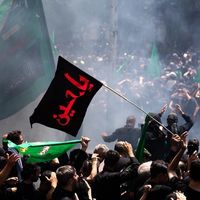
The episode comes as the character of pro-government gatherings has been changing since the ceasefire that ended weeks of fighting nearly two weeks ago.

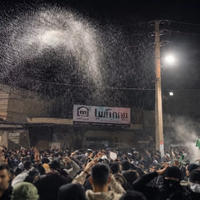
Social media posts increasingly depict the rallies as taking on a festival-like atmosphere. Families attend together, and for some participants the events appear to function as social gatherings as much as political demonstrations.

Large banners, video screens and coordinated staging are now common, while mosques and local Basij militia bases often serve as assembly points before crowds move toward central gathering locations.

These developments have also generated complaints from residents about late-night noise and traffic congestion, concerns widely discussed on social media.

Incentives and organization

There are also claims—difficult to independently verify—that participants are being mobilized through local institutions and offered incentives such as food, snacks or other benefits.

Photographs circulating online show numerous tents distributing free food and drinks, a practice consistent with the Shia tradition of nazri, in which charitable offerings are made during religious gatherings.

Images from recent days also showed senior military figure General Habibollah Sayyari helping prepare and distribute food at one such tent, highlighting the visible presence of state institutions at the events.

Pro-government celebrities from the film and sports worlds have also attended, with state media giving extensive coverage to their participation.

Political messaging intensifies

Hardline political groups have used the rallies as platforms for speeches and mobilization, with invited speakers addressing contentious issues such as whether Iran should accept ceasefire terms or pursue negotiations with the United States.

Some speeches have targeted prominent political figures, including former President Hassan Rouhani, former foreign minister Mohammad-Javad Zarif and Parliament Speaker Mohammad-Bagher Ghalibaf, encouraging crowds to chant slogans against them.

In one instance, a live broadcast of a speech by a religious performer was abruptly cut by state television and replaced with pre-recorded programming, suggesting heightened sensitivity to the messages being aired.

The rallies themselves were initially encouraged by senior officials as a demonstration of wartime solidarity. Earlier in the conflict, Ghalibaf called on citizens to take to the streets in support of Iran’s armed forces.

Yet the appearance of Boutros’s unveiled image on a giant screen at a pro-government gathering has underscored the contradictions between Tehran’s cultural restrictions and the messaging it seeks to project.