Iran negotiators ordered to return after internal rift over Islamabad talks
Sharp disagreements among members of Iran’s negotiating team led them to abandon US talks in Islamabad and return to Tehran on April 11 following an order from Iran's top security official, sources familiar with the deliberations told Iran International.
The sources said that during Friday’s negotiations with the United States, Foreign Minister Abbas Araghchi showed signs of flexibility in some of his positions, particularly regarding reducing or halting financial and military support for the so-called Axis of Resistance, including Lebanon’s Hezbollah.
Sharp disagreements among members of Iran’s negotiating team led them to abandon US talks in Islamabad and return to Tehran on April 11 following an order from Iran's top security official, sources familiar with the deliberations told Iran International.
The sources said that during Friday’s negotiations with the United States, Foreign Minister Abbas Araghchi showed signs of flexibility in some of his positions, particularly regarding reducing or halting financial and military support for the so-called Axis of Resistance, including Lebanon’s Hezbollah.
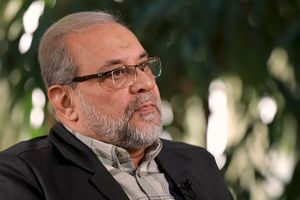
According to the sources, this approach drew a strong reaction from Mohammad Bagher Zolghadr, the Secretary of the Supreme National Security Council, in Tehran.
The sources said Zolghadr, who was briefed on the talks, submitted a report to the leadership and senior IRGC commanders, which fueled anger at the highest levels. The report reportedly cited “deviation from the delegation’s mandate” and engagement in discussions beyond the leadership’s directives.
Following consultations at the leadership level, and with the involvement of Hossein Taeb, an advisor to the supreme leader, an order was issued on Saturday afternoon for the delegation’s immediate return to Tehran, the sources said.
Reports of similar internal rifts had surfaced earlier. On March 28, accounts emerged of serious disagreements between President Masoud Pezeshkian and IRGC Chief-Commander Ahmad Vahidi.
Informed sources told Iran International that the rifts stemmed from disagreements over the conduct of the war and its impact on livelihoods and the wider economy.
Three days later, reports indicated Pezeshkian was dissatisfied with being in a “complete political deadlock” and had even lost authority over appointing officials killed during the war.
According to those reports, Vahidi had said that due to wartime conditions, all key managerial positions should be directly controlled by the IRGC until further notice.
Iran’s insistence on continuing its nuclear program and maintaining control over the Strait of Hormuz ultimately contributed to the failure of the Islamabad talks, according to reports.
Following the breakdown, the United States announced a naval blockade targeting Iran’s southern ports, with US Central Command saying from Monday morning it would prevent ships from entering or leaving Iranian ports. The blockade was implemented as scheduled.
Despite the failure of the first round of talks, Pakistan said on Monday that consultations with both sides were ongoing and another round of talks remained possible.
US President Donald Trump also told the New York Post on Tuesday that talks with Iran “could resume within two days” in Pakistan.
Sources had earlier told Reuters that despite the apparent deadlock, diplomatic channels remain open, with an Iranian embassy official in Pakistan saying the next round of talks could take place later this week or early next week.
Books and papers lie scattered amidst the rubble of a building in Tehran's Sharif University of Technology, after a US-Israeli strike, April 7, 2026
Iran’s central bank has warned President Masoud Pezeshkian that rebuilding the country’s war-damaged economy could take more than a decade, sources familiar with internal deliberations told Iran International.
In a stark assessment delivered to the president in recent days, senior economic officials said the damage inflicted during the 40-day war with the United States and Israel—combined with Iran’s already fragile economic situation—could take up to 12 years to repair.
Several major airports were damaged during the conflict, while strikes also targeted oil facilities, refineries and petrochemical installations that are central to Iran’s export revenues and industrial supply chains.
Officials involved in the discussions warned that the destruction of production capacity could trigger a sharp surge in inflation in the coming months. According to the assessment presented to the president, inflation could reach as high as 180% if shortages of industrial inputs persist.
The same projections estimate that unemployment could rise by around two million people as factories, service providers and small businesses struggle to resume operations.
According to sources familiar with the discussions, central bank governor Abdolnaser Hemmati has been urging Pezeshkian to take urgent steps to stabilize the economy, including restoring full internet access and pursuing an agreement with the United States.
Tehran and Washington appear to be exploring the possibility of further talks following the one in Pakistan last weekend. Iranian economists have long argued that a diplomatic thaw and easing of sanctions could be the best path toward economic stabilization.
Iran has maintained a nationwide internet shutdown for weeks during the conflict, a move officials say was intended to counter cyber threats but which has also severely disrupted businesses that rely on global connectivity.
Iran’s digital economy accounts for roughly 5–6% of the country’s GDP, and the shutdown has cut off millions of entrepreneurs from customers, payment systems and online platforms.
Small businesses, freelancers and startup founders have been among the hardest hit. Many rely on services such as Instagram, messaging apps and foreign-hosted websites to reach clients.
Economists inside the government warn that prolonged restrictions could deepen the downturn and slow recovery even further.
The bleak economic projections have heightened concerns among members of Pezeshkian’s team, according to the sources.
Some officials fear that if the economic crisis worsens or the state faces financial collapse, powerful figures within the Islamic Revolutionary Guard Corps could seek to shift blame onto the president, they said.
Iran entered the war already under heavy economic strain from years of sanctions, high inflation and currency instability.
Senior Iranian officials are locked in a dispute over the composition and authority of the delegation set to negotiate with the United States in Islamabad, sources with knowledge of the matter told Iran International.
IRGC commander-in-chief Ahmad Vahidi is seeking to curb the authority of Mohammad Bagher Ghalibaf and Foreign Minister Abbas Araghchi in the talks, according to the sources.
Vahidi has also pushed for the inclusion of Mohammad-Bagher Zolghadr, secretary of the Supreme National Security Council, in the negotiating team — a move opposed by current members, who consider him lacking experience for strategic negotiations, the sources said.
At the same time, Vahidi and the IRGC Aerospace Force commander have stressed that the delegation must avoid any negotiations over Iran’s missile program.
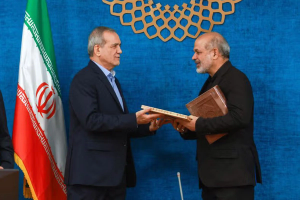
President Masoud Pezeshkian (left) and IRGC chief commander Ahmad Vahidi
A deepening rift at the top of the Islamic Republic has spilled into an unusually sharp confrontation, with President Masoud Pezeshkian accusing senior Guards commanders of unilateral actions that have wrecked ceasefire prospects and pushed Iran toward disaster.
Two sources close to the presidential office said a tense exchange took place on Saturday, April 4, between Pezeshkian and Hossein Taeb, a powerful figure close to Supreme Leader Mojtaba Khamenei. Those present described the conversation as unusually difficult and highly charged.
During the meeting, Pezeshkian accused IRGC chief commander Ahmad Vahidi and Ali Abdollahi, commander of Khatam al-Anbiya Central Headquarters – the country’s armed forces' unified command, of acting unilaterally and driving escalation through attacks on regional countries, especially against their infrastructure.
According to the sources, Pezeshkian said those policies had destroyed any remaining chance of a ceasefire and were steering the Islamic Republic directly toward “a huge catastrophe.”
He also warned that, based on what he described as precise assessments, Iran’s economy would not be able to withstand a prolonged war for much longer and that full economic collapse was inevitable under current conditions.
The confrontation comes amid mounting evidence of a broader power shift inside the Islamic Republic, with military and intelligence networks increasingly displacing both the elected government and the traditional clerical order.
A regional source familiar with internal developments told Iran International in February that the model of velayat-e faqih (guardianship of the jurist) that has defined the Islamic Republic for more than four decades is now undergoing a fundamental transformation and even an “ideological collapse.”
According to that source, the appointment of Mojtaba Khamenei to the leadership, despite lacking the traditional qualifications and legitimacy associated with the position, took place through an opaque process that in practice amounts to the sidelining of the traditional clergy and the consolidation of full control by the Guards’ military-intelligence apparatus.
The source said this process has strengthened what many insiders describe as the Islamic Republic’s “hidden state.”
Iran International has previously reported growing tensions between Pezeshkian and senior IRGC commanders, particularly Vahidi, over how the war should be managed and over its destructive impact on people’s livelihoods and the economy.
On March 28, informed sources said Pezeshkian had criticized the Guards’ approach to escalating tensions and continuing attacks on neighboring countries, warning that without a ceasefire the economy could collapse within three weeks to a month.
Subsequent reporting by Iran International showed that the president’s authority has continued to shrink.
Sources said the Guards have resisted Pezeshkian’s appointments and decisions, effectively stripped the government of executive control and erected a security barrier around the core of power.
According to those reports, Pezeshkian’s attempt to appoint a new intelligence minister collapsed under direct pressure from Vahidi, who rejected all proposed candidates, including Hossein Dehghan, and insisted that all key wartime positions must, for now, be chosen and managed directly by the Guards.
Alongside the political infighting, fresh field reports received by Iran International point to a worsening human and logistical crisis inside the Guards and the Basij.
Sources said that over the past 72 hours, operational forces have faced acute shortages of basic supplies, including edible food, hygiene facilities and places to sleep.
Recent strikes on infrastructure and bases have left many Guards and Basij personnel sleeping in the streets, and in some areas they have had access to only one meal a day.
According to informed sources, some personnel were forced to buy food from shops and restaurants with their own money after expired rations were distributed.
At the same time, disruptions affecting Bank Sepah’s electronic systems have reportedly delayed the salaries and benefits of military personnel, fueling fresh anger and mistrust within the ranks.
Iran International had previously reported similarly dire conditions in field units, including severe shortages of ammunition, water and food, as well as growing desertions by exhausted soldiers.
Even in the Guards’ missile units, which have historically received priority treatment, sources reported serious communications failures and food shortages. They said commanders were continuing to send only technical components needed to keep missile systems operational, rather than food or basic individual supplies for personnel.
Iranian security forces have still not returned the body of 18-year-old protester Amirhossein Hatami to his family, four days after his execution, in what informed sources described as further pressure on relatives already reeling from his death.
Information obtained by Iran International shows that Hatami, who was executed on April 2, remains unburied as authorities continue to withhold his body.
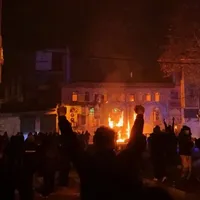
Hatami was one of the defendants in a case linked to a fire at the Mahmoud Kaveh Basij base on Namjoo Street in eastern Tehran during the January protests.
Others in the same case included Mohammadamin Biglari, Shahin Vahedparast Kalur, Abolfazl Salehi Siavashani and Ali Fahim, all of whom were sentenced to death.
Biglari and Vahedparast were executed on April 5, while Fahim’s execution was carried out on Monday, April 6.
Informed sources told Iran International that Hatami’s body has not been released because his name appeared on a website linked to the Mojahedin-e Khalgh organization, an allegation his family strongly rejects.
Sources familiar with the case said Hatami was an industrial design student at the University of Tehran and was fluent in three languages.
A source with knowledge of the events of January 8 said the case involved seven defendants, none of whom had any role in starting the fire.
According to the source, Hatami and the others entered the Basij base with around 50 other people only after the fire had already broken out.
Minutes later, another fire began. Many managed to escape, but seven people, including Hatami, were unable to flee.
They went to the rooftop, where they were detained by Basij forces and severely beaten, the source said.
Judicial authorities later accused the defendants of trying to gain access to the armory.
After their arrest, the detainees were subjected to severe interrogations and then transferred to Ghezel Hesar prison.
They were denied in-person visits throughout their detention and were allowed only phone calls.
Their trial was presided over by Judge Abolghasem Salavati, and they were denied access to lawyers of their own choosing.
Death sentences were issued on February 7.
Sources told Iran International that the confessions in the case were extracted under pressure and coercion, and that the judicial process ended in executions carried out without the defendants and their families having full knowledge of the proceedings.
In the same case, 28-year-old Shahin Vahedparast was also executed on April 5, and his body, too, has still not been returned to his family, according to informed sources.
Those sources said Vahedparast’s wife was four months pregnant at the time of his execution.
Relatives said he had dreamed of opening a restaurant with her.