Rift in Iran over negotiating team’s makeup and mandate
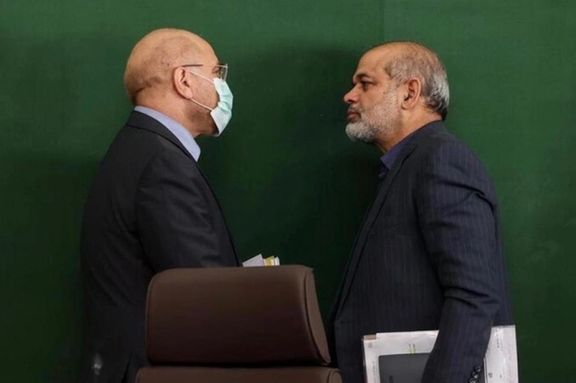
Senior Iranian officials are locked in a dispute over the composition and authority of the delegation set to negotiate with the United States in Islamabad, sources with knowledge of the matter told Iran International.
IRGC commander-in-chief Ahmad Vahidi is seeking to curb the authority of Mohammad Bagher Ghalibaf and Foreign Minister Abbas Araghchi in the talks, according to the sources.
Vahidi has also pushed for the inclusion of Mohammad-Bagher Zolghadr, secretary of the Supreme National Security Council, in the negotiating team — a move opposed by current members, who consider him lacking experience for strategic negotiations, the sources said.
At the same time, Vahidi and the IRGC Aerospace Force commander have stressed that the delegation must avoid any negotiations over Iran’s missile program.



Two sources close to the presidential office said a tense exchange took place on Saturday, April 4, between Pezeshkian and Hossein Taeb, a powerful figure close to Supreme Leader Mojtaba Khamenei. Those present described the conversation as unusually difficult and highly charged.
During the meeting, Pezeshkian accused IRGC chief commander Ahmad Vahidi and Ali Abdollahi, commander of Khatam al-Anbiya Central Headquarters – the country’s armed forces' unified command, of acting unilaterally and driving escalation through attacks on regional countries, especially against their infrastructure.
According to the sources, Pezeshkian said those policies had destroyed any remaining chance of a ceasefire and were steering the Islamic Republic directly toward “a huge catastrophe.”
He also warned that, based on what he described as precise assessments, Iran’s economy would not be able to withstand a prolonged war for much longer and that full economic collapse was inevitable under current conditions.
The confrontation comes amid mounting evidence of a broader power shift inside the Islamic Republic, with military and intelligence networks increasingly displacing both the elected government and the traditional clerical order.
Ideological collapse and hidden state
A regional source familiar with internal developments told Iran International in February that the model of velayat-e faqih (guardianship of the jurist) that has defined the Islamic Republic for more than four decades is now undergoing a fundamental transformation and even an “ideological collapse.”
According to that source, the appointment of Mojtaba Khamenei to the leadership, despite lacking the traditional qualifications and legitimacy associated with the position, took place through an opaque process that in practice amounts to the sidelining of the traditional clergy and the consolidation of full control by the Guards’ military-intelligence apparatus.
The source said this process has strengthened what many insiders describe as the Islamic Republic’s “hidden state.”
Iran International has previously reported growing tensions between Pezeshkian and senior IRGC commanders, particularly Vahidi, over how the war should be managed and over its destructive impact on people’s livelihoods and the economy.
On March 28, informed sources said Pezeshkian had criticized the Guards’ approach to escalating tensions and continuing attacks on neighboring countries, warning that without a ceasefire the economy could collapse within three weeks to a month.
Subsequent reporting by Iran International showed that the president’s authority has continued to shrink.
Sources said the Guards have resisted Pezeshkian’s appointments and decisions, effectively stripped the government of executive control and erected a security barrier around the core of power.
According to those reports, Pezeshkian’s attempt to appoint a new intelligence minister collapsed under direct pressure from Vahidi, who rejected all proposed candidates, including Hossein Dehghan, and insisted that all key wartime positions must, for now, be chosen and managed directly by the Guards.
Iran International also reported that Pezeshkian was forced, under direct IRGC pressure, to appoint Mohammad Bagher Zolghadr as secretary of the Supreme National Security Council despite his dissatisfaction with the choice.
Logistical crisis
Alongside the political infighting, fresh field reports received by Iran International point to a worsening human and logistical crisis inside the Guards and the Basij.
Sources said that over the past 72 hours, operational forces have faced acute shortages of basic supplies, including edible food, hygiene facilities and places to sleep.
Recent strikes on infrastructure and bases have left many Guards and Basij personnel sleeping in the streets, and in some areas they have had access to only one meal a day.
According to informed sources, some personnel were forced to buy food from shops and restaurants with their own money after expired rations were distributed.
At the same time, disruptions affecting Bank Sepah’s electronic systems have reportedly delayed the salaries and benefits of military personnel, fueling fresh anger and mistrust within the ranks.
Iran International had previously reported similarly dire conditions in field units, including severe shortages of ammunition, water and food, as well as growing desertions by exhausted soldiers.
Even in the Guards’ missile units, which have historically received priority treatment, sources reported serious communications failures and food shortages. They said commanders were continuing to send only technical components needed to keep missile systems operational, rather than food or basic individual supplies for personnel.
Information obtained by Iran International shows that Hatami, who was executed on April 2, remains unburied as authorities continue to withhold his body.
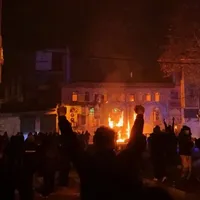
Hatami was one of the defendants in a case linked to a fire at the Mahmoud Kaveh Basij base on Namjoo Street in eastern Tehran during the January protests.
Others in the same case included Mohammadamin Biglari, Shahin Vahedparast Kalur, Abolfazl Salehi Siavashani and Ali Fahim, all of whom were sentenced to death.
Biglari and Vahedparast were executed on April 5, while Fahim’s execution was carried out on Monday, April 6.
Informed sources told Iran International that Hatami’s body has not been released because his name appeared on a website linked to the Mojahedin-e Khalgh organization, an allegation his family strongly rejects.
Sources familiar with the case said Hatami was an industrial design student at the University of Tehran and was fluent in three languages.
A source with knowledge of the events of January 8 said the case involved seven defendants, none of whom had any role in starting the fire.
According to the source, Hatami and the others entered the Basij base with around 50 other people only after the fire had already broken out.
Minutes later, another fire began. Many managed to escape, but seven people, including Hatami, were unable to flee.
They went to the rooftop, where they were detained by Basij forces and severely beaten, the source said.
Judicial authorities later accused the defendants of trying to gain access to the armory.
After their arrest, the detainees were subjected to severe interrogations and then transferred to Ghezel Hesar prison.
They were denied in-person visits throughout their detention and were allowed only phone calls.
Their trial was presided over by Judge Abolghasem Salavati, and they were denied access to lawyers of their own choosing.
Death sentences were issued on February 7.
Sources told Iran International that the confessions in the case were extracted under pressure and coercion, and that the judicial process ended in executions carried out without the defendants and their families having full knowledge of the proceedings.
In the same case, 28-year-old Shahin Vahedparast was also executed on April 5, and his body, too, has still not been returned to his family, according to informed sources.
Those sources said Vahedparast’s wife was four months pregnant at the time of his execution.
Relatives said he had dreamed of opening a restaurant with her.