The operation may have cost the United States several military assets, but it also forced Iran to reveal what it considers key terrain, according to former intelligence officer Michael Pregent.
A veteran with more than 28 years of experience in security and terrorism in the Middle East, Pregent believes that in scrambling to protect what it thought would be the next landing zone, Iranian forces exposed troop movements and defensive priorities that US planners may now be able to exploit.
“You can see movement of assets to protect key terrain that we may not have thought was key terrain but the regime does, and that gives an opportunity to exploit the situation," Pregent told Iran International.
"The establishment of this base now changes that focus. It's not just about fixed airstrips. Air bases that the US can take over—now it's just flat terrain, because that's what this was.”
For Pregent, the deeper implication is what the mission revealed about the regime’s internal weakness.
“It indicates a lack of command and control of regime forces due to the degradation, due to key leaders being taken out… the regime wasn't able to do anything about it. And that says something.”
That reading is echoed, though more cautiously, by Farzin Nadimi, a defense and military expert on Iran at the Washington Institute, who says the rescue proved American reach but also exposed how fragile that success was.
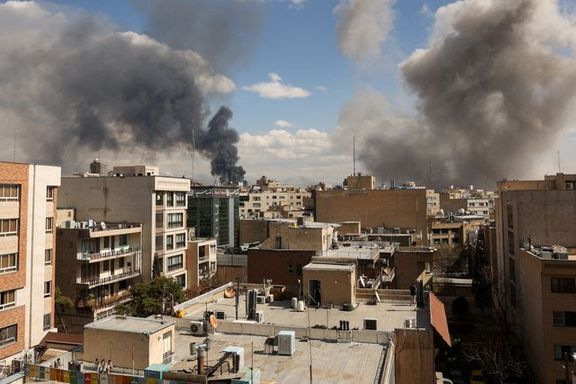
The mission itself was among the most daring US operations of the war so far. Special operations forces moved deep into Iran under cover of darkness, crossed mountainous terrain to reach the stranded weapons systems officer, and rushed him toward extraction before dawn.
But the operation nearly unraveled when two transport aircraft were unable to take off, forcing commanders to improvise a new extraction plan in real time to avoid leaving roughly 100 troops stranded inside Iran.
US troops destroyed the disabled MC-130s and four additional helicopters inside Iran rather than risk leaving sensitive equipment behind.
Ahead of the mission, the CIA reportedly ran a deception campaign inside Iran, planting false information that US forces had already found and moved the missing officer. As the rescue unfolded, US forces also jammed communications and struck key roads near the location to keep Iranian forces away.
"Over the past several hours, the United States military pulled off one of the most daring search and rescue operations in US history," Trump said in a statement. The airman was injured, but Trump said "he will be just fine."
For Nadimi, that near miss is the real takeaway.
“It was a very successful operation… It showed real reach, real flexibility, and real results. But at the same time, it also showed… that the mission could very well have failed. And that would leave almost 100 troops in the middle of Iran," he told Iran International.
That warning now carries added weight as the fate of Iran’s uranium stockpile remains unresolved.
The International Atomic Energy Agency (IAEA) had estimated Iran held roughly 440.9 kilograms of uranium enriched to near weapons-grade levels before the latest round of strikes, much of it still unaccounted for.
But when asked whether the rescue mission could make a future operation to secure that stockpile more likely, Nadimi is blunt.
“I think the simple answer is no.”
His assessment is that a mission to secure more than 400 kilograms of highly enriched uranium would require a fundamentally different scale of operation: heavy engineering equipment, excavation teams, perimeter defense, airlift support and the ability to seize and hold key terrain for days or even weeks.
Yet the political lesson may be moving in the opposite direction.
Shahram Kholdi, a Middle East historian whose own Iranian conscript service to the regular army (Artesh) gives him firsthand insight into how the Islamic Republic prioritizes the IRGC and Basij in any domestic theater, says the operation may strengthen the hand of those in Washington arguing that half measures are no longer enough.
“Those so-called hawks now have a stronger view… to convince the president not to go in half-baked anymore… we are going to see blows that would be interdisciplinary actions.”
The Islamic Republic's rush to capture the downed airman may reinforce arguments among hawks that future operations should combine overwhelming air power with more deliberate ground-enabled missions, according to Kholdi.
The rescue not only brought both men home but also demonstrated that Washington can execute complex operations deep inside Iran—leaving the far bigger question of how, and how far, it may use that lesson next.