Massive blasts rock northern Tehran, video shows
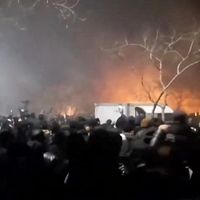
Multiple explosions struck Niavaran district in northern Tehran on Friday night, a video obtained by Iran International shows.
Multiple explosions struck Niavaran district in northern Tehran on Friday night, a video obtained by Iran International shows.



The Pentagon has notified the House Armed Services Committee that the status of a second service member remains unknown after a US fighter jet was shot down, the Associated Press reported, citing a congressional aide.
The panel was told one service member has been recovered, while the other’s duty status is unknown, the aide said, speaking on condition of anonymity to disclose the private communication.
That designation generally means the Defense Department does not know the person’s whereabouts and they are considered missing, the report said.
The downing of a US fighter jet will not affect negotiations with Iran, President Donald Trump said in a brief phone interview with NBC News on Friday.
“No, not at all. No, it’s war. We’re in war,” NBC News quoted Trump as saying.
Trump declined to discuss the specifics of ongoing search and rescue efforts in Iran, the report said.
Iran’s exiled prince Reza Pahlavi said Iraqi militias from the Popular Mobilization Forces have taken positions in cities across Iran and called for their immediate expulsion, while criticizing Iran’s authorities over their presence.
“The terrorists of the Popular Mobilization Forces (Hashd al-Shaabi), carrying Iraqi flags, have taken up positions in the streets and squares of Iran,” Pahlavi said in a post on X.
“They have no place in Iran. They must be expelled immediately from the pure soil of Iran,” he added.
Iran and the United States may prefer an end to the war, but the gap between the minimum terms each side could accept is so wide that a deal remains unlikely for now.
What we are more likely to see instead are continued displays of power intended to shape the terms of any eventual agreement.
For now, negotiations speak the language of war more than diplomacy. When Washington talks about “progress” or “flexibility,” it is not simply describing talks; it is projecting the idea that military pressure is forcing Iran toward an American framework for ending the conflict.
Tehran’s denial of negotiations serves a similar purpose. Rejecting reports of talks helps prevent any existing contacts from being interpreted as evidence of weakness or submission.
Nor will the outcome depend only on Washington and Tehran. Regional actors will seek a role in shaping any settlement, and any country or coalition attempting to reopen the Strait of Hormuz will attach its own demands to the process.
Washington’s rhetoric reflects this struggle over narrative as much as over territory. In the second week of the war, the US defense secretary said that “at every stage, the conditions of the war will be determined by us.” Similar language echoes in Donald Trump’s repeated threats to send Iran “back to the Stone Age.”
Yet military power becomes a real victory only when it can be translated into a political settlement. When US officials speak about “progress in negotiations,” they are attempting to move from delivering blows to defining the outcome.
The very need to emphasize negotiations suggests that this transition remains incomplete. If battlefield superiority had already produced a decisive political result, Washington would have little reason to stress mediation and contacts.
The rhetoric also serves audiences beyond Tehran: financial markets, domestic politics, and allies trying to assess the war’s trajectory.
Israeli objectives further complicate the picture. US officials have acknowledged that Washington’s goals differ from those of Israel, which appears more focused on weakening Iran’s leadership.
Tehran’s definition of victory is also different. For the Islamic Republic, success means preserving the regime while reshaping the balance of power in the Strait of Hormuz.
Admitting negotiations under intense military pressure and under Washington’s conditions would risk appearing politically subordinate. Denial therefore becomes part of the struggle over legitimacy.
At the same time, Iran’s leadership—its military weakened and many senior figures killed—also needs a way out of the conflict. It must keep communication channels open while ensuring those contacts cannot be portrayed as retreat.
Iran’s strategy is therefore less about proving it has won than about preventing the United States from presenting its victory as complete. Tehran may not be able to claim triumph outright, but it seeks to ensure Washington cannot dictate the outcome alone.
Trump’s push for negotiations may also serve another purpose: testing where real power lies inside Iran. Every reported contact, denial, or proposed channel becomes a way of probing who still has the authority to make decisions.
Reports of fractures inside Iran’s leadership since the war began suggest uncertainty over that question. In wartime conditions, however, the Revolutionary Guards appear to hold the strongest position within the system.
Meanwhile, mediators are beginning to shape the diplomatic landscape. Turkish Foreign Minister Hakan Fidan recently suggested that neither Washington’s nor Tehran’s demands will remain at their current levels, and that the task of mediators is to bring those positions closer to political reality.
But mediators are not neutral actors. Any settlement will also reflect their own interests in the region’s future energy and security order.
These states are caught between two fears: they do not want the Gulf to become a permanent instrument of Iranian pressure, yet they are also wary of confronting Tehran alone if Washington eventually disengages.
For now, mediation reflects less a drive for peace than a shared effort to contain instability.
Diplomacy has become another arena in the struggle to shape the balance of power emerging from the battlefield. As long as both Washington and Tehran continue to claim the upper hand, escalation remains more likely than compromise.
For now, what passes for diplomacy is the management of collapse, not the architecture of peace.
President Trump’s threat to bomb Iran’s infrastructure and “send it back to the stone ages,” followed by strikes that reportedly included a not-yet-opened bridge, has sparked anger among Iranians at home and abroad.
Iran’s president Masoud Pezeshkian condemned the remarks, writing: “Does threatening to send an entire nation back to the Stone Age mean anything other than a massive war crime? … History is full of those who paid a heavy price for their silence in the face of criminals.”
Ground Forces commander Ali Jahanshahi, warned to send US troops “not to the Stone Age but to pre-Stone Age.”
International reactions have also been critical. Former IAEA chief Mohamed ElBaradei accused Trump and Israel’s prime minister Benjamin Netanyahu of “employing horrific methods” and quipped, “I truly don't know who belongs to the Stone Age!”
Former Swedish prime minister Carl Bildt also weighed in, saying Iranians want “a decent and representative government” not being bombed back to the Stone Age.
‘War crimes’
Anger also surged among ordinary Iranians and diaspora communities—many of whom oppose the government but object strongly to threats against national infrastructure and civilian sites.
Strikes on health facilities such as the Pasteur Institute of Tehran have heightened sensitivities about civilian harm.
Hadi Partovi, a technology investor with Iranian roots, framed the issue in moral terms: “Many Iranians supported your war because your plan was to liberate Iran. Instead, you celebrate sending a civilization to the Stone Age. Great leaders build, not destroy… I weep to see America like this.”
London-based human rights lawyer Shadi Sadr accused Western governments of hypocrisy, arguing that initial justifications under the “Responsibility to Protect” have given way to actions that “send those same people back to the Stone Age, committing war crimes on a massive scale.”
Tehran-based journalist Yashar Soltani wrote: “You first spoke of ‘liberating Iran.’ Then you bombed a school in Minab and took the lives of children. And today you speak of dragging Iran back to the ‘Stone Age’.”
“Iran is a land that, when many nations were still in the Stone Age, was building cities, writing laws, and creating civilization,” he added.
Rift over costs of war
Despite widespread criticism, reactions among Iran’s opposition have not been uniform.
Some supporters of regime change argue that damage to infrastructure, while painful, can ultimately be repaired. They point to historical precedents such as the Iran–Iraq War, when key facilities including oil refineries and export terminals were rebuilt after extensive destruction.
Others contend that the Islamic Republic’s long-term impact on governance, the economy and human capital outweighs the immediate damage caused by military strikes. For them, the focus should remain on political repression, including executions and internet shutdowns.
One social media user questioned priorities: “How can your infrastructure and the Stone Age be your priority before you even mention the executions and internet shutdowns!”
Another argued that reconstruction would follow regime change, writing: “Don’t worry about iron and concrete; worry about a homeland occupied by incompetence… after that, a free Iran will build infrastructure worthy of the name Iran.”
Some commentators have also suggested that Trump’s rhetoric was directed primarily at Iran’s ruling establishment rather than the public. “When he says… ‘we’ll hit you and send you back to the Stone Age,’ he’s talking to the clerics, not the people,” one user wrote.