• العربية
  • فارسی
Brand
  • Iran Insight
  • Politics
  • Economy
  • Analysis
  • Special Report
  • Opinion
  • Podcast
  • Iran Insight
  • Politics
  • Economy
  • Analysis
  • Special Report
  • Opinion
  • Podcast
  • Theme
  • Language
    • العربية
    • فارسی
  • Iran Insight
  • Politics
  • Economy
  • Analysis
  • Special Report
  • Opinion
  • Podcast
All rights reserved for Volant Media UK Limited
volant media logo

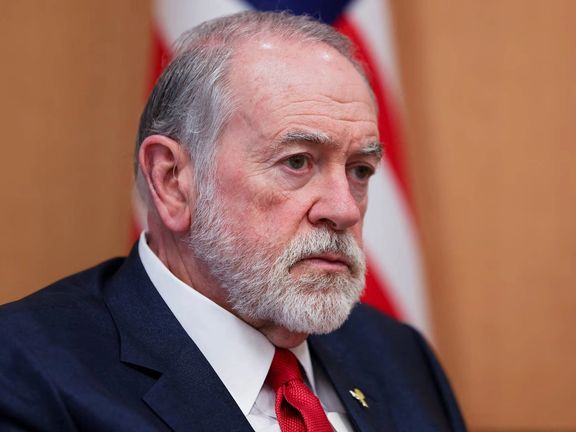
‘Iranians know what they have to do’ to avoid escalation, US ambassador to Israel says
Feb 26, 2026, 09:08 GMT+0

Mike Huckabee, the United States ambassador to Israel, said Iran is aware of what steps it must take to resolve tensions peacefully as nuclear talks unfold in Geneva.

“The Iranians know what they have to do if they want to resolve this peacefully,” Huckabee told Ynet, reiterating Washington’s position that any agreement must mean “no enrichment, no nuclear weapons.” He said concerns also extend to Iran’s missile program and regional activities.

Asked whether the negotiations would continue, Huckabee said the outcome depends on Tehran. “I don’t know. It really depends on what they come to the table with,” he said, confirming that US envoys are representing Washington in the talks.

“Let’s hope for some reasonable approach from the Iranians,” he added. “But it’s 47 years and we’re still waiting on one.”


Most Viewed

100 days after carnage: Iran economy reels from war, inflation, unemployment
1
INSIGHT

100 days after carnage: Iran economy reels from war, inflation, unemployment

2
INSIGHT

Ghalibaf defends Iran-US talks amid hardline backlash

3
EXCLUSIVE

Iranian assaulted in London amid concern over threats to regime critics

4

IRGC fires at Indian vessel in Hormuz

5
INSIGHT

A nation in limbo: 100 days after the massacre, has the world moved on?

Banner
Banner

Spotlight

  • War-hit homeowners feel abandoned as Iran’s reconstruction aid fades

    War-hit homeowners feel abandoned as Iran’s reconstruction aid fades

  • 100 days on: the anatomy of Iran’s January crackdown
    INSIGHT

    100 days on: the anatomy of Iran’s January crackdown

  • Ghalibaf defends Iran-US talks amid hardline backlash
    INSIGHT

    Ghalibaf defends Iran-US talks amid hardline backlash

  • 100 days on: why Iran’s January protests spread across social classes
    ANALYSIS

    100 days on: why Iran’s January protests spread across social classes

  • From instability to influence: Pakistan’s pivotal role in US-Iran diplomacy
    ANALYSIS

    From instability to influence: Pakistan’s pivotal role in US-Iran diplomacy

  • A nation in limbo: 100 days after the massacre, has the world moved on?
    INSIGHT

    A nation in limbo: 100 days after the massacre, has the world moved on?

•
•
•

More Stories

Iran says indirect talks with US to resume shortly in Geneva

Feb 26, 2026, 08:33 GMT+0

Ministry of Foreign Affairs of Iran said indirect talks between Iran and the United States would resume shortly in Geneva under Omani mediation.

The foreign ministry spokesperson Esmaeil Baghaei said Rafael Grossi, head of the International Atomic Energy Agency, is expected to join the third round of negotiations, as he did in the previous round.

“Our delegation has come to this round fully prepared,” Baghaei said, adding that Iran is participating “with full seriousness to secure our national interests.” The talks are focused on nuclear issues, including sanctions relief and Iran’s nuclear rights, which Tehran has conveyed to the Omani side, the spokesperson said, adding that discussions between the US and Oman began earlier in the day.


Oman FM meets IAEA chief in Geneva ahead of Iran-US talks

Feb 26, 2026, 08:03 GMT+0

Oman's Foreign Minister Badr Albusaidi met Rafael Grossi, head of the International Atomic Energy Agency, in Geneva to discuss technical issues related to Iran’s nuclear file, Oman’s foreign ministry said.

Albusaidi stressed the importance of the IAEA’s professional and technical role in ensuring transparency and credibility in nuclear oversight, it added.

Khamenei has banned nuclear weapons, Iran president says

Feb 26, 2026, 07:25 GMT+0

Iran would not develop nuclear weapons because Supreme Leader Ali Khamenei has banned them, President Masoud Pezeshkian said on Thursday, adding that “the religious leader of a society cannot lie like politicians.”

“When he announces that we will not have a nuclear weapon, it means we won’t have it,” Pezeshkian said ahead of a third round of nuclear talks with the US, which has continued to accuse Tehran of seeking a nuclear weapon.

Khamenei issued a fatwa, an Islamic religious decree, banning the development of nuclear weapons in the early 2000s.

Oman foreign minister meets Araghchi ahead of US-Iran talks

Feb 26, 2026, 07:00 GMT+0

Badr Albusaidi met Abbas Araghchi in Geneva on Wednesday evening ahead of indirect talks between Iran and the United States, Oman’s foreign ministry said.

The two ministers reviewed recent developments and discussed proposals Iran plans to present in a bid to reach an agreement on its nuclear program, based on guiding principles agreed in the previous round, the foreign ministry said.

Albusaidi is expected to meet the US negotiating team on Thursday to convey Iran’s views and hear the American side’s ideas, the foreign ministry said, adding that Oman remains committed to facilitating dialogue to reach a sustainable solution.

Democrat lawmaker says US, allies may need strikes on Iran

Feb 26, 2026, 01:08 GMT+0

Democrat Representative Greg Landsman of Ohio said on Wednesday that the United States and its allies may need to carry out targeted strikes on Iranian assets, according to Jewish Insider.

“If targeted, defensive strikes are necessary, and these strikes are successful, the prospect of war and further violence is diminished. That’s what we should all want: an end to decades of bloodshed and mayhem by this regime. We should continue to work to weaken the regime’s ability to do harm,” Landsman said.

Landsman highlighted defensive action against ballistic missiles, rocket infrastructure, weapons depots, and nuclear facilities as potentially necessary to protect lives.