• العربية
  • فارسی
Brand
  • Iran Insight
  • Politics
  • Economy
  • Analysis
  • Special Report
  • Opinion
  • Podcast
  • Iran Insight
  • Politics
  • Economy
  • Analysis
  • Special Report
  • Opinion
  • Podcast
  • Theme
  • Language
    • العربية
    • فارسی
  • Iran Insight
  • Politics
  • Economy
  • Analysis
  • Special Report
  • Opinion
  • Podcast
All rights reserved for Volant Media UK Limited
volant media logo

Netanyahu says Iran deal must address missiles, cites 300 km cap
Feb 15, 2026, 17:01 GMT+0Updated: 20:20 GMT+0

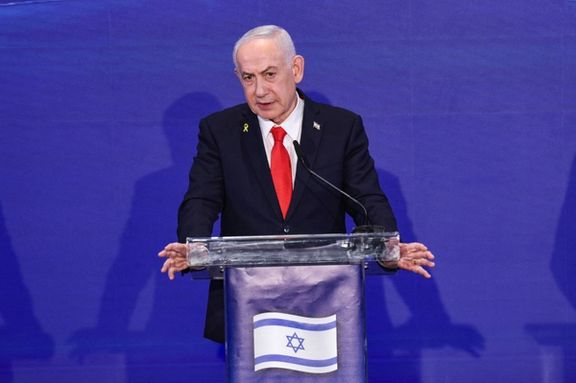
Israeli Prime Minister Benjamin Netanyahu on Sunday outlined what he said were key conditions required for an agreement including curbs on its ballistic missiles program.

“I will not hide from you that I expressed my skepticism of any deal with Iran because, frankly, Iran is reliable on one thing: they lie and they cheat,” Netanyahu said, speaking at the Conference of Presidents’ 51st Annual National Leadership Mission.

He said any deal should include several components he views as essential not only for Israel’s security but for that of the United States and the wider world.

“The first is that all enriched material has to leave Iran. The second is that there should be no enrichment capability, not stopping the enrichment process, but dismantle the equipment and the infrastructure that allows you to enrich in the first place,” he said.

Netanyahu added that an agreement should also address Iran’s ballistic missile program, citing a 300-kilometer range limit under the Missile Technology Control Regime (MTCR).

“There's an MTCR limitation of 300 kilometers, and Iran is supposed to adhere to it. Of course, it doesn't,” Netanyahu said.

He added that any agreement should also address its support for Iran’s regional allied groups.

“And the fourth is… dismantle the axis of terror that Iran has built. It's been smashed, but it's still there, and it's trying to recover, as Iran itself is trying to do,” he said.

Netanyahu also cited the need for inspections.

“And the last thing is, remember Ronald Reagan's dictum vis-à-vis the Soviet Union: Trust but verify, distrust, distrust, and always verify. So there has to be real inspections, substantive inspections, no lead-time inspections, but effective inspections for all of the above,” he said.


Most Viewed

100 days after carnage: Iran economy reels from war, inflation, unemployment
1
INSIGHT

100 days after carnage: Iran economy reels from war, inflation, unemployment

2
INSIGHT

Ghalibaf defends Iran-US talks amid hardline backlash

3
EXCLUSIVE

Iranian assaulted in London amid concern over threats to regime critics

4

IRGC fires at Indian vessel in Hormuz

5
INSIGHT

A nation in limbo: 100 days after the massacre, has the world moved on?

Banner
Banner

Spotlight

  • War-hit homeowners feel abandoned as Iran’s reconstruction aid fades

    War-hit homeowners feel abandoned as Iran’s reconstruction aid fades

  • 100 days on: the anatomy of Iran’s January crackdown
    INSIGHT

    100 days on: the anatomy of Iran’s January crackdown

  • Ghalibaf defends Iran-US talks amid hardline backlash
    INSIGHT

    Ghalibaf defends Iran-US talks amid hardline backlash

  • 100 days on: why Iran’s January protests spread across social classes
    ANALYSIS

    100 days on: why Iran’s January protests spread across social classes

  • From instability to influence: Pakistan’s pivotal role in US-Iran diplomacy
    ANALYSIS

    From instability to influence: Pakistan’s pivotal role in US-Iran diplomacy

  • A nation in limbo: 100 days after the massacre, has the world moved on?
    INSIGHT

    A nation in limbo: 100 days after the massacre, has the world moved on?

•
•
•

More Stories

Taliban says it would support Iran if US attacks

Feb 15, 2026, 15:56 GMT+0

The Taliban said it is ready to cooperate with Iran if Washington launches a potential attack, spokesman Zabihullah Mujahid said on Sunday.

In an interview with Radio Iran’s Pashto service, Mujahid said that in the event of an attack — and if assistance were requested — Kabul would cooperate with the Islamic Republic.

He added that Tehran emerged victorious in June's 12-day war with Israel, adding that Iran would prevail again in the event of a US attack.

‘We are dealing with radical Shiite clerics’ in Iran talks, Rubio says

Feb 15, 2026, 14:49 GMT+0

“The President has made clear he prefers diplomacy and an outcome of negotiated settlement. Now, we are dealing with radical Shiite clerics… We are dealing with people who make geopolitical decisions on the basis of pure theology, and it is a complicated thing,” US Secretary of State Marco Rubio said on Sunday, referring to negotiations with Iran.

"No one has ever been able to do a successful deal with Iran, but we are going to try,” he added, speaking at a press conference alongside Slovak Prime Minister Robert Fico in Bratislava, Slovakia.

Rubio said the United States remains militarily postured in the region to protect its forces but stressed that current efforts are centered on diplomacy.

“We are postured in the region for one simple reason, and that is that we understand that there could be threats to our forces in the region… We want to make sure that we have sufficient capacity to defend them if God forbid that were to happen,” he said.

He added that any future decisions would comply with US law and congressional requirements but emphasized negotiations remain the immediate priority.

“Right now we are talking about negotiations. We are focused on negotiations. That is what we are focused on. The President has made that clear,” Rubio said.

Passive defense chief says Iran prepared for any scenario

Feb 15, 2026, 14:14 GMT+0

Iran’s passive defense chief Gholamreza Jalali said the Islamic Republic is “fully prepared” for what he described as threat scenarios designed by the United States and Israel, Iranian state media reported.

Speaking at the start of a chemical emergency drill in Assaluyeh, in the Persian Gulf, Jalali said Iran’s defense planning has pushed threats from Washington and Israel to a “deterrence” stage, arguing adversaries must calculate the costs before taking action.

He outlined three scenarios he said opponents pursue, including media pressure and threats aimed at intimidation and forcing negotiations, limited and controlled actions, and attempts to trigger a broader regional war.

Jalali also said safety rules in high-risk sectors including chemical and nuclear industries are enforced strictly, and described drills as a way to identify weaknesses and improve coordination in crisis response.

Rubio says Trump envoys traveling for Iran meetings, says president prefers diplomacy

Feb 15, 2026, 13:51 GMT+0

US Secretary of State Marco Rubio said President Donald Trump’s envoys Steve Witkoff and Jared Kushner are traveling to hold “important meetings” related to Iran.

Speaking in Bratislava, Rubio said he believes the two aides are en route “right now” for discussions concerning Iran.

Rubio added that Trump still prefers diplomacy in dealing with Tehran.

Iran says incentives for US central to sustaining any nuclear deal

Feb 15, 2026, 13:09 GMT+0

An Iranian foreign ministry official said Tehran’s talks with Washington include proposals for economic cooperation ranging from oil and gas to mining investment and even aircraft purchases, Iranian media reported.

Hamid Ghanbari, deputy for economic diplomacy at Iran’s foreign ministry, told a meeting at Iran’s Chamber of Commerce that the negotiations include shared interests in areas such as energy, joint oil and gas fields, fast-return mineral investments, urban development and buying planes, according to Fars news agency.

"For the sake of an agreement's durability, it is essential that the US also benefits in areas with high and quick economic returns... Common interests in the oil and gas fields, joint fields, mining investments, and even aircraft purchases are included in the negotiations."

He said the previous agreement failed in part because the United States did not secure economic benefits, arguing that any new deal would need opportunities with quick, high returns for Washington to make it durable.

Ghanbari also said any release of Iran’s blocked or restricted funds should be “real and usable,” not symbolic or temporary, and could be carried out step-by-step or in a single move, the report said.