• العربية
  • فارسی
Brand
  • Iran Insight
  • Politics
  • Economy
  • Analysis
  • Special Report
  • Opinion
  • Podcast
  • Iran Insight
  • Politics
  • Economy
  • Analysis
  • Special Report
  • Opinion
  • Podcast
  • Theme
  • Language
    • العربية
    • فارسی
  • Iran Insight
  • Politics
  • Economy
  • Analysis
  • Special Report
  • Opinion
  • Podcast
All rights reserved for Volant Media UK Limited
volant media logo

Iran prosecutor says police contained unrest without weapons
Feb 1, 2026, 11:48 GMT+0

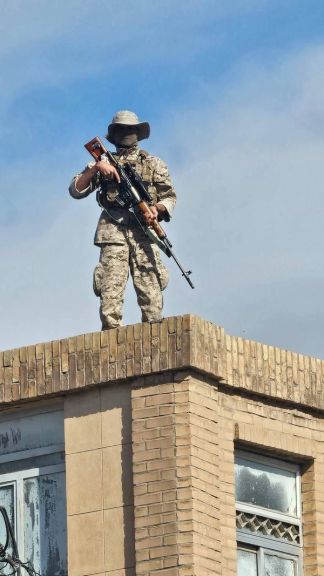
Iran’s Prosecutor General Mohammad Movahedi praised police forces for what he called their role in containing recent unrest, saying officers acted “empty-handed” because they were not permitted to use weapons.

Speaking at a police gathering, Movahedi said security forces had brought the situation under control despite casualties among officers, and stressed close coordination between police and the judiciary.

More than 36,500 Iranians were killed by security forces during the January 8-9 crackdown on nationwide protests, making it the deadliest two-day protest massacre in history, according to documents reviewed by Iran International.


Most Viewed

100 days after carnage: Iran economy reels from war, inflation, unemployment
1
INSIGHT

100 days after carnage: Iran economy reels from war, inflation, unemployment

2
INSIGHT

Ghalibaf defends Iran-US talks amid hardline backlash

3
EXCLUSIVE

Iranian assaulted in London amid concern over threats to regime critics

4

IRGC fires at Indian vessel in Hormuz

5
INSIGHT

A nation in limbo: 100 days after the massacre, has the world moved on?

Banner
Banner

Spotlight

  • War-hit homeowners feel abandoned as Iran’s reconstruction aid fades

    War-hit homeowners feel abandoned as Iran’s reconstruction aid fades

  • 100 days on: the anatomy of Iran’s January crackdown
    INSIGHT

    100 days on: the anatomy of Iran’s January crackdown

  • Ghalibaf defends Iran-US talks amid hardline backlash
    INSIGHT

    Ghalibaf defends Iran-US talks amid hardline backlash

  • 100 days on: why Iran’s January protests spread across social classes
    ANALYSIS

    100 days on: why Iran’s January protests spread across social classes

  • From instability to influence: Pakistan’s pivotal role in US-Iran diplomacy
    ANALYSIS

    From instability to influence: Pakistan’s pivotal role in US-Iran diplomacy

  • A nation in limbo: 100 days after the massacre, has the world moved on?
    INSIGHT

    A nation in limbo: 100 days after the massacre, has the world moved on?

•
•
•

More Stories

US must strengthen air defenses in Mideast before any Iran strike - WSJ

Feb 1, 2026, 11:31 GMT+0

The United States needs to reinforce air defenses across the Middle East before launching any potential strike on Iran, as Washington prepares for possible retaliation by Tehran, the Wall Street Journal reported.

The report quoted US officials as saying that airstrikes on Iran are not imminent, as the Pentagon is still deploying additional air defense systems.

According to the report, the Pentagon is taking steps to better protect Israel, Arab allies, and US forces in the region, amid growing concern that Iran could respond with missile and drone attacks.

The Journal said US military planners view expanded air and missile defense coverage as critical to limiting damage and escalation if Iran retaliates against American or allied targets.

US officials told the Journal that while limited airstrikes on Iran could be carried out quickly, a larger operation would likely prompt a proportional response from Tehran, making robust air defenses essential.

The US already has naval destroyers capable of intercepting aerial threats in the region and has increased their presence.

The buildup comes as President Donald Trump has sent what he described as an “armada” to the Middle East, including the USS Abraham Lincoln aircraft carrier group and F-35 fighter jets, while stopping short of saying whether he intends to use force.

Iran lawmaker says succession plans in place if commanders are killed

Feb 1, 2026, 11:25 GMT+0

Iran is not a country that can be brought down by the loss of a few commanders or a handful of military strikes, and replacements are ready, parliamentary deputy speaker Hamidreza Hajibabaei said on Saturday.

Hajibabaei said there is strong unity between parliament, the government and the armed forces, while stressing that criticism and differences are handled in expert meetings without allowing adversaries to exploit them.

He said Iran’s main economic problem is not a lack of resources but weaknesses in management and policymaking, adding that next year’s budget plans include wage rises, higher tax exemptions and provisions for essential goods to ease living costs.

He also said the world is moving toward a multipolar order and argued that Iran’s main battle is now in news and online space, warning officials against rhetoric that fuels public fear, despair or division.

'All those killed in protests were enemies of God,' Tehran council head says

Feb 1, 2026, 11:21 GMT+0

Tehran City Council head Mehdi Chamran said on Sunday that no protesters were killed in recent unrest and described those who died as “mohareb,” a term Iranian officials use for people they accuse of armed rebellion against God.

“In these protests we had no deaths, and only moharebs were present with guns and knives,” Chamran said.

More than 36,500 Iranians were killed by security forces during the January 8-9 crackdown on nationwide protests, making it the deadliest two-day protest massacre in history, according to documents reviewed by Iran International.

Moments from life and funeral of Iranian protester

Feb 1, 2026, 11:06 GMT+0

Videos received by Iran International show moments of laughter and joy shared by Mozhgan Zeynali, a 38-year-old protester, with her children, as well as scenes from her funeral, following her killing during protests in Iran.

She was killed in protests on January 7 in the city of Fardis, west of Karaj in central Iran.

Iran says it will turn regional shipping routes unsafe after any strike

Feb 1, 2026, 11:01 GMT+0

Iran warned on Sunday it could retaliate against any US strike on its vital infrastructure by disrupting key international waterways and targeting American forces across the region, according to remarks by a lawmaker carried by Iranian media.

“If Americans want to threaten our vital infrastructure like the energy sector or our export terminals, they themselves know that certainly the Strait of Hormuz and Bab al-Mandab will be closed and the Suez Canal will definitely become insecure,” Salar Velayatmadar, a member of parliament’s national security and foreign policy committee, told Didban Iran.

Velayatmadar said Iran would not be forced to retreat from its positions by military threats. “Today our finger is on the trigger and if the enemy makes a mistake, it will see that the blow it receives will be much more severe than before,” he said.

He warned that US bases in countries around Iran would be targeted if Washington “puts a foot wrong,” saying the entire region would be drawn into the conflict.

Velayatmadar dismissed President Donald Trump’s recent statements about sending aircraft carriers and “very big, very powerful ships” toward Iran as bluster, arguing that moving warships closer to Iran indicated the United States did not intend to fight because such vessels would become clear targets.

Velayatmadar added that he saw no sign of war unless the United States committed what he called a “suicidal” act, warning that any attack would backfire and trigger global consequences given Iran’s control over strategic waterways.