Iran state media rally video draws online doubts as users flag altered footage
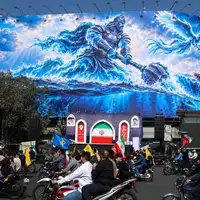
A pro-government rally in Tehran, January 12, 2026
A video circulated by Iran’s state media to promote pro-government rallies has gained wide traction online, with social media users questioning its authenticity and pointing to apparent inconsistencies, reflecting broader public mistrust of official messaging.
As nationwide protests continue, authorities have taken steps including staging government-organized countermarches, shutting down the internet, and tightening controls on the media to shape the narrative.
One clip aired by state media and presented as aerial helicopter footage of pro-government rallies in Tehran drew fresh questions after viewers pointed to anomalies, including wind visibly blowing the reporter’s hair while leaving his clothing and microphone seemingly unaffected.
IRIB News shared the video on X on Monday, writing: “Breaking | The first aerial video of the people of Tehran, the capital of Iran, marching in support of the Islamic Republic of Iran has been released.”
Readers added context on X saying the video appears to have been altered using chroma key (green screen), citing what they described as “unnatural subject edges, mismatched lighting and shadows, wind affecting only the reporter’s hair and not his clothing, a lack of realistic depth of field, and the absence of a seatbelt and headset," calling it a crude propaganda edit.
Multiple users also suggested the post showing large crowds appeared to recycle older material rather than depict new footage from the ongoing protests.
In a follow-up video, the reporter featured in the clip defended the broadcast footage as authentic. Some users, however, said they also saw inconsistencies in the new recording, and continued to question the original video’s provenance and how it was produced.
Separately, another image that circulated widely from the Monday rally showed demonstrators carrying a large Islamic Republic flag. In the photo, one person appears to be visibly inside the cloth, and some users pointed to irregularities in the flag’s details, including inconsistencies in the Arabic takbir rendered in white Kufic script along the edges of the green and red bands.
In another state-rally video, social media users focused on the color of trees in the background, arguing that the foliage appeared unusually vivid for mid-winter and did not match how Tehran’s street trees typically look at this time of year.
Several foreign influencers supportive of the Islamic Republic have published content portraying life in Tehran as calm despite an escalating deadly crackdown on protests across the country amid an internet blackout.
Video they share presents scenes of shopping, leisure and normal activity, offering images that contrast sharply with stark scenes of unrest and bloodshed emerging daily.
Foreign nationals in Iran typically operate under close monitoring, and public activity by visitors—particularly during periods of unrest—requires official permission. The influencers’ movements and access leaves little doubt that their ventures are state-sponsored or at least approved.
Among the most prominent figures is Maram Susli, a Syrian-Australian influencer known online as “Syrian Girl” or “Partisan Girl,” who has more than half a million followers on X.
Over the past several days, she has posted repeatedly in support of the Islamic Republic, framing Iran as the target of Western and Israeli misinformation.
In a post dated January 11 and captioned “Come shopping with me in Iran, Tehran,” Susli shared images showing herself without a hijab inside a Tehran shopping mall and the city’s Grand Bazaar.
“They are lying to you about Iran, and Iranian women, to sell you regime change for Israel!!!” she posted.
Counter-narrative
In another image, which she later acknowledged had been edited using artificial intelligence, Susli appears wearing a short-sleeved T-shirt and jeans in front of Tehran’s Azadi Tower while burning an Israeli flag.
Many users on social media noted that the images appeared to have been taken during summer months, while Tehran is currently experiencing winter conditions. Others pointed out that Susli appears to be posting from Australia, where she resides.
Another pro-Islamic Republic figure, Suleiman Ahmed, shared a video showing a woman burning an image of Reza Shah, the founder of the Pahlavi dynasty and grandfather of the exiled opposition figure Reza Pahlavi.
The post appeared to respond directly to a viral image circulating inside Iran of a young woman setting fire to a portrait of Supreme Leader Ali Khamenei and lighting a cigarette with it.
On Monday, other pro-Tehran influencers from various countries shared footage of state-organized rallies broadcast on Iranian state television, presenting the gatherings as evidence of mass public support—as the nation entered its fourth day of blackout.
Deadly crackdown
Fragmentary messages transmitted via Starlink connections and accounts from recent travelers indicate that security forces have carried out a widespread lethal crackdown.
Eyewitnesses and medics told Iran International the preliminary death tolls since protests began on Dec. 28 had ramped up in recent days to up to 2,000 people.
In an article published Sunday on Substack, the Berlin-based political analyst Hamidreza Azizi wrote that after January 8, Iranian authorities increasingly sought to frame the domestic unrest as a continuation of Iran’s recent confrontation with Israel, shifting the narrative from internal dissent to external conflict.
Officials have largely stopped referring to demonstrators as “protesters” or even “rioters,” instead describing them as “CIA- and Mossad-backed terrorists” and characterizing the unrest as “urban warfare.”
Senior officials, including the head of the judiciary, have said detainees will be prosecuted swiftly on charges of moharabeh or "waging war against God", an offense that carries the death penalty.
The contrast between the images circulating online and the conditions reported from inside Iran underscores the degree to which information itself has become a central battleground, as the state seeks to shape perceptions at home and abroad while restricting independent verification on the ground.
Iran International’s Editorial Board has published a statement titled “The killing of 12,000 Iranians will not be buried in silence,” setting out its findings on the latest crackdown and calling for documents and testimony.
The full text of the statement follows:
Iran is under a coordinated blackout aimed not only at security control but at concealing the truth. Internet cuts, crippled communications, media shutdowns, and intimidation of journalists and witnesses point to one goal: preventing a vast and historic crime from being seen.
In recent days, after receiving scattered but shocking and deeply troubling reports, Iran International has focused on verifying information to build a clearer picture of the scale of repression and the killings during the latest protests.
In a country where authorities deliberately restrict access to information, such an assessment is difficult and time-consuming – particularly because rushing to publish incomplete casualty figures risks errors in documenting events and could distort the true scale of this tragedy.
From Sunday, the volume of evidence and the convergence of accounts reached a point where a relatively accurate assessment became possible.
Over the past two days, Iran International’s editorial board has reviewed – through a rigorous, multi-stage process and in accordance with established professional standards – information received from a source close to the Supreme National Security Council; two sources in the presidential office; accounts from several sources within the Islamic Revolutionary Guard Corps in the cities of Mashhad, Kermanshah, and Isfahan; testimonies from eyewitnesses and families of those killed; field reports; data linked to medical centers; and information provided by doctors and nurses in various cities.
Based on these reviews, we have concluded that:
In the largest killing in Iran’s contemporary history – carried out largely over two consecutive nights, Thursday and Friday, January 8 and 9 – at least 12,000 people were killed.
In terms of geographic scope, intensity of violence, and the number of deaths in a short time span, this killing is unprecedented in Iran’s history.
Based on information received, those killed were mainly shot by forces of the Islamic Revolutionary Guard Corps and the Basij.
This killing was fully organized, not the result of “sporadic” and “unplanned” clashes.
Information received from the Supreme National Security Council and the presidential office indicates that the killing was carried out on the direct order of Ali Khamenei, with the explicit knowledge and approval of the heads of all three branches of government, and with an order for live fire issued by the Supreme National Security Council.
Many of those killed were young people under the age of 30.
Casualty estimate
Based on available data and cross-checking information obtained from reliable sources, including the Supreme National Security Council and the presidential office, the initial estimate by the Islamic Republic’s security institutions is that at least 12,000 people were killed in this nationwide killing.
It is clear that, under a communications blockade and without direct access to information, confirming a final figure will require further, detailed documentation.
Experience in recent years shows that security institutions have consistently withheld information and avoided recording and announcing accurate figures for those killed.
Iran International commits to refining this figure with the help of its audience – by collecting documentation, cross-checking accounts, and verifying information on an ongoing basis – so that no name is lost and no victim’s family is left unheard.
Communications and media blackout
Media outlets inside the country have been shut down. Hundreds of national and local newspapers, an unprecedented development in the history of Iran’s press, have fallen silent since Thursday.
Today, aside from the Islamic Republic of Iran Broadcasting (IRIB), only a handful of news websites remain active inside the country, and they too operate under censorship and the direct control of security institutions.
This is not “crisis control.” It is an admission of fear that the truth will be exposed.
Call for evidence
Iran International calls on all compatriots inside and outside the country to send any documents, videos, photographs, audio testimony, and information related to those killed, medical centers, locations of clashes, the time and place of incidents, and any other verifiable details from the events of recent days.
The security of sources and confidentiality of information are our absolute priority.
Verified findings and international follow-up
After careful verification and assessment, Iran International will publish its findings and provide them to all relevant international bodies and institutions.
The Islamic Republic cannot conceal this crime by cutting the people of Iran off from the world. The truth will be recorded; the names of those killed will be preserved; and this massacre will not be buried in silence.
These honored dead belong not only to their grieving families and loved ones, but to the national revolution of Iranians.
As much of the world celebrated the start of a new year, night fell hard on three Western towns where the final hours of 2025 and the dawn of 2026 were marked not by celebration, but deadly gunfire.
The killings in Kuhdasht, Azna and Lordegan came before the government shut down internet access, cutting off communication with the outside world and plunging Iran into silence. The area home to Iran's marginalized Lur ethnic minority.
In those early hours, shock and horror spread through hushed calls and voice notes, as brief videos surfaced of blood-stained children of Iran — someone’s son, someone’s brother, someone’s loved one — all killed by security forces.
Sources who spoke to Iran International requested anonymity, fearing reprisals from authorities for speaking to the media.
Hessam Khodayarifard: a life snuffed out on New Year’s Eve
Hessam Khodayarifard
Hessam Khodayarifard was shot dead in the western Iranian city of Kuhdasht on the evening of New Year's eve. The 22-year-old was killed on Wednesday night, December 31, 2025, during a crackdown on protests, two family sources told Iran International.
Authorities initially refused to hand over his body and pressured the family to present him as a member of the Revolutionary Guard’s Basij militia, relatives said. The claim was later publicly rejected by Hessam’s father, who spoke at his son’s funeral after the body was eventually returned.
But his burial brought no peace. Mourners gathered in large numbers, chanting anti-government slogans. Confrontations erupted as security personnel moved in, turning the funeral into another site of repression where grief and anger were met with force.
Shayan Asadollahi: the family’s only provider
Shayan Asadollahi
On New Year’s Day, gunfire cut through the night in Azna in Iran’s western Lorestan province, where Shayan Asadollahi was shot dead. He was 28.
A relative told Iran International that Shayan was killed as he and a group of other protesters were returning home from a demonstration. Several military pickup trucks belonging to the Revolutionary Guard attacked the group, the source said, and security forces opened fire using military-grade weapons.
A live round struck Shayan in the abdomen according to photographs verified by Iran International. At least two other protesters were also killed during the same crackdown, the source added. Revolutionary Guards-affiliated Fars News later reported that three protesters had been killed in Azna.
Shayan was a barber, known in his community for working long hours to support his family. About a year earlier, his father and uncle had both died in an accident, the source said, leaving Shayan as the family’s sole breadwinner.
Reza Moradi: a child killed in the protests
Reza Moradi
Another victim from Azna was still a child.
Reza Moradi was 17 — the eldest child in his family which hails from the Abdolvand tribe, part of Iran’s Lur minority. He was shot on Thursday, January 1 during protests outside Azna’s central police station.
Security forces shot him twice, a source close to the family said: once in the head and once in the lower torso.
Video analyzed and verified by Iran International from that evening shows Reza unconscious on the ground, blood visible along the side of his head. Bystanders carried him to Valian Hospital in the nearby city of Aligudarz.
The hospital was placed under heavy security, the source said. Visits were banned. Only once — after repeated insistence — was Reza’s mother allowed to see her son briefly.
Reza died in hospital on the following Monday morning.
Authorities initially refused to hand over his body. When Reza was eventually returned and buried, a video at his grave site showed his younger brother clinging to the fresh earth in tears.
Reza had dropped out of school to help support his family, working as an apprentice in auto body repair and paint. His father is a laborer, and the family’s financial situation was dire, the source said.
Sajjad Valamanesh: grief and coercion
Sajjad Valamanesh
In neighboring Chaharmahal and Bakhtiari province, home to Bakhtiari Lur communities and about a three-hour drive southeast of Azna, authorities followed up another deadly shooting with further crackdowns.
In the city of Lordegan, Sajjad Valamanesh, a 20-year-old protester, was killed after being shot by security forces during demonstrations on Thursday, January 1, sources close to the family told Iran International.
The violence did not end with his death. Authorities repeatedly contacted Sajjad’s relatives in the days that followed, including calls from the Revolutionary Guard’s Intelligence Organization, a source close to the family said.
His father was pressured into giving an interview aired by state media in which he called for an official crackdown on "rioters," but the source said he did so only to secure the release of Sajjad’s body for burial.
Sajjad was not a member of the Basij and was a monarchy supporter, the source said.
He was buried on Friday with a large crowd attending his funeral.
Witness to the fate of the boy in a blue T-shirt
A 20-year-old witness who was present at the protests in Azna said he saw security forces shoot a teenager who looked “no more than 15 years old” on a road near the city’s main police station, where protesters had gathered on January 1.
“I saw them with my own eyes,” he said. “Security forces shot the boy, and he fell into a roadside drainage ditch.”
A group of protesters rushed to help him, he said. “But he was not moving anymore.”
The witness said the scene stayed with him.
“After seeing what I saw, I just could not take it anymore,” he said. “So I went back to the protests the next day as well.”
In messages sent shortly before the internet was shut down, the witness said he feared the world would never know what was happening in his hometown.
“Maybe it does not matter to the world,” he said, “because Azna is so small.”
“But the truth is that Lurs and Bakhtiaris have been deeply harmed by this wretched regime, even though this land is rich and full of resources,” he added.
“For us, it is already over,” he said. “I only wish that the lives of the next generation will be more beautiful.”
Before contact was cut, he made a final plea: “Please tell our stories,” he said. “Please tell the world what they did to my people.”
Four names, countless others remain unknown
These four names represent only a fraction of what unfolded in those days. They are among the few cases Iran International was able to document in detail.
Eyewitnesses and medics told Iran International the preliminary death tolls since protests began on Dec. 28 had ramped up in recent days to up to 2,000 people.
As an internet shutdown entered its fifth day, cutting off Iranians from the world and silencing independent reporting, the scale of the violence and suffering remained unknown.
As Iran steps up a deadly crackdown on nationwide demonstrations, some analysts warned that if US President Donald Trump does not act on his vow to protect protestors, the unrest he helped galvanize may be stamped out.
Trump said on Sunday that Iranian officials had reached out seeking talks on a nuclear deal and said the United States may meet with them after repeatedly warning Tehran against killing demonstrators and mooting "very strong" military options.
Former British Army officer and military analyst Andrew Fox told Iran International that the Islamic Republic is deliberately applying maximum force early to crush the protests before Washington can act decisively.
“If (Trump) limits his intervention to just rhetoric, then clearly that is, of course, strategic restraint, but also an absolute betrayal at a critical moment,” Fox said.
“He’s made promises. It’s very clear that there were promises that the Americans were not ready to deliver.”
Trump, in a post on Truth Social last week, warned that the United States is “locked and loaded” and ready to intervene in Iran if authorities violently suppress demonstrators — statements that analysts say emboldened many to take to the streets.
“It’s questionable that this many people would have protested had Mr. Trump not made those promises,” Fox said. “So at the moment,” he added, “America potentially has blood on its hands quite frankly.”
Publicly, Iranian officials struck a defiant tone. Foreign Minister Abbas Araghchi said Iran was open to negotiations but also “fully prepared for war,” insisting the situation inside the country was under control.
Behind the scenes, however, US officials say Tehran is sending a different message.
White House Press Secretary Karoline Leavitt said an Iranian official had reached out to US Special Envoy Steve Witkoff “expressing a far different tone than what you’re seeing publicly.”
Axios earlier reported a phone call between Araghchi and Witkoff during which the two sides discussed both the protests and Iran’s nuclear program.
On the ground, the crackdown has intensified amid a near-total internet shutdown.
Medics and eyewitnesses told Iran International that the preliminary death toll over more than two weeks of unrest had surged in recent days to as many as 2,000 people.
The full scale remains impossible to verify due to communications blackouts.
New evidence suggests the state response is being conducted as a wartime operation.
A physician who treated large numbers of wounded protesters described mass-casualty conditions, overwhelmed hospitals, and the use of live ammunition and military-grade weapons by Islamic Revolutionary Guard Corps and Basij forces according to the Center for Human Rights in Iran.
The doctor said security forces operated under orders that eliminated accountability and treated civilian protests as a battlefield scenario, with injured protesters systematically identified inside hospitals and communications deliberately shut down.
To intervene or not?
Trump’s own mixed messaging, analysts say, risks compounding the damage.
“President Trump’s comments on Air Force One contained something for everyone in them,” said Jason Brodsky, the policy director for United Against Nuclear Iran (UANI), pointing to the combination of military threats, diplomacy with Tehran and outreach to the opposition.
While unpredictability can have tactical benefits, Brodsky warned that a US meeting with Iran’s leadership now “will provide relief for the regime.”
“It can prop-up the currency while demoralizing the Iranian freedom fighters on the ground,” he said. “There is great benefit for Iran in a negotiating process with the US. But no benefit for the US.”
Such talks, Brodsky said, would be “perceived by the Iranian people as external American intervention on the side of the Islamic Republic, not the Iranian people.”
“We should be giving time, space, and resources to the Iranian people,” he said, “not the Islamic Republic.”
Confidence that US military action was imminent has meanwhile begun to waver.
“Do I believe President Trump will strike Iran? Yesterday I was more confident of an attack, today, not quite as much,” said Dr. Eric Mandel, director of the Middle East Political Information Network (MEPIN).
Mandel said he had spoken with Israeli analysts saying they were confident Trump would strike but “did not know sooner or later.”
He said Washington still retains options short of a full-scale war, including seizing oil tankers tied to Iran’s shadow fleet exporting more than two million barrels of oil a day, CIA covert actions, cyber operations, kinetic action against the Islamic Revolutionary Guard Corps and Basij and restoring communications through satellite internet systems such as Starlink.
Trump said Sunday he would speak to Elon Musk about restoring internet access in Iran.
As the death toll rises and Iran remains largely cut off from the outside world, analysts warn the moment for measures is rapidly disappearing.
What comes next, they say, will determine not only the fate of Iran’s uprising — but whether US warnings are remembered as deterrence or as words that raised hope just long enough to deepen a sense of betrayal.
Iranian authorities have intensified efforts to choke off information and curb unrest by enforcing a nationwide internet shutdown, confiscating satellite dishes, and seizing footage from private security cameras to identify protesters, sources say.
Informed sources told Iran International that security forces in parts of Tehran started door-to-door operations on Monday, removing satellite dishes and confiscating recordings from private CCTV cameras.
These actions are taking place amid a complete internet blackout and severe disruption to phone networks nationwide that started on January 8, leaving satellite channels as almost the only source of updates.
Agents posed as water and electricity officials to enter homes and seize satellite dishes, residents told Iran International.
Iran has entered its fifth day of a nationwide internet shutdown. NetBlocks said the blackout had reached 100 hours on Monday evening local time.
The loss of internet and phone access has left families inside and outside Iran increasingly cut off from one another. Many people have been unable to contact loved ones, heightening public anxiety and fear, according to messages sent to Iran International.
Protesters disable CCTV cameras
Despite the restrictions, limited footage that has reached the outside world shows protests continuing in several cities.
Videos sent to Iran International show protesters disabling CCTV cameras in Karaj, Alborz province; Mahallat, Markazi province; and Pakdasht, Tehran province.
One video from Karaj, shows a protester disabling a CCTV camera amid a crowd.
Other footage from Mahallat, in central Iran’s Markazi province, shows protesters lighting fires in the street and taking surveillance cameras offline.
A separate video from the funeral of Khodadad Shirvani, a protester killed in Marvdasht, Fars province, shows a mourner disabling a security camera as the crowd chants slogans against the government.
In another video from Pakdasht, southeast of Tehran, a resident says: “Out of fear of the people, they are installing cameras again.”
The government has a track record of recycling old footage and using AI-generated visuals, tactics that can help dominate the news cycle quickly.
In mid-2025, during a period of heightened regional conflict, state-run IRIB TV1 was shown in fact-check reports to have reused 2022 footage of Russian missile launches and presented it as Iranian strikes. State-run PressTV also published recycled images, including photos linked to a downed drone from the India-Pakistan border, which it labeled as an Israeli drone shot down over Iran.
State-affiliated social media accounts and some news broadcasts went further during the 12-day war with Israel, using high-fidelity graphics from the military simulator Arma 3 to claim “confirmed kills” of advanced fighter jets such as the F-35.
Such measures are framed by Iranian officials within the concept of soft war, an information and influence campaign in which the aim is not necessarily to persuade everyone indefinitely, but to create a temporary sense of superiority or confusion.
Iran has been under an almost complete internet blackout since January 8, when authorities largely cut off access amid nationwide protests, reducing connectivity to around 1 % of normal levels, according to internet monitoring group NetBlocks.