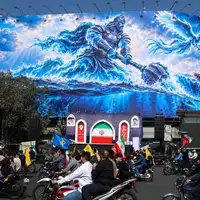
Supporters of the Islamic Republic hold Iranian flags and images of supreme leader Ali Khamenei, in a state-sponsored rally in Tehran, Iran, January 12, 2026
Tehran on Monday conducted large pro-government rallies in several cities intended to counter the nationwide protests challenging its rule, in a strategy it has deployed against previous bouts of mass unrest ultimately crushed by deadly force.
The aim is not necessarily to convince skeptics, but to project an image of control and popular backing at a moment of visible strain.
After days of sustained demonstrations calling for the overthrow of the system, authorities organized counter-rallies in several cities on Monday, presenting them as popular condemnations of the protests themselves.
State television depicted the gatherings as mass denunciations of unrest, echoing official claims that the uprising was driven by “armed terrorists” and foreign adversaries.
A familiar mobilization
The mechanics of the rallies followed a script many Iranians recognize. State bodies drew participants to central locations in Tehran and other major cities, relying on administrative pressure and access to public resources.
Coverage was then amplified by state television and media outlets affiliated with the Islamic Revolutionary Guards Corps.
In recent broadcasts, state outlets released a mix of ground-level footage and aerial images intended to convey scale. Some of the images show visible crowds, underscoring that the authorities retain a base of support.
It is difficult to determine precise numbers, the duration of the gatherings, or whether all images reflect live events from the same day. Similar visual techniques — including the reuse of footage or the circulation of undated aerial shots — have been employed during previous protest cycles.
Even taken at face value, the rallies appeared limited in duration and geographic spread.
By contrast, demonstrations opposing the government have persisted for weeks, erupting across hundreds of locations according to tallies compiled by activists and researchers, despite the risks involved.
The contrast is sharpened by the conditions under which each takes place: pro-government gatherings proceed under heavy security, while protesters have faced gunfire, mass arrests and lethal force.
Information control as context
This round of rallies unfolded amid unusually severe restrictions on communication. For several consecutive days, internet connectivity across much of Iran has been sharply curtailed, according to digital rights groups and user reports, leaving millions unable to communicate freely or share information.
State and Guards-linked outlets, by contrast, have continued to publish without interruption. Agencies such as Tasnim, Fars and Mehr have maintained full access, flooding television and online platforms with official narratives.
The result is a highly asymmetric information environment. While ordinary citizens struggle to document events or verify developments, state-aligned media dominate the public space with curated imagery.
Under such conditions, rallies are presented largely on the authorities’ terms, with limited independent means to corroborate scale, timing or participation.
A recurring sequence
Similar state-organized rallies followed major protest movements in 2009, 2019 and 2022, each time presented as demonstrations of enduring legitimacy. In each case, they coincided with intensified security measures and tighter controls on dissent.
Evidence of the human toll has continued to surface despite efforts to restrict documentation.
Videos circulating online in recent days, which could not be independently verified, appeared to show bodies in a morgue in Kahrizak, with grieving relatives gathered nearby—imagery that contrasted sharply with official broadcasts of unity and resolve.
In a message released Sunday night, Reza Pahlavi described the moment as a new phase in what he called a national uprising, urging supporters to challenge the state’s control over information and public space.
What the competing images ultimately underscore is a question that spectacle alone cannot answer: how Iranian cities would look if opposing sides were able to assemble under comparable conditions.
The return to this familiar choreography comes as protests continue despite severe limits on communication, widespread arrests and the high personal cost of participation.
The repeated staging of loyalty rallies suggests not confidence, but the absence of other tools for demonstrating consent. Carefully framed images may circulate for a time, but they cannot indefinitely substitute for credibility rooted in broad public trust.
In the end, theater may delay recognition of a crisis, but it does not resolve one.