Tehran’s show of strength—and the cracks beneath

Tehran is signaling no retreat in the face of escalating protests, issuing fresh threats and hardening its rhetoric even as unrest continues across multiple cities.
Iran International

Tehran is signaling no retreat in the face of escalating protests, issuing fresh threats and hardening its rhetoric even as unrest continues across multiple cities.
Rather than acknowledge public anger or suggest compromise, Iran’s leadership has moved to project defiance—tightening control, mobilizing loyalists and insisting that the state remains firmly in charge.
That posture was most clearly on display on state television on Friday, with thinly veiled threats against protesters, including warnings to parents to keep their children off the streets “if they care about their safety.”
Channel 3, one of the country’s most-watched stations, framed the unrest as a coordinated assault on the state, while commentators denounced protesters for demanding basic civil rights even as images showed security forces firing tear gas and live ammunition into crowds.
Tehran’s mayor, Alireza Zakani, said protesters in the capital had set fire to dozens of buses and public buildings, branding them “terrorists” while omitting that many of those buses are routinely used to transport detainees.
Parallel universes
Leading this hard line—as always—was Supreme Leader Ali Khamenei, who delivered a defiant, threat-laden speech after a night of furious protests. He accused demonstrators of acting on behalf of foreign enemies and vowed to confront what he called “sabotage” with force.
Throughout the day, television screens depicted two Irans unfolding in parallel.
On one channel, young men with patchy beards sang aging anthems glorifying violence and sacrifice in the name of religious devotion. On another, images showed frustrated protesters attacking a supermarket—only to leave without taking anything. The two sides appeared to inhabit different moral and political universes.
The attacks on regime icons, including toppled effigies of former IRGC Qods Force commander Qasem Soleimani, point to something deeper than rage: the breaking of a spell.
For decades, Khamenei cultivated the image of an untouchable ruler—a giant towering over a society long conditioned to fear the machinery of repression. But power often begins to erode symbolically before it does materially.
The Islamic Republic’s response to loud cries of rejection has been to insist, ever more loudly, that nothing essential has changed. Yet the need for such insistence is itself revealing. Giants do not announce their strength; they assume it.
When power must be constantly performed, restated and enforced on screen, it is often because the myth that sustained it is beginning to crack.
Iran’s leadership may yet suppress the unrest. It still commands formidable coercive tools. But the scenes now unfolding—even through the narrow lens of state television—suggest that something has shifted.
The state is shouting certainty into a country that no longer appears convinced. And once that moment arrives, the fall of a giant is no longer unthinkable—even if it is not yet complete.


Nationwide protests in Iran stretched into their 13th consecutive day on Friday as demonstrators returned to the streets for a second night following a call by exiled Prince Reza Pahlavi, with authorities enforcing a sweeping internet blackout and threatening severe punishment.
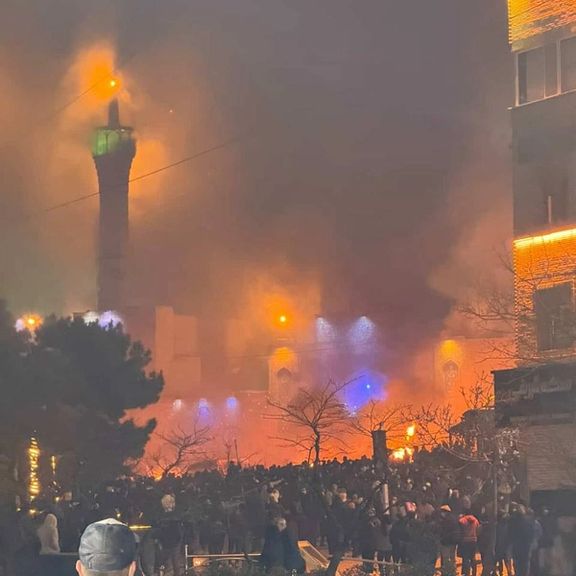
Videos and eyewitness accounts reviewed by Iran International showed crowds gathering after dark in Tehran, Isfahan, Mashhad, Tabriz and other cities despite gunfire, blocked roads and widespread disruptions to communications. The demonstrations followed massive rallies the previous night that was described as among the largest since the unrest began.
Eyewitnesses in Tehran described demonstrators regrouping after nightfall in multiple neighborhoods, blocking major roads, setting fire to police vehicles, and chanting anti-government slogans as security forces attempted to disperse crowds. Chants of “Death to the dictator” and “Neither Gaza nor Lebanon, my life for Iran” echoed through the capital, while car horns blared continuously in what witnesses described as coordinated acts of defiance.
In Isfahan, video verified by Iran International showed a large crowd chanting “Khamenei is a murderer, his rule is illegitimate,” alongside monarchist slogans including “Long live the King.”
In Mashhad, protesters filled major streets chanting “This is the last battle, Pahlavi will return,” according to eyewitnesses, as demonstrations continued despite heavy security deployments.
Footage from Tabriz showed protesters marching through city streets as the sound of gunfire rang out nearby, while other videos captured demonstrators disabling surveillance cameras and erecting makeshift barricades.
Eyewitness accounts from southern and central cities described similar scenes, with crowds converging on symbolic locations, burning banners and posters associated with the Islamic Republic, and remaining in the streets for hours despite internet outages and disruptions to phone service and electronic payments.
Several witnesses told Iran International that security forces appeared overstretched in some areas, relying on intimidation tactics, warning shots and use of force. In other locations, particularly in southeastern Iran, rights groups reported that security forces fired directly on protesters in Zahedan after Friday prayers, wounding several people.
Authorities threaten executions, tighten pressure
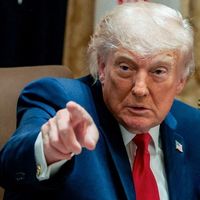
Supreme Leader Ali Khamenei warned US President Donald Trump that he would be brought down.
“Trump should know that world tyrants such as Pharaoh, Nimrod, Reza Shah and Mohammad Reza were brought down at the peak of their arrogance. He too will be brought down,” Khamenei said in remarks aired on state television.
The Islamic Republic, he said, would not retreat in the face of unrest. “Everyone should know that the Islamic Republic came to power with the blood of hundreds of thousands of honorable people, and it will not back down in the face of saboteurs,” he added.
Tehran’s public prosecutor, Ali Salehi, said those accused of arson, destruction of public property or armed clashes with security forces would face charges of moharebeh, an offense that carries the death penalty under Iranian law.
Separately, Ali Larijani, Iran’s security chief, blamed what he described as “armed protesters” for fatalities during the unrest and said security forces had begun arresting what he called ringleaders. Iran’s Revolutionary Guards intelligence organization also issued a warning saying the continuation of protests was “unacceptable.”
The Supreme National Security Council accused foreign powers of steering the unrest and said security forces and the judiciary would show no leniency toward what it called saboteurs. Education officials announced that schools in several provinces would move to online classes, citing security concerns and disruptions caused by the blackout.
Exiled prince urges sustained action and strikes
Exiled Prince Reza Pahlavi urged protesters to return to the streets over the weekend, push toward central city areas and prepare for prolonged presence. He also called on workers in transportation, oil, gas and the broader energy sector to begin nationwide strikes aimed at cutting off state revenues.
Pahlavi said the demonstrations had exposed vulnerabilities within the security apparatus and appealed to members of the armed forces who support the opposition’s defection platform to further disrupt repression. He also said he was preparing to return to Iran and stand alongside protesters at what he described as a decisive moment.
International pressure builds
UN human rights chief Volker Türk said he was “deeply disturbed” by reports of violence and urged independent investigations and restoration of communications. The European Union condemned any excessive use of force and called for restraint, while France, Britain and Germany issued a joint statement urging Iranian authorities to protect peaceful assembly.
US President Donald Trump warned Iran against killing protesters and said Washington was watching closely, while the State Department cautioned Tehran not to test US resolve.
Several airlines, including Flydubai and Turkish Airlines, cancelled flights to Iran as unrest intensified, underscoring the widening international impact of a crisis entering its second week.

The Islamic Republic has entered a decisive rupture, with intensifying protests and internet blackouts pointing to a government increasingly reliant on force — dynamics that senior Western officials and analysts suggested may mark the beginning of an endgame.
Demonstrations have spread across major cities and provinces despite a nationwide internet and phone blackout, with rights groups reporting at least 42 people killed and more than 2,000 arrested since unrest began.
Supreme Leader Ali Khamenei on Friday accused foreign powers of fueling the protests and warned demonstrators of severe punishment, as security forces fired live ammunition in several regions.
Tom Tugendhat, a British MP and former UK security minister, told Eye for Iran the moment reflects a system confronting its own limits.
“I think this is the end game for the regime,” Tugendhat said.
“What we’re watching is not whether or not the regime survives, but how many people does it try to kill?” he added.
His remarks came as Iranian prosecutors threatened protesters with charges carrying the death penalty, and the Revolutionary Guards’ intelligence arm warned that the continuation of protests was “unacceptable.”
Western officials reassess as fear appears to erode
Early this week, US intelligence assessed that the protests lacked the momentum to threaten regime stability, US officials told Axios, but that assessment is now being reconsidered in light of recent developments.
“This is truly an extraordinary moment,” said Norman Roule, a former senior CIA official, who served as the national intelligence manager for Iran at the Office of the Director of National Intelligence from 2008 to 2017.
“We are watching a regime that is clearly in its dying days,” Roule said.
Roule said the leadership’s response shows narrowing options.
“It’s a government that can sustain itself, but it’s incapable of decisions that can stop this,” he said.
US President Donald Trump has warned Iran’s authorities against killing demonstrators, praising Iranians as “brave people” and signaling consequences if repression escalates. European officials and the UN human rights chief have also condemned the crackdown and the communications blackout.
Policy analysts say the current unrest is not an isolated episode but part of a longer erosion of regime authority.
“The Iranian people have the singular ability to expose the regime for its illegitimacy,” said Jason Brodsky, policy director at United Against Nuclear Iran.
“Since 2017 onwards, the Iranian people have come to the conclusion that the Islamic Republic can’t be reformed and therefore has to be overthrown,” Brodsky said.
Journalist and author of Nuclear Iran David Patrikarakos said the protests differ fundamentally from earlier waves that focused on specific demands.
“These aren’t issue-based protests anymore. These are existential,” Patrikarakos said.
He said the leadership now faces a dangerous calculation. “If the Ayatollahs are tempted to think he’s bluffing, they should take a look at the ruins of their nuclear facilities,” he said, referring to recent US and Israeli strikes.
Protesters defy repression as blackout deepens
Verified videos circulating on social media show protesters confronting security forces in Tehran, Mashhad, Zahedan and other cities, even as authorities cut communications and deploy live fire.
One widely shared video shows a wounded protester declaring: “I’m not scared. For 47 years, I’ve been dead.”
The demonstrations have drawn participation across Iran’s political, ethnic and religious spectrum. Exiled Prince Reza Pahlavi praised the nationwide turnout and urged coordinated nightly protests, while Sunni cleric Molavi Abdolhamid warned of deepening poverty and backed the demonstrations.
International pressure has continued to build. The UN human rights chief said he was “deeply disturbed” by reports of killings and internet shutdowns, while EU officials accused Tehran of using blackouts to conceal violence.
Despite uncertainty over how events will unfold, guests on Eye for Iran converged on a central conclusion: the Islamic Republic is confronting a crisis in which repression remains its primary instrument, even as its effectiveness appears increasingly uncertain.
You can watch Episode 85 of Eye for Iran on YouTube or Listen on any podcast platform of your choosing.

Internet experts are warning that Iran’s sweeping nationwide internet blackout is being used to shield lethal crackdowns on protesters, cutting off evidence of state violence as unrest continues across the country.
“This is the worst internet shutdown in Iran’s history,” said Ali Tehrani, director of Washington operations for Psiphon, an open-source anti-censorship tool widely used in Iran. “Even Starlink uploads have been affected.”
Tehrani said supporting internet freedom in Iran must become a serious and active priority for the U.S. government, particularly as Iranian authorities increasingly rely on digital blackouts during periods of unrest.
Cybersecurity expert Amin Sabeti told Iran International that the blackout, which began Thursday evening local time, has severed access to the global internet across much of the country and disrupted domestic online services that remained partially available during previous crackdowns.
“This is the most extreme internet shutdown we’ve ever had,” Sabeti said, adding that its scope signals a significant escalation in Tehran’s use of digital repression amid nationwide unrest.
‘Iranians will die’
Iranian authorities have imposed the communications blackout to prevent protesters from coordinating and to stop evidence of state violence from reaching the outside world.
Tehrani said the current shutdown is even more severe than the near-total blackout during the November 2019 uprising, widely known as Bloody Aban, named after the month in the Persian calendar when the protests occurred.
“It’s not just for The Washington Post that democracy dies in the darkness—it’s Iranians that die in the dark,” said Behnam Ben Taleblu, a senior fellow at the Foundation for Defense of Democracies.
Taleblu said communications shutdowns are a core component of Iran’s repression strategy, designed to sever the link between protesters and the international community while security forces operate with reduced scrutiny.
Dozens killed
Despite the blackout, Iran International said it has received and reviewed a disturbing video showing several people lying motionless on the ground following large protests held Thursday night in Fardis, about 25 miles west of Tehran.
The outlet said the shutdown has obstructed efforts to determine the full scale of casualties shown in the footage.
The Center for Human Rights in Iran said on Friday that it has grave and urgent concerns that Iranian security forces may be carrying out lethal repression under the cover of the internet shutdown.
The group said it has received credible first-hand reports of hospitals overwhelmed with injured protesters in several cities and has documented the use of live ammunition by security forces.
It warned that reports of mass killings from the night of January 8 could not be independently verified due to the communications blackout.

In a speech on Friday, Supreme Leader Ali Khamenei left little doubt that Tehran intends to confront the current wave of protests with force rather than concession.
The remarks pointed to an intensifying crackdown, unfolding amid a near-total internet shutdown across Iran.
Those signals have placed renewed focus on Washington, where US President Donald Trump has issued repeated public warnings to Tehran in recent days, including statements suggesting the United States could act if Iranian authorities continue killing protesters.
Whether those threats translate into policy remains unclear, but they have sharpened attention on how the White House responds as events unfold inside Iran.
Khamenei’s remarks, which included renewed accusations that protesters are being directed by foreign powers, were accompanied by direct criticism of Trump, who late Thursday night warned Iran against further violence.
Taken together, the exchanges have added to tensions already heightened by months of mutual suspicion and rhetorical escalation.
The result has been growing unease across the Iran–US–Israel triangle. Iranian officials routinely frame internal unrest as foreign intrigue, while Israeli leaders have long described the Islamic Republic as a persistent, existential threat.
Risk of escalation
Iran’s rulers now appear increasingly concerned that the United States or Israel could seek to exploit domestic instability—fears that, in turn, risk shaping Tehran’s military calculations.
Earlier this week, Iran’s National Defense Council and other security bodies issued statements warning that the country could carry out a preemptive strike if it detected preparations for an attack.
Those warnings coincided with missile tests, moves officials described as defensive but which analysts say added another layer of volatility.
The rhetoric and military signaling have raised fears of escalation even in the absence of clear intent on any side to seek a confrontation.
In Israel, security officials have expressed concern that Iran could attempt to divert attention from internal unrest by provoking an external crisis, though many analysts consider such a move unlikely.
Still, Israel’s heightened sensitivity to risk since the October 7 attacks has reinforced a preference for preparing for worst-case scenarios.
Critical decisions
As Iran’s leadership faces mounting pressure at home, the margin for error abroad appears to be narrowing.
Clear signals of US support for protesters, even if not backed by immediate action, risk aggravating Tehran’s fears of external intervention, while Iranian military signaling increases the danger of miscalculation.
Some in Washington worry that even limited American involvement—military or otherwise—could destabilize an already fragile regional balance and draw Israel into a broader confrontation.
At the same time, a White House decision to refrain from action, despite repeated warnings, could also carry consequences. Protesters inside Iran have often looked to international pressure for protection or leverage, and the absence of follow-through could further dampen momentum on the streets.
What is clear is that Iran’s internal crisis is no longer insulated from its external rivalries.
Developments inside the country now carry implications far beyond its borders, raising the risk that repression at home could intersect with miscalculation abroad—between Iran, the United States and Israel.

Dozens of people have been killed in protests across Iran in recent days, according to human rights groups and witness accounts, with the full scale of casualties from Thursday night still unknown after authorities imposed a nationwide internet blackout.
Before communications were cut, Iran Human Rights, a Norway-based monitoring group, said at least 45 protesters had been killed between December 28 and January 8, and that more than 2,000 people had been arrested.
Those figures are likely to rise following Thursday’s nationwide protests and reports of further unrest on Friday night, but verification has become increasingly difficult as images and firsthand accounts from inside Iran have largely disappeared.
One video that circulated online on Thursday appears to show at least seven bodies lying on the ground in what looks like an underground parking area.
The footage, which has not been independently verified, is said by the narrator to have been recorded in Fardis, near the city of Karaj, west of Tehran. The narrator claims the victims were killed by live fire.
Warnings from the top
Supreme Leader Ali Khamenei, who has appeared rarely in public since last month’s 12-day war, addressed the nation on Friday, a day after the mass protests. He referred to demonstrators as “saboteurs” and said he would not retreat in the face of unrest.
Soon afterward, the Secretariat of Iran’s Supreme National Security Council issued a statement warning that security forces and the judiciary would show “no leniency toward saboteurs.”
Similar statements later issued by the national police force and the Revolutionary Guards’ intelligence arm described the protests as a “joint design” by Israel and the United States to undermine Iran’s security and vowed retaliation.
The remarks heightened concerns among activists and rights groups that the authorities were preparing for further violent crackdowns.
Recasting the dead
Alongside the use of force, Iranian authorities have in several cases sought to portray slain protesters as government supporters or as victims of protesters’ violence—a pattern seen in previous waves of unrest.
One such case involved Amir-Hessam Khodayari, 22, who was wounded by security forces on December 31 in the western city of Kouhdasht, in Lorestan province, and later died after being transferred to a hospital in the provincial capital, Khorramabad.
Little is publicly known about his education or occupation, but his family is described as working-class Kurds who follow the Yarsan faith, a religious minority.
The Revolutionary Guards issued a statement describing Khodayari as a member of the Basij, a pro-government militia, and as one of the “forces defending security.” State media echoed the claim, and local officials visited his family.
That account was contradicted after his family rejected efforts to identify him as a Basij member.
In a widely shared video, his father is seen telling mourners that his son had been a protester. Other videos showed crowds forcing security forces to retreat from his funeral, despite attempts by authorities to control the ceremony.
Family members and activists said they faced pressure, including threats to withhold his body and offers of financial compensation, to accept the official version of events.
A similar pattern was documented during the 2022 Woman, Life, Freedom protests, including in the case of Hamid-Reza Rouhi, another protester initially portrayed by authorities as a Basij member after his death.
Many more to come?
Another recent case involved Shayan Asadollahi, 28, who was killed in the city of Azna, also in Lorestan province. Authorities withheld his body for five days, pressuring his family to say he had been a Basij member or that he had died in a traffic accident.
He was eventually buried quietly in the remote village of Deh Haji.
Asadollahi worked as a hairdresser and was the sole breadwinner for his mother and sister after his father died in an accident last year. Friends described him as an avid supporter of the Persepolis football club.
Like many young Iranians, he was active on Instagram, where he shared photos of his work, daily life and football fandom—an online presence that fell silent after his death.
The stories that have emerged so far may represent only a fraction of what occurred, with many more accounts expected to surface if and when full internet access is restored.