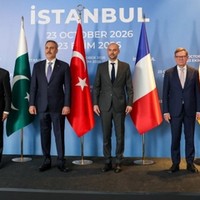
Tom Tugendhat, a British MP and former UK security minister, File photo
The Islamic Republic has entered a decisive rupture, with intensifying protests and internet blackouts pointing to a government increasingly reliant on force — dynamics that senior Western officials and analysts suggested may mark the beginning of an endgame.
Demonstrations have spread across major cities and provinces despite a nationwide internet and phone blackout, with rights groups reporting at least 42 people killed and more than 2,000 arrested since unrest began.
Supreme Leader Ali Khamenei on Friday accused foreign powers of fueling the protests and warned demonstrators of severe punishment, as security forces fired live ammunition in several regions.
Tom Tugendhat, a British MP and former UK security minister, told Eye for Iran the moment reflects a system confronting its own limits.
“I think this is the end game for the regime,” Tugendhat said.
“What we’re watching is not whether or not the regime survives, but how many people does it try to kill?” he added.
His remarks came as Iranian prosecutors threatened protesters with charges carrying the death penalty, and the Revolutionary Guards’ intelligence arm warned that the continuation of protests was “unacceptable.”
Western officials reassess as fear appears to erode
Early this week, US intelligence assessed that the protests lacked the momentum to threaten regime stability, US officials told Axios, but that assessment is now being reconsidered in light of recent developments.
“This is truly an extraordinary moment,” said Norman Roule, a former senior CIA official, who served as the national intelligence manager for Iran at the Office of the Director of National Intelligence from 2008 to 2017.
“We are watching a regime that is clearly in its dying days,” Roule said.
Roule said the leadership’s response shows narrowing options.
“It’s a government that can sustain itself, but it’s incapable of decisions that can stop this,” he said.
US President Donald Trump has warned Iran’s authorities against killing demonstrators, praising Iranians as “brave people” and signaling consequences if repression escalates. European officials and the UN human rights chief have also condemned the crackdown and the communications blackout.
Policy analysts say the current unrest is not an isolated episode but part of a longer erosion of regime authority.
“The Iranian people have the singular ability to expose the regime for its illegitimacy,” said Jason Brodsky, policy director at United Against Nuclear Iran.
“Since 2017 onwards, the Iranian people have come to the conclusion that the Islamic Republic can’t be reformed and therefore has to be overthrown,” Brodsky said.
Journalist and author of Nuclear Iran David Patrikarakos said the protests differ fundamentally from earlier waves that focused on specific demands.
“These aren’t issue-based protests anymore. These are existential,” Patrikarakos said.
He said the leadership now faces a dangerous calculation. “If the Ayatollahs are tempted to think he’s bluffing, they should take a look at the ruins of their nuclear facilities,” he said, referring to recent US and Israeli strikes.
Protesters defy repression as blackout deepens
Verified videos circulating on social media show protesters confronting security forces in Tehran, Mashhad, Zahedan and other cities, even as authorities cut communications and deploy live fire.
One widely shared video shows a wounded protester declaring: “I’m not scared. For 47 years, I’ve been dead.”
The demonstrations have drawn participation across Iran’s political, ethnic and religious spectrum. Exiled Prince Reza Pahlavi praised the nationwide turnout and urged coordinated nightly protests, while Sunni cleric Molavi Abdolhamid warned of deepening poverty and backed the demonstrations.
International pressure has continued to build. The UN human rights chief said he was “deeply disturbed” by reports of killings and internet shutdowns, while EU officials accused Tehran of using blackouts to conceal violence.
Despite uncertainty over how events will unfold, guests on Eye for Iran converged on a central conclusion: the Islamic Republic is confronting a crisis in which repression remains its primary instrument, even as its effectiveness appears increasingly uncertain.
You can watch Episode 85 of Eye for Iran on YouTube or Listen on any podcast platform of your choosing.
An illustration showing an ancient Iranian soldier and a Revolutionary Guard member holding a weapon together, displayed during a November 7 ceremony in Tehran where a statue of pre-Islamic Persian King Shapur I was unveiled.
Tehran’s unveiling of a towering statue depicting the Roman Emperor Valerian kneeling before pre-Islamic Persian King Shapur I has renewed criticism of the Islamic Republic’s appeal to nationalist sentiment following the June war with Israel.
For over forty years, the theocracy purged ancient Persian history from schoolbooks, replacing it with post-Islamic narratives. But after the 12-day conflict with Israel, officials have turned to the distant pre-Islamic past to rally a divided society.
From murals of ancient kings and soldiers to patriotic songs added to Shi’ite mourning ceremonies performed before Supreme Leader Ali Khamenei, Tehran now embraces imagery once deemed heretical by its own revolutionary ethos.
The statue unveiled in Tehran's Revolution Square
'Kneel before Iran' campaign
Tehran’s Revolution (Enghelab) Square was the scene of an unusual spectacle on Friday as officials unveiled a massive bronze statue depicting Roman Emperor Valerian kneeling in submission before Sassanid King Shapur I, commemorating Iran’s victory at the Battle of Edessa (260 AD).
The event was held under the slogan “Kneel before Iran,” part of what authorities describe as a campaign to project “national unity and historical pride” following the June war with Israel.
Tehran Mayor Alireza Zakani, a staunch ultraconservative, said on X: “Enmity with Great Iran can only end in kneeling before this historic nation.”
Municipal official Davood Goodarzi said the installation would be accompanied by visual displays depicting “other victories of Iranians over foreign aggressors,” including the defeat of British forces by local commander Rais-Ali Delvari, Mirza Kuchak Khan’s resistance against Russian troops, and Surena’s triumph over Rome at the Battle of Carrhae in 53 BCE.
The goal, Goodarzi said, is “strengthening concepts such as national dignity, social unity, and Iranian identity.”
The statue, he said, would remain temporarily at Revolution Square before being moved to a city gateway “where it will stand as the first emblem of Iran before diplomats and foreign visitors.”
Unveiled women were allowed to attend the unveiling ceremony—an uncommon scene at events organized by Tehran’s ultra-hardline municipality.
The turn to the pre-Islamic past
The sharp reversal also recalls remarks once made by Khamenei. In a 2011 speech, he asserted that “all the great military victories of this nation came after Islam,” dismissing pre-Islamic accounts as “things that are not documented.”
In 1987, he had said that prophets triumphed over kings such as Cyrus and that “nothing remains of these monarchs in history but names remembered with derision.”
Nevertheless, pro-government social media accounts have now gone so far as to circulate posters equating Khamenei himself with Shapur, showing him standing with a staff as Benjamin Netanyahu and Donald Trump kneel before him. The caption reads: “You will kneel before Iran.”
Image circulating by hardliners on social media
'Hypocrisy'
Pro-government figures have hailed the move as a patriotic success. Conservative political reporter Hossein Saremi posted: “Today’s grand Iranian gathering showed that people and the state share one essence: Iran itself. Nothing can take our homeland away.”
Others, however, called the spectacle “hypocrisy.” Journalist Gholamhossein Pashaei wrote on X: “Every year you close Pasargadae to stop people from celebrating Cyrus Day, yet you unveil Shapur’s statue in Enghelab Square with drums and fireworks during Fatimiyya (mourning period)!”
Dissident commentator Hamid Asafi called the ceremony “a perfect snapshot of the Islamic Republic’s contradictions.”
On Telegram he wrote: “A week ago they closed Cyrus’s tomb out of fear of the crowds, and now they glorify Shapur in the same breath. The Islamic Republic fears living history but poses for selfies with its corpse.”
He added: “They know people no longer respond to rosaries and sermons. That’s why they’ve brought history back to the stage—in a controlled costume. If they can’t erase the past, they’ll try to own it.”
The irony deepened as UNESCO formally recognized Cyrus’s Charter as one of the earliest human-rights documents.
President Masoud Pezeshkian wrote on X: “Iran, the cradle of dialogue, justice, and coexistence, can still inspire peace today.”
Users swiftly replied, questioning how such pride could coexist with a government that blocks access to Cyrus’s tomb each year to those wishing to visit it on his birthday.