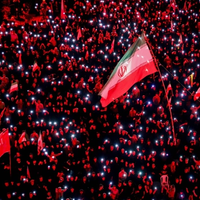
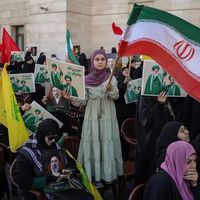
Female members of Iran's paramilitary Basij hold Iranian flags on a state-sponsored group hike in the mountains overlooking Tehran, December 9, 2025
The mood in Tehran appears to be shifting from a sense of imminent danger that followed the June war to a more resigned belief that diplomacy with Washington is stuck in a strategic stalemate rather than a temporary lull.
Across the political spectrum, officials and commentators now speak less about breakthroughs and more about the constraints that make a return to the negotiating table unlikely.
“This is a structural lock that has evolved out of developments in recent years,” international relations professor Mohsen Jalilvand told the moderate outlet Fararu.
The deadlock, Jalilvand argued, stems from Tehran’s red lines: uranium enrichment and missiles—which he said form the core of Iran’s “security architecture and deterrence doctrine,” and therefore “cannot even be part of preliminary talks.”
The Trump administration last month responded to a message from Iran conveyed through the Saudi crown prince by saying three US conditions for any negotiations with Tehran remain unchanged, sources told Iran International.
These include Iran completely halting uranium enrichment, ending support for armed allies in the Middle East and accepting curbs on its ballistic missile program. Tehran has long dismissed the demands as a non-starter.
Many in Tehran believe previous rounds of bargaining delivered few tangible gains while reinforcing a cycle of pressure and concession that Iran cannot afford to repeat.
Washington’s messaging has done little to shift these perceptions.
US Middle East envoy Tom Barrack insisted last week that President Donald Trump wants an agreement with Iran—but on his terms.
Jalilvand warned that the upcoming visit of Israel’s prime minister, Benjamin Netanyahu, to Washington will likely raise the political cost of any rapprochement with the United States.
‘Like before June war’
Inside Iran’s parliament, the view is similarly bleak.
MP Beitollah Abdollahi told the reformist outlet Rouydad24: “There are no negotiations with the United States on the horizon,” warning that the situation was similar to the period before a surprise Israeli military campaign in June.
In the six months since that conflict, Tehran has rebuilt parts of its regional posture, tightened internal discipline, and recalibrated its rhetoric.
What once looked like an emergency phase has settled into a colder equilibrium: no active escalation, no meaningful diplomacy, and a widening perception inside Iran that neither side is prepared to assume the political risk required for movement.
Iranian officials are increasingly portraying US expectations as calls for fundamental transformation rather than technical compromises.
A December 8 commentary on Rouydad24 said this shift in mood was evident in Foreign Minister Abbas Araghchi’s recent emphasis on “managing hostilities” instead of avoiding conflict or resolving the standoff.
MP Ali Hashemi had one of the more sobering assessments.
“(Araghchi) knew that talks with the US had reached a deadlock at least three weeks before the war with Israel,” he said on Tuesday. “This explains his shift.”
Lebanon’s Foreign Minister Youssef Raji said he had declined an invitation from Foreign Minister Abbas Araghchi to visit Tehran as Beirut continues to push for the disarmament of Iran-backed Hezbollah.
Israel mauled the group at the tail end of a year-long war which ended in November of last year, after which the Lebanese government tasked the army with confiscating Hezbollah's arsenal by 2026.
Iran has resisted the initiative to defang the group which it founded in 1982, saying continued Israeli attacks justify what it calls Hezbollah's resistance.
In a written reply published by Lebanon’s foreign ministry on X, Raji said not accepting the visit “does not mean rejecting discussion,” adding that “the favorable conditions are not available.”
He renewed an invitation to Araghchi to meet in “a neutral third country to be agreed upon.”
Raji said Lebanon was ready to establish “a new phase of constructive relations” with Iran, but only if ties were based “exclusively on mutual respect and absolute respect for the independence and sovereignty of each country and non-interference in internal affairs under any pretext.”
“Building any strong state cannot happen unless the state alone, through its national army, holds the exclusive right to carry arms and the sole authority over decisions of war and peace,” he added, saying Araghchi was welcome to visit Lebanon.
Iran invitation amid Hezbollah debate
Iran invited Raji to Tehran earlier this month to discuss bilateral ties, according to Iran’s foreign ministry, amid growing debate in Lebanon over the future of the Iran-aligned Hezbollah group and calls for state control over weapons.
The exchange followed criticism in Beirut of comments by Ali Akbar Velayati, a senior adviser to Iran’s Supreme Leader, who said Hezbollah’s existence was more important than “bread and water” for Lebanon.
Responding at the time, Raji wrote on X: “What is more important than bread and water for us is our sovereignty, freedom and independent decision-making,” rejecting what he described as outside interference.
Lebanon’s stance comes as Israel and Lebanon expand contacts through a committee monitoring their 2024 ceasefire, with Beirut saying the group could verify Israeli accusations that Hezbollah is re-arming.
Israel continues to occupy outposts on Lebanese territory and has launched a series of deadly attacks which it says targets Hezbollah militants despite the ceasefire.
Iran’s First Vice President Mohammad Reza Aref shakes hands with Belarusian Industry Minister Andrei Kuznetsov during talks in Tehran on expanding bilateral cooperation.
Iran is ready to expand cooperation with Belarus “without any restrictions,” First Vice President Mohammad Reza Aref said on Wednesday in Tehran, following the conclusion of the 18th Iran–Belarus Joint Economic Committee.
“Tehran and Minsk have complementary economies and can meet each other’s needs,” Aref said, stressing that political goodwill between the two nations provides “a strong basis for broadening ties in trade, industry, and technology.”
The two-day meeting, co-chaired by Iran’s Industry Minister Mohammad Atabak and Belarusian Industry Minister Andrei Kuznetsov, brought together senior officials, business representatives, and experts from both countries to outline a new phase of economic, scientific, and industrial cooperation.
Officials from Iran and Belarus meet in Tehran during the 18th session of their Joint Economic Committee to discuss expanding trade and industrial cooperation.
Atabak announced that Tehran and Minsk had agreed to establish joint industrial plants in Sistan-Baluchestan Province in southeastern Iran, focusing on the production of heavy machinery, agricultural equipment, and mining technology as part of efforts to expand bilateral industrial cooperation. He called the initiative “a turning point” in bilateral industrial relations and part of efforts to implement the Iran–Eurasian Economic Union (EAEU) free trade agreement.
Atabak added that the two governments aim to remove banking and customs obstacles, enhance trade facilitation, and allow Belarusian firms to use Iran’s southern ports as gateways to markets in India, Africa, and Southeast Asia.
Officials also discussed joint ventures in pharmaceuticals, medical technology, and higher education, including university partnerships and mutual recognition of degrees. Aref said these initiatives could “turn scientific and technological cooperation into one of the pillars” of Iran–Belarus relations.
Seattle's iconic Space Needle flies the LGBTQ+ flag in this file photo.
Iran and Egypt have lodged formal protests with FIFA after Seattle designated their 2026 World Cup group-stage game as a “Pride Match,” triggering a diplomatic and cultural backlash from two countries where homosexuality is criminalized.
The decision had been announced previously by Seattle’s local organizing committee as part of the host city’s Pride weekend celebrations long before match dates and venues were assigned.
When FIFA released the official schedule on Saturday, it confirmed that the June 26 Group G match would be between Iran and Egypt at Lumen Field falls on Seattle’s annual Pride weekend, during which the city traditionally holds public events and art displays honoring the LGBTQ+ community.
In an interview with state TV, Iranian Football Federation President Mehdi Taj condemned the move as “unreasonable conduct that supports a specific group,” adding that both Tehran and Cairo have communicated their objections to FIFA.
Iranian media reported on Tuesday that Taj, a member of Organizing Committee for FIFA Competitions, plans to raise the issue with FIFA’s competitions committee, while Egyptian football authorities have sent an official letter refusing any LGBTQ-themed activities during the match.
The Egyptian Football Association sent an official letter to FIFA Secretary-General Mattias Grafström saying it rejects any initiatives “related to supporting homosexuality” during the fixture, citing cultural, religious and social sensitivities shared by fans of both countries.
It added that such events contravene FIFA’s own statutes, including Article 4, which calls for neutrality in political and social matters, and the disciplinary code’s requirement that World Cup events remain free of actions that could provoke tension among supporters.
Iran has issued a similar warning, arguing that designating the game as a Pride Match violates FIFA rules prohibiting political, religious or ideological messaging inside stadiums.
According to state media, Iranian officials say the federation intends to formally notify FIFA of the “consequences” of proceeding with LGBTQ-themed celebrations linked to the fixture.
Seattle organizers, for their part, insist the city’s Pride programming is not aimed at any participating nation. Hanna Tadesse of the Seattle World Cup committee told Germany’s DPA news agency that LGBTQ+ culture is “an integral part” of the city’s identity and confirmed that celebrations will go ahead as planned.
The controversy echoes the 2022 World Cup dispute in Qatar, when FIFA banned the “OneLove” armband intended as a symbol against discrimination.
Germany's players stoked controversy in Qatar by posing for a picture with their hands over their mouths in a symbol of stifled expression in protest of the ban and laws in the conservative Islamic country criminalizing LGBTQ+ activity.
Iran, China and Saudi Arabia held a trilateral meeting in Tehran on Tuesday, the third since their 2023 normalization agreement brokered in Beijing, state media reported.
Deputy Foreign Minister Majid Takht-Ravanchi headed the Iranian delegation. A preparatory session with diplomats and experts from the three countries was held on Monday, according to ISNA.
The meeting reviewed progress in implementing the Beijing accord, which restored diplomatic relations between Tehran and Riyadh after a seven-year rift and set out commitments to reopen embassies and expand political and economic ties.
According to China’s foreign ministry, the three sides called for an immediate halt to Israeli actions against Palestine, Lebanon, and Syria, and condemned violations of Iran’s national sovereignty and territorial integrity. The statement also said the parties look forward to expanding cooperation in various fields, including economics and politics.
The previous rounds of the trilateral committee were held in Beijing and Riyadh, where the sides reaffirmed respect for sovereignty and non-interference and welcomed China’s continued mediation to support regional dialogue.
Regional visits to Tehran
The Tehran meeting followed a flurry of recent diplomatic activity involving Iran and its regional neighbors. Last month, senior officials from Turkey and Saudi Arabia also visited Tehran for high-level talks widely seen as efforts to manage regional tensions through dialogue.
At the same time, new reports shed light on broader diplomatic exchanges behind the scenes.
According to an exclusive report by Iran International, the Trump administration responded to a message from Iranian President Masoud Pezeshkian, conveyed through Saudi Crown Prince Mohammed bin Salman, by reaffirming its three preconditions for any talks with Tehran: a halt to uranium enrichment, an end to Iran’s support for regional armed groups, and restrictions on its ballistic missile program.
Reuters earlier reported that Pezeshkian’s letter to the crown prince, sent before his late-November visit to Washington, said Iran “does not seek confrontation” and remains open to diplomacy if its rights are guaranteed.
During that trip, US President Donald Trump said he was “open” to a new deal with Tehran, while Mohammed bin Salman pledged to “do our best to help reach a deal between America and Iran.”
Supreme Leader Ali Khamenei later dismissed reports of Iranian outreach via Riyadh as “pure lies,” though it remains unclear whether he was briefed on the exchange or if Tehran chose to deny it after the US response.
The Spokesman for the Atomic Energy Organization of Iran Behrouz Kamalvandi.
Iran’s existing nuclear safeguards agreement with the International Atomic Energy Agency (IAEA) does not account for wartime conditions and must be revised to protect national security, Behrouz Kamalvandi, spokesman for the Atomic Energy Organization of Iran, said on Tuesday.
Kamalvandi said the current safeguards agreement under the Nuclear Non-Proliferation Treaty (NPT) was written for “normal circumstances” and provides no clear mechanism for facilities that have come under attack. “The safeguards agreement was not designed for wartime situations and therefore needs to be updated,” he told IRNA.
He added that Iran remains committed to the NPT and its verification framework but said the agency’s political approach has complicated cooperation. “When a country is attacked, it cannot be expected to immediately allow inspectors into damaged sites, because that could mean handing sensitive information to its enemies,” Kamalvandi said.
The spokesman said Tehran would continue cooperating with the IAEA over undamaged facilities, but for those hit during recent strikes, “a new legal understanding is needed.” He said the safeguards regime allows for such revisions under its articles 20–22, which permit amendments in exceptional circumstances.
IAEA 'accepted Iran’s point' in Cairo talks
Kamalvandi also revealed that during recent discussions in Cairo, IAEA officials had effectively acknowledged Iran’s legal argument, accepting that the existing safeguards framework does not fully address post-conflict conditions. “Their agreement in Cairo shows that they understood our point — the current text cannot respond to the realities after the 12-day war,” he said.
He stressed that any future cooperation with the agency must ensure that Iran’s security and classified information are protected, saying Tehran is prepared to propose new verification methods “compatible with the realities of a conflict environment.”
“Our main goal is to find a path within the law,” Kamalvandi said. “We are not closing the door to cooperation, but the rules must reflect the conditions that Iran — or any country under attack — faces.”
Foreign minister warns of radiation risk at bombed nuclear sites
Meanwhile, earlier this week Foreign Minister Abbas Araghchi said Iran faces “security threats and safety concerns” after strikes on its nuclear facilities during the 12-day war in June, warning of potential radiation leaks from damaged sites.
In an interview with Japan’s Kyodo News published on Sunday, Araghchi said the attacks had created “serious dangers,” including possible contamination and unexploded ordnance.
Araghchi added that while Tehran remains open to new nuclear talks if Washington shows “a logic of confidence-building,” IAEA inspections cannot resume at damaged facilities until “clear protocols” are established to protect both safety and sovereignty.