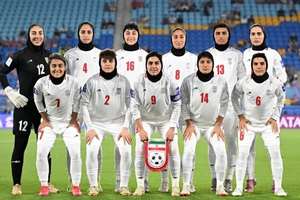
A photo of Iranian women players who sought asylum in Australia
A member of Iran’s women’s national football team staff who sought asylum in Australia along with several of her players is trying to persuade the others not to follow suit but instead return to Iran, informed sources told Iran International.
Sources said Zahra Meshkinkar, a member of the team’s technical staff, has been relaying messages from Iran's football authorities to players in an effort to convince them to abandon asylum plans and return home.
The effort comes after several members of the Iranian delegation sought protection abroad during the AFC Women’s Asian Cup in Australia.
The team’s equipment manager, known as “Flor,” and player Mohaddeseh Zolfi were among the latest members of the delegation to apply for asylum, following five other players who had already taken similar steps.
The remaining members of the squad later traveled to Malaysia, where they are currently staying while officials consider possible routes for their return to Iran amid the US-Israeli airstrikes.
Semi-official news agency ISNA on Saturday posted an image of players Mona Hamoudi and Zahra Sarbali as well as the coaching staffer Zahra Meshkin-Kar apparently minutes before traveling to Malaysia to join their team members.
"These three, after withdrawing their asylum request in Australia, will join the rest of the national team players tonight," the report said.
Sources previously told Iran International that players have been kept under tight supervision at their hotel in Kuala Lumpur.
Journalists and outside visitors have been barred from entering, and several players have had their mobile phones confiscated. Others were allowed to keep their phones only under the supervision of security personnel linked to the Iranian Football Federation.
Pressure on the players began before the team left Iran and continued during the tournament and afterward. Mohammad Rahman Salari, a member of the football federation’s board, has played a central role in enforcing restrictions and repeatedly collecting and inspecting the phones of players and staff.
Fatemeh Bodaghi, traveling with the delegation as the team’s manager, has also been described by sources as monitoring players’ social media activity and reporting developments to officials in Tehran. Zeinab Hosseinzadeh, the team’s physiotherapist, has also been cited as among those exerting pressure on players.
The crisis surrounding the team began earlier in the tournament when the players refused to sing the Iranian national anthem before their opening match against South Korea. The silent protest occurred shortly after the escalation of conflict involving Iran and the killing of Supreme Leader Ali Khamenei.
State media quickly labeled the act as “wartime treason,” and officials warned the players they could face serious consequences if they refused to return to Iran.
The Iranian judiciary also issued a statement urging the athletes to return to the country “for the sake of their families,” a warning widely interpreted as indirect pressure on the players through their relatives.
Farideh Shojaei, the vice president for women’s affairs at the Iranian Football Federation, is also accompanying the delegation. She previously said officials were exploring possible routes for the team’s return to Iran amid ongoing US-Israeli airstrikes, including the possibility of traveling overland through Turkey after attempts to fly through the United Arab Emirates failed.
The developments have drawn international attention and concern from human rights groups, which warned that the players could face punishment if forced to return to Iran after their protest during the tournament.