Leaked Russian files show Iran’s €6bn plan to buy 48 Russian fighter jets
A Russian Aerospace Forces Su-35S during a standard takeoff procedure
Leaked Russian defense documents indicate Iran has signed a €6 billion deal to buy 48 Su-35 fighter jets from Moscow, with deliveries expected between 2026 and 2028, according to reports by Defense Security Asia and Newsweek.
The reports cite export data allegedly taken from Concern Radio-Electronic Technologies (KRET), a subsidiary of Russia’s state-owned Rostec Corporation.
The documents, published online by hacker group Black Mirror in early October, list Iran under customer code “364” for a package of 48 Su-35 multirole fighters.
“The leaked tables show Iran’s Su-35 package valued at more than €5–6 billion once full airframe and weapons systems are included,” Defense Security Asia said.
The leak also included “48 heads-up display systems and electronic-warfare components, confirming the 48-aircraft figure linked to Iran’s order,” the report added.
A separate defense blog said the files contain “detailed pricing, delivery schedules, and export plans for advanced Sukhoi fighter jets destined for several foreign clients — including Iran, Algeria, and Ethiopia.”
The material, it said, was “published online on October 3 by the hacker collective Black Mirror, which claims to have accessed more than 300 internal documents from Rostec’s systems.”
Deliveries and local assembly plans
The leaked export tables outline a multi-year schedule, with shipments of avionics and electronic-warfare systems for the Iranian jets between 2024 and 2026.
Full aircraft deliveries are expected from 2026 through 2028.
Defense Security Asia wrote the leak “suggests Russia may go beyond simple export delivery -- offering semi-knocked-down assembly in Iran through a local aerospace partner, possibly under the Iran Aviation Industries Organization.”
Unverified details in the same tranche say Russian technicians from Sukhoi and KRET have been stationed in Iran since early 2024 to oversee assembly preparations.
“This arrangement could allow Iran to assemble 48 to 72 units over several years, creating its first near-indigenous fourth-plus-generation fighter production line since the 1970s,” the outlet said.
Russian Sukhoi Su-35 jet fighters firing missiles during the International Army Games 2021, at the Dubrovichi range outside Ryazan, Russia August 27, 2021
Iranian lawmakers confirm fighter and missile purchases
Iranian officials have recently discussed the arrival of Russian aircraft. Lawmaker Abolfazl Zohrevand said on October 1 that Russian MiG-29s had already entered Iran as what he called a short-term solution, adding that “for long-term solutions, Su-35s will gradually enter.”
He also said, “The HQ-9 system is entering substantially and the S-400 likewise.”
Another lawmaker, Fada Hossein Maleki, said in September that Iran’s general staff “is pursuing the purchase of air-defense systems from China and Russia.”
Moscow’s reliability questioned inside Iran
Some senior figures have voiced skepticism about Russia’s commitment. Mohammad Sadr, a member of Iran’s Expediency Council, said Moscow “was willing to sell S-400 systems to Turkey, a NATO member, but has still not provided them to Iran.”
“Russia has a particular inclination toward Israel and for a long time there has been talk of buying Su-35s, while Russia has built higher models, but even this it does not give us,” he added.
The conservative daily Farhikhtegan reported that Foreign Minister Abbas Araghchi recently carried a “message of reproach” from Supreme Leader Ali Khamenei to President Vladimir Putin over Moscow’s performance during the 12-day war.
If the leaked Rostec files are genuine, the Su-35 deal would mark Iran’s largest military procurement in decades, deepening its strategic dependence on Russia.
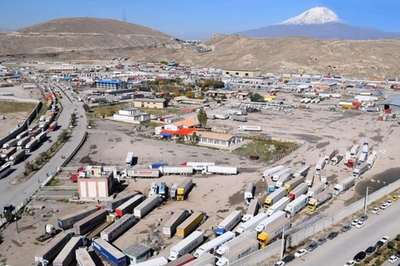
Iran has resumed wheat imports from Caspian Sea countries for the first time in three years, with the arrival of an initial shipment at Amirabad port in northern Mazandaran province, the semi-official Tasnim news agency reported on Monday.
“The first shipment of imported wheat, part of a 30,000-ton import permit and weighing nearly 5,000 tons, has reached Amirabad port and will soon be transferred to provincial silos,” said the head of Mazandaran’s Grain and Commercial Services, as quoted by Tasnim.
The move follows sustained efforts by provincial authorities to diversify wheat supplies and improve food quality amid recurring drought and local production challenges. Officials said mixing imported grain with domestic wheat is expected to enhance flour quality across the province.
Caspian nations including Russia, Kazakhstan, Turkmenistan and Azerbaijan are among the region’s key grain producers.
Mazandaran officials also discussed tighter oversight of the flour and bread supply chain, including mandatory GPS and camera systems for flour transport vehicles to prevent diversion and ensure transparency, Tasnim said.
Provincial economic deputy governor Mohammad Ebrahim Toulaei added that Iran aims to strengthen local mills and improve the quality of subsidized bread, while providing loans to bakers for upgrading dual-fuel and backup power equipment.
Iran acquitted dual German-French national Lennart Monterlos of espionage charges linked to the recent 12-day conflict, the head of Hormozgan Province’s judiciary said on Monday.
Lennart Christian Jean-Pierre Le Monterles, described by officials as a German citizen holding French nationality, had been arrested in southern Iran on suspicion of espionage during the conflict.
He was tried by the Revolutionary Court in Bandar Abbas, Hormozgan province’s chief justice Mojtaba Ghasemi said.
The official added that although prosecutors had filed an indictment, the court concluded there was insufficient evidence to prove guilt. Under Iranian law, the prosecutor retains the right to appeal the decision.
According to Le Monde, the 19-year-old is about to leave Iran and will be repatriated to France in the coming hours.
The verdict comes amid reports about Iran’s treatment of foreign detainees. Just last month, a British couple, Craig and Lindsay Foreman, appeared in court in Tehran on similar espionage charges after being held since January.
Their family has described “inhumane conditions” and accused authorities of extracting confessions through intimidation — claims Iran denies.
Western governments and rights groups say Tehran routinely detains foreign nationals to gain political leverage in disputes with Europe and the United States, an accusation Iran rejects, saying such cases involve genuine security concerns.
Iran-France prisoner talks advance
Iran and France signaled progress on Monday in negotiations to exchange two French citizens held in Iran for an Iranian national detained in France.
Iran has detained French nationals Cécile Kohler and Jacques Paris since 2022, while 18-year-old French-German cyclist Lennart Monterlos has been in custody since June.
France has repeatedly condemned their detention as arbitrary and accused Iran of subjecting them to harsh conditions in Tehran’s Evin prison -- allegations Tehran denies.
Iranian Foreign Minister Abbas Araghchi suggested last month that the two could be exchanged for Mahdieh Esfandiari, an Iranian woman arrested in Lyon in February on charges of promoting terrorism through social media.
“The decision regarding the release of these two individuals and Mrs. Esfandiari is currently being reviewed by the competent authorities,” Foreign Ministry spokesperson Esmaeil Baghaei said on Monday, adding that the exchange could happen soon once procedures are completed.
Also on Monday, French Foreign Minister Jean-Noël Barrot said on France Inter radio that Paris had solid prospects of securing their release in the coming weeks, adding that France “remains fully mobilized and demands their immediate and unconditional release.”
In September, France withdrew its case against Iran at the International Court of Justice over consular access violations, a move widely interpreted as a gesture to facilitate a potential deal.
Iran has accused Kohler and Paris of spying for Israel’s Mossad intelligence agency, charges both have denied.
The last prisoner swap between Iran and a European country came when Italy freed an Iranian national wanted by the United States for allegedly supplying Tehran with drone technology in exchange for an Italian journalist arrested in Iran.
Iran has in recent months repeatedly said that all espionage cases are handled through “legal and transparent” procedures, while maintaining that several Western intelligence networks have sought to infiltrate the country during periods of heightened regional tension.
Iran’s foreign ministry on Sunday expressed cautious support for Hamas’s response to Donald Trump’s Gaza ceasefire plan, but warned against what it called the proposal's dangerous dimensions and Israel’s alleged failure to honor past commitments.
Iran welcomes any decision “that would result in stopping the genocide of Palestinians, the withdrawal of the occupying Zionist army from Gaza, respect for the Palestinian people’s right to self-determination, the entry of humanitarian aid, and the reconstruction of Gaza,” the Foreign Ministry said in a statement.
However, it warned about the risks surrounding the ceasefire plan and the “dangerous aspects of this plan.”
It also cautioned against what it called Israel’s “obstruction (of peace efforts) and bad faith in fulfilling its promises—especially in light of the regime’s expansionist and racist schemes.”
Despite the risks, it said, “Tehran maintains that any decision on this matter rests with the Palestinian people and resistance.”
Trump said on Saturday that Israel had agreed to an initial withdrawal line in Gaza and that a ceasefire would take effect once Hamas confirms acceptance.
Hamas said it accepts several parts of Trump’s ceasefire plan including the release of Israeli hostages it is holding since October 7 2023, but added that some elements still require further negotiations.
On Sunday, Al-Arabiya quoted a Hamas source as saying that the Palestinian group had agreed to hand over its weapons to a Palestinian-Egyptian authority under international supervision.
However, a Hamas source denied the report later in the day, telling Qatar’s Al-Araby TV the claims were misleading, incorrect, and baseless.
Israeli Prime Minister Benjamin Netanyahu's office said on Sunday that an Israeli delegation led by Strategic Affairs Minister Ron Dermer will fly to Egypt on Monday to take part in talks on Trump's Gaza plan, also attended by White House special envoy Steve Witkoff and Trump’s son-in-law Jared Kushner.
The war in Gaza began after an attack on Israel on October 7, 2023 by Hamas militants, in which 1,200 people, mostly civilians, were killed and about 251 were taken hostage, according to Israeli figures.
Since then, more than 67,000 people, also mostly civilians, have been killed in Gaza, according to Hamas-run health authorities.
A court in Tehran has sentenced three prisoners of conscience from Iran’s ethnic minorities, including a woman, to death on charges of waging war against God, Norway-based rights group Hengaw said on Sunday.
The defendants were identified as Nasimeh Eslamzahi, a woman from Iran’s Baluch minority; her husband, Arsalan Sheikhi, from a Kurdish minority community in the northwest; and a third man identified only as Hassan.
Eslamzahi is being held in Gharchak prison near Tehran, while Sheikhi and Hassan are detained in Evin Prison in northern Tehran, Hengaw said.
The case was overseen by Judge Abolghasem Salavati, who is known for issuing harsh sentences in political cases and was sanctioned by the United States in 2019 for his role in what Washington described as “unfair trials” and multiple death sentences.
Hengaw said the defendants were accused of involvement in a 2023 bus bombing that killed an infant but denied the charges during their trial.
Eslamzahi was pregnant at the time of her arrest and gave birth to her daughter in prison. Hengaw said she and the baby were held for 40 days in solitary confinement in a cell with poor ventilation and inadequate lighting before being transferred to another ward.
The report comes a day after Iran executed seven political prisoners from ethnic minorities, including six Arabs and one Kurd, in what rights groups called a “grave violation” of international human rights and due process standards following torture and unfair trials.
According to Amnesty International, Iranian authorities have executed more than 1,000 people so far this year, the highest annual figure recorded by the group in at least 15 years.
Iran’s naval forces are fully prepared to confront any threat across its islands, coasts, and territorial waters, the Revolutionary Guards chief said during a visit to an IRGC naval base, warning that any move by adversaries will be met with a firm response.
“There is full preparedness so that if any move comes from the enemy, it will receive a strong response,” Major General Mohammad Pakpour said during a visit to naval units stationed on Abu Musa, Greater Tunb, Lesser Tunb, and Siri islands in the Persian Gulf.
He said the forces demonstrated high readiness and strong morale, adding that the same spirit that enabled Iranian forces to bring “the Zionist regime (Israel) and the United States to their knees” during the 12-day war in June remains in place.
Iran has long sought to highlight its military presence around the Strait of Hormuz, a strategic waterway for global oil shipments, amid heightened tensions with Western powers over its nuclear program.
About a fifth of the world’s oil and gas shipments pass through the chokepoint, which was a major flashpoint during the Iran-Iraq War in the 1980s.
Iranian officials have repeatedly threatened to close the strait as tensions with Israel and the United States flared in recent years.
In August, Iran staged its first major naval exercise since the June war with Israel. The two-day drill covered the Strait of Hormuz, the Gulf of Oman and the Indian Ocean.
IRGC commander Pakpour monitors a US destroyer on screen at a naval base in southern Iran