• العربية
  • فارسی
Brand
  • Iran Insight
  • Politics
  • Economy
  • Analysis
  • Special Report
  • Opinion
  • Podcast
  • Iran Insight
  • Politics
  • Economy
  • Analysis
  • Special Report
  • Opinion
  • Podcast
  • Theme
  • Language
    • العربية
    • فارسی
  • Iran Insight
  • Politics
  • Economy
  • Analysis
  • Special Report
  • Opinion
  • Podcast
All rights reserved for Volant Media UK Limited
volant media logo

US senator calls for military strike on Iran's nuclear facilities
Apr 24, 2025, 07:57 GMT+1Updated: 10:33 GMT+1

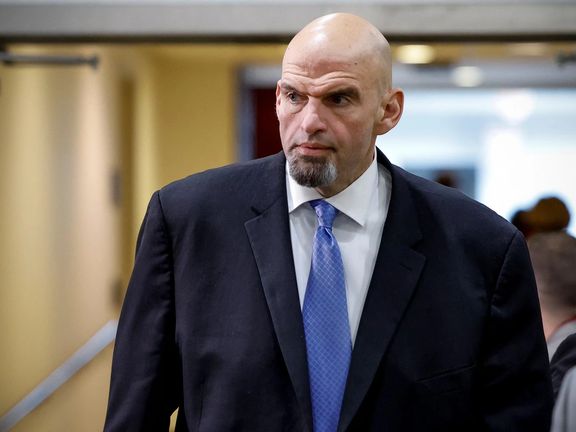
US Senator John Fetterman (D-PA) has called for the Trump administration to abandon nuclear negotiations with Iran and instead launch a military strike to destroy the country's nuclear facilities.

In an interview with the Washington Free Beacon published Wednesday, Fetterman advocated for decisive military action, saying, "Waste that s—t."

He argued that negotiations with Iran which he described as destabilizing the region for decades, are futile. "You're never going to be able to negotiate with that kind of regime...and now we have an incredible window, I believe, to do that, to strike and destroy Iran's nuclear facilities.”

Fetterman dismissed concerns from foreign policy experts who warn that a military strike on Iran would trigger a regional war, citing the recent conflicts involving Hezbollah, Hamas, and the Houthis as evidence that expert predictions are often inaccurate. "And remember, all of these so-called experts were all wrong."

Fetterman concluded that Iran, with its nuclear facilities, remains the primary threat. "So what's left? You have Iran, and they have a nuclear facility, and it's clearly only for weapons," he said.

On negotiations with Iran, Fetterman said, "Years ago, I completely understood why Trump withdrew from the Obama deal. Today, I can't understand why Trump would negotiate with this diseased regime. The negotiations should be comprised of 30,000-pound bombs and the Israel Defense Forces.”

Most Viewed

Iran diplomacy wobbles as factions compete to avoid looking soft on US
1
INSIGHT

Iran diplomacy wobbles as factions compete to avoid looking soft on US

2

IRGC-linked media hints at threat to Persian Gulf undersea internet cables

3
ANALYSIS

The politics of pink: how Iran uses cuteness to rebrand violence

4

Iran Guards say two ships seized in Hormuz after ceasefire extension

5

Scam messages seek crypto for ships’ safe passage through Hormuz, firm warns

Banner
Banner

Spotlight

  • As Tehran digs in, ordinary Iranians pay the price
    INSIGHT

    As Tehran digs in, ordinary Iranians pay the price

  • Internet Pro or Censor Pro? Iran rolls out a new service
    ANALYSIS

    Internet Pro or Censor Pro? Iran rolls out a new service

  • Strikes on petrochemical hubs leave Iran short of plastics
    EXCLUSIVE

    Strikes on petrochemical hubs leave Iran short of plastics

  • Diplomacy tolls at Hormuz as conflict returns to its doorstep
    OPINION

    Diplomacy tolls at Hormuz as conflict returns to its doorstep

  • Opposition to US talks grows in Tehran as ceasefire deadline nears
    INSIGHT

    Opposition to US talks grows in Tehran as ceasefire deadline nears

  • The future has been switched off here
    TEHRAN INSIDER

    The future has been switched off here

•
•
•

More Stories

Nuclear deal possible if US resists Israeli pressure, Iranian MP says

Apr 24, 2025, 07:31 GMT+1

A senior Iranian lawmaker said the outcome of the nuclear talks between Iran and the United States depends in part on whether Israel can influence the US position.

“If the malicious Zionist regime, which is actively trying to sabotage the process, fails to influence the American side, a brighter outlook lies ahead,” said Alaeddin Boroujerdi, a member of Iran’s national security and foreign policy commission on Thursday.

He said both Tehran and Washington are determined to reach an agreement, as “there is no alternative.”

Boroujerdi added the negotiations have moved into a more complex phase, and stressed that Iran will not abandon its nuclear rights.

“If the Americans want guarantees and to ease their concerns, they must offer concessions—namely, lifting sanctions,” he said.

Alaeddin Boroujerdi
100%
Alaeddin Boroujerdi

Iran-US talks likely to succeed, former UK ambassador says

Apr 23, 2025, 21:15 GMT+1

"I don't think (the talks) are going to fail, and that is because neither side has a better means of achieving its fundamental objectives," Sir Richard John Dalton, British Ambassador to Iran from 2002 to 2006, told the BBC in an interview on Wednesday.

"For the international community and the United States, that's a high level of assurance that Iran will stick to its commitments and never militarize its nuclear program, and for Iran that it gets some of its internationally linked economy back."

"Another reason for optimism is that President Trump's language has been consistent despite the threats which he should dial down," Dalton continued. "It's been consistent in expressing preference for sorting matters out through dialogue."

Dalton added that a statement by the foreign ministry of Oman, the country mediating the talks, following the latest US-Iran meeting on Saturday pointed to a framework for a successful deal.

"It included 'fair'. That means win-win, something for both sides. 'Enduring': this is vitally important because of the absence of any trust in Tehran that the United States is capable of sticking to agreements that it signs."

"'Binding': again endorsed by the international community, may be something which puts constraints on both sides that go beyond the actual words of the agreement. Then, 'Iran free of nuclear weapons' ... but Iran having its right to 'peaceful nuclear energy' that was in the Omani statement too, together with Iran being free of sanctions."

"Now this is the big win potentially for Iran, because its economy has been in tatters for many years, and the most significant threat to the survival of the regime is instability caused by potential breakdown of the economy," he said.

Netanyahu says battle with Iran to decide 'fate of all free societies'

Apr 23, 2025, 20:31 GMT+1

Israeli Prime Minister Benjamin Netanyahu on Wednesday called the Islamic Republic "a threat to the fate and the existence, not just of our own future, but the fate and the future of all mankind."

"This will be the outcome if it achieves nuclear arms. The battle between us and the empire of terror in Iran will determine the fate of all free societies," he said in a speech at the start of Israel's Holocaust Remembrance Day.

"We will prevent Iran from achieving nuclear weapons. We will fight the zealot regimes threatening the entire world. We shall fight forcefully against those regimes threatening the whole world," the Israeli prime minister said.

Netanyahu said if Israel "loses this war, the Western countries are next in turn. The wave of zealots will wash upon all of them, and it will happen much more quickly than they think."

100%

Iran opens door to restoring nuclear surveillance, UN watchdog says

Apr 23, 2025, 20:29 GMT+1

Iran has agreed to allow a technical team from the International Atomic Energy Agency (IAEA) to discuss restoring camera surveillance in Iranian nuclear facilities, the head of the UN nuclear watchdog said on Wednesday.

IAEA Director General Rafael Grossi confirmed the agency would send a technical team to Iran following his visit to Tehran this month.

Grossi said his impression is that the Islamic Republic's leaders are "seriously engaged in discussions... with a sense of trying to get to an agreement."

The UN body would be the party responsible for verifying Iran's compliance with a deal, Grossi said. "This will have to be verified by the IAEA.''

Behrouz Kamalvandi, the spokesman for the Atomic Energy Organization of Iran, said on Friday that a deputy to the head of the UN nuclear watchdog will visit Tehran in the coming two weeks to continue high-level technical talks.

Kamalvandi added that discussions aim to resolve recurring issues in IAEA reports that, according to Tehran, have contributed to mounting political pressure rather than advancing technical cooperation.

Rubio rules out allowing any Iranian uranium enrichment in deal

Apr 23, 2025, 17:37 GMT+1

"If Iran wants a civil nuclear program, they can have one just like many other countries in the world have one, and that is they import enriched material," US secretary of state Marco Rubio said in an interview with The Free Press podcast.

"There’s a pathway to a civil, peaceful nuclear program if they want one. But if they insist on enriching, then they will be the only country in the world that doesn’t have a 'weapons program,' quote-unquote, but is enriching. And so I think that’s problematic."

The UN nuclear watchdog said last month that Iran is only non-nuclear armed state enriching uranium to 60%. Several countries which do not possess nuclear weapons, including Japan, Brazil, Germany and the Netherlands, enrich uranium at lower levels.