• العربية
  • فارسی
BrandBrand
  • Iran Insight
  • Politics
  • Economy
  • Analysis
  • Special Report
  • Opinion
  • Podcast
  • Live TV
  • Iran Insight
  • Politics
  • Economy
  • Analysis
  • Special Report
  • Opinion
  • Podcast
  • Live TV
  • Theme
  • Language
    • العربية
    • فارسی
  • Iran Insight
  • Politics
  • Economy
  • Analysis
  • Special Report
  • Opinion
  • Podcast
  • Live TV
All rights reserved for Volant Media UK Limited
volant media logo

‘Repentance room’ in Tehran metro station fans flames of hijab war

Feb 23, 2025, 10:08 GMT+0Updated: 13:21 GMT+0
A screengrab from a video showcasing an exhibit to promote hijab at Tajrish subway station in Tehran (February 2025)

A new high-tech public art display at a Tehran metro station aimed at cajoling women into wearing hijabs has been met with scorn by some Iranians describing the immersive exhibit as a state-backed "repentance room."

A video showcasing the interactive installation at Tajrish station established by the Tehran municipality and run by the Daughters of the Revolution group aired on state television Tuesday.

The group, known for promoting an Islamic lifestyle and championing the Islamic veil is headed by Bahareh Jangravi, who said the project was a means of spreading the importance of wearing the hijab, in the wake of a national mass rebellion against the Islamic Republic's mandatory dress code.

The video shows women whose attire violates hijab rules weeping in the room. They are then offered headscarves by metro officials and encouraged to comply with the theocracy's strict regulations.

Concerns have also been raised on social media platforms about the authenticity of the video, with some suggesting that the women depicted either paid actors or women acting under duress.

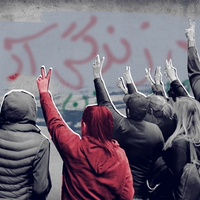
Jangravi explained that her group's name, "Daughters of the Revolution," was chosen in response to the "Girls of Enghelab (Revolution) Street" movement, a wave of symbolic protests against mandatory hijab inspired by activist Vida Movahed's 2017 public act of defiance.

100%
Vida Movahed protesting against compulsory hijab in Tehran in December 2017

The interactive installation also features images of slain Islamic Revolutionary Guard Corps commanders and other figures revered by the Islamic Republic.

They include the slain commander of the IRGC foreign operations arm Qassem Soleimani and Hamas leader Yahya Sinwar. The two figures revered by Iran's military-clerical establishment were killed by the United States and Israel, respectively.

The exhibit is a scaled model of the shrine of Imam Husayn ibn Ali, the third Shia Muslim Imam. Through VR goggles, visitors can explore a lifelike virtual rendering of the actual shrine and its surroundings in Karbala, Iraq.

The initiative has drawn widespread criticism, with many viewing the room as an inappropriate use of public space to enforce the government's ideological agenda.

Critics question the municipality's involvement, arguing it oversteps its mandate and diverts resources from pressing urban issues.

Similar controversies have surrounded previous actions by the municipality, such as the deployment of "hijab guards" in metro stations and the burial of "unknown martyrs" at universities and recreational sites, along with the construction of mosques in parks.

The controversy highlights the ongoing struggle over hijab enforcement in Iran since the nationwide Woman Life Freedom protest movement following the death of 22-year-old Mahsa Amini in the custody of morality police in September 2022.

A large number of women in Tehran and other major cities continue to defy the mandatory hijab, a trend that began with the 2022 protests.

The widespread non-compliance has strained police enforcement efforts, prompting the government to explore alternative methods, including a controversial new bill that emphasizes fines, deprivation of public services and the so-called cultural initiatives over direct confrontation.

Most Viewed

‘We cannot bring America to its knees,’ former Tehran mayor says
1

‘We cannot bring America to its knees,’ former Tehran mayor says

2

Iran’s strikes on Persian Gulf water and power were deliberate - Reuters

3

Tehran hospital locks its main building and treats patients in the courtyard

4

Iran speaker says government overstepped on anti-terror finance rules

5

Iran shipped jet fuel to Myanmar despite US blockade - Reuters

Banner
Banner
Banner
Banner
Banner

Spotlight

  • Iran cultivated Houthis for years before opening new war front, Yemeni insider says
    PODCAST

    Iran cultivated Houthis for years before opening new war front, Yemeni insider says

  • After the killings, Iran turned on the families of the dead

    After the killings, Iran turned on the families of the dead

  • Iran’s rulers face a reckoning with their own people, former US envoy says
    ONE-ON-ONE

    Iran’s rulers face a reckoning with their own people, former US envoy says

  • Iran speaker says government overstepped on anti-terror finance rules

    Iran speaker says government overstepped on anti-terror finance rules

  • Ignore prices and economy is fine, Iran ex-minister says

    Ignore prices and economy is fine, Iran ex-minister says

  • Iran police killed brothers celebrating Khamenei’s death, source says

    Iran police killed brothers celebrating Khamenei’s death, source says

  • Nowhere else to go? The puzzle behind Iran’s stock rally
    INSIGHT

    Nowhere else to go? The puzzle behind Iran’s stock rally