Three-Quarters Of Iranians Will Boycott Elections

A recent survey has shown that the majority of Iranians will boycott the upcoming parliamentary elections, with 75 percent seeking the overthrow of the government.
A recent survey has shown that the majority of Iranians will boycott the upcoming parliamentary elections, with 75 percent seeking the overthrow of the government.
A survey by the Netherlands-based Gamaan institute collected information from 58,015 Iranian residents over an eight-day period from January 31 to February 7. Titled “Iranians’ Attitudes Toward the 2024 Elections,” the survey targeted people aged 19 and above, a sample from 90% of the country's literate adult population.
Several balancing techniques were used to ensure that the demographics and characteristics of the sample closely mirror those of the population, but the survey was conducted via a specialized platform for sampling on the internet, which is not openly accessible to all Iranians. Although such methods help mitigate the risk of bias in the results, the sample may not accurately represent the population as most people who use censorship circumvention tools to access the internet are critical of the regime.
The survey by the non-profit research foundation provides a nuanced understanding of voter sentiments and preferences as the nation approaches a pivotal moment in its political trajectory, the first election after the 2022 popular uprising. The nationwide protests, ignited by the death of 22-year-old Mahsa Amini, were the boldest challenge the regime witnessed since its establishment in 1979.
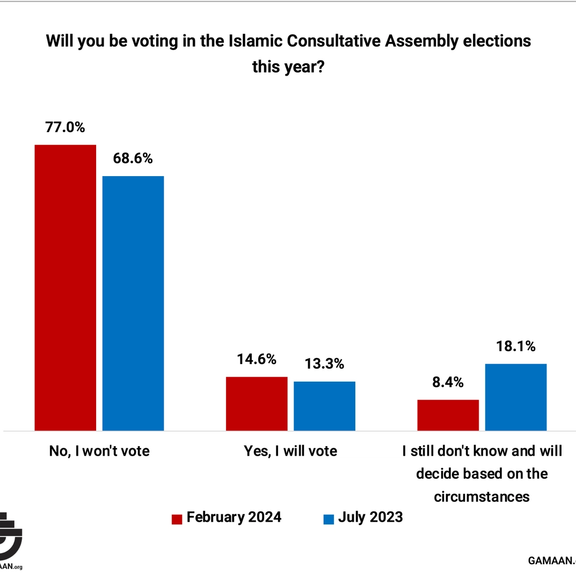
While a staggering 77 percent of respondents expressed their intention not to participate in the upcoming elections, eight percent of respondents remain undecided, while only around 15 percent expressed a definite intention to vote on March 1.
Underlining deep skepticism towards the efficacy of the electoral process in effecting meaningful change within the country, the survey revealed that approximately 38 percent of respondents were unaware of the exact date of the upcoming elections.
Additionally, 39 percent of those who voted in the previous round of parliamentary elections in 2019 do not intend to vote this year. Among people who are legally allowed to vote for the first time, 65 percent expressed their disinclination towards participating in the upcoming polls.
On SUnday, Iran's ruler, Ali Khamenei, made a fervent appeal for voter turnout in the March 1 elections, amidst indications of a potential low participation rate, signaling a declining legitimacy.
A sobering finding was the high number of people who would vote against the Islamic Republic in case of a referendum. In a hypothetical plebiscite with the question “Islamic Republic: Yes or No?” around 75 percent would vote “No,” 16 percent “Yes,” and about nine percent are unsure.
The survey also delved into Iranians' perspectives on alternative avenues for effecting societal change, contrasting electoral participation with participation in protests. Notably, approximately one-third of respondents (33 percent) considered participation in protests as a more effective means of effecting change, while around 13 percent viewed electoral participation as preferable. Additionally, around one-third of respondents (33%) expressed skepticism towards the efficacy of both methods in catalyzing meaningful change within the nation.
Replying to a question about their political orientation, 40 percent of the participants favored overthrowing the Islamic Republic as a precondition for any change and 25 percent voted for structural transformations and a transition from the Islamic Republic, while 11 percent supported preserving the principles and values of the Islamic Republic regime. Nine percent of the respondents expressed support for gradual reforms within the framework of the Islamic Republic system and 14 percent did not identify with any of these options.
The survey also explored Iranians' attitudes towards the ongoing conflict between Israel and Hamas. Responses indicated varying perceptions regarding the primary instigator of the conflict, which started after Tehran-backed Islamist militia Hamas invaded Israel and killed 1,200 people on October 7. Approximately 35% attributed the blame to Hamas, 20% to Israel, and 31% believed both parties were responsible.