Macron, Biden Eye-To-Eye On Iran as Hillary Clinton Rules Out Talks

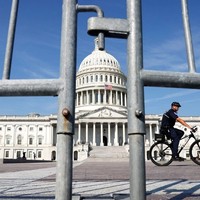
A joint statement marking French President Emmanuel Marcon’s visit to the White House expressed “respect for the Iranian people, in particular women and youth.”
A joint statement marking French President Emmanuel Marcon’s visit to the White House expressed “respect for the Iranian people, in particular women and youth.”
With an array of celebrities at a red-carpeted state dinner Thursday, Secretary of State Antony Blinken told France 2 TV he would support the French team if the United States were knocked out of the World Cup. The joint presidential statement called France the US’s oldest ally.
The two countries were at one in supporting global human rights and in Middle East policy, the presidents’ statement said. This included a “just solution to the Syrian conflict,” where US troops remain in the north east, backing the Abrahamic Accords, by which some Arab states have recognized Israel ahead of Palestinian statehood, and a determination that “Iran can never develop or acquire a nuclear weapon.”
While the statement expressed commitment to “democratic values,” respect for international law, and international cooperation to address Iran’s “nuclear escalation,” the Washington political mood is increasingly polarizing the US and western Europe on one side, against Iran, China, and Russia on the other.
Republicans and Democrats are vying to push harder. Senator Mario Rubio, an advocate of more US weapons for Israel, Wednesday demanded that President Joe Biden look into whether the Chinese tech company Tiandy’s involvement in Iran “raises serious questions about whether its products are being used against peaceful Iranian protesters.”
‘Barbaric treatment’
In a 20-minute interview for CNN, former secretary of state Hillary Rodham Clinton envisaged US foreign policy as a struggle for women’s rights. Highlighting violations by Russia, Iran and the Afghan Taliban, Clinton called for an “absolute rejection of using sexual attack as a weapon of war,” for holding leaders accountable for “barbaric treatment,” and for stepping up sophisticated arms supplies to Ukraine, including from Israel, whose new government needed to understand “Iran and Russia have made an alliance.”
Clinton explained her approach as secretary of state to protests in Iran after the disputed 2009 presidential election as due to intelligence assessments that “overt American support would actually hurt” and that “behind the scenes” activity was better. “Now it’s very different, what’s happening now deserves our full-throated support,” she said.
“I would not be negotiating with Iran on anything right now, including the nuclear agreement,” Clinton continued. With the US withdrawal in 2018 from the 2015 Iran nuclear agreement, “that horse is out of the barn,” she said, while the International Atomic Energy Agency (IAEA) had lost its “eyes” on Iran’s nuclear program as Tehran reduced the agency’s access in response to US sanctions and attacks on its atomic sites.
Clinton suggested that maintaining US ‘maximum pressure’ sanctions was to force “regime change” but rather to spark “internal discussions” in Iran, “not just [within] the government … but [within] the clerics.” This tied in with Rob Malley, the White House special envoy for Iran, telling Foreign Policy magazine in an interview this week that “the Iranian system is divided.”
‘Active diplomatic track’
The Biden administration’s approach is not without critics. Much of the ‘global south’ is increasingly wary of US ‘exceptionalism,’ accusing the US of hypocrisy and double standards. The US-France presidents’ statement expressed support for the International Criminal Court, which Washington has refused to join. Both India and Pakistan abstained on the recent US-sponsored resolution condemning Iran at the IAEA governing board. South Africa and Brazil are among those refusing to take sides over Nato and Ukraine.
Nor is opposition to talks with Iran unanimous, in the US or Europe. In the Washington Post Thursday, Ellie Geranmayeh, of the European Council on Foreign Relations, argued for “an active diplomacy track to reverse Iran’s nuclear conduct before it is too late.” Rejecting the case for more and more sanctions, she argued there was “little evidence” they had worked, since Iran had “escalated its behavior” in response.
“It is irresponsible to risk everything on the hope that a peaceful transition of power will place Iran’s nuclear program under democratic and safe control anytime soon,” Geranmayeh wrote.
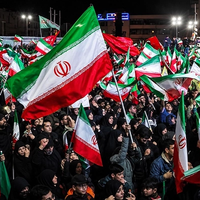
But the issue now is not just nuclear escalation. It is also the deadly violence the Islamic Republic is using against antigovernment protesters, which leaves little room for sanctions relief. More than 450 protesters have been killed since mid-September while several have been sentenced to death.