Biden, Merkel, Johnson, Macron Meet In Rome To Discuss Iran

US President Joe Biden has met with the British, French and German leaders in Rome to discuss strategy and coordination regarding Iran's nuclear program.
US President Joe Biden has met with the British, French and German leaders in Rome to discuss strategy and coordination regarding Iran's nuclear program.
UK Prime Minister Boris Johnson, French President Emmanuel Macron, German Chancellor Angela Merkel and Joe Biden met on the sidelines of the G-20 summit in Rome to discuss the next steps on Iran's nuclear program.
The four posed for a group photo before they went behind closed doors for their consultations.
Biden's meeting with the leaders of Germany, France, and Britain - known as the E3 - comes at a pivotal time, as Iran continues to enrich uranium to near-weapons-grade levels.
Biden is trying to revive the 2015 nuclear deal and bring Iran back into compliance with the pact that would have kept the Islamic republic at least one year away from the potential to field a nuclear weapon.
US national security adviser Jake Sullivan said the meeting would feature the leaders “all singing from the same song sheet on this issue.”
Amidst tense relations between France and Britain over post-Brexit fishing rights, Johnson and Macron walked away from the photo with arms around each other.
Report by AP




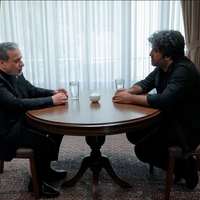




The US and its allies may now be more willing to impose penalties if Iran continues acting in violation of its nuclear deal and delaying talks to revive it.
Sources in Washington told the CNN Friday that US officials are very skeptical of any breakthrough in renewed nuclear talks with Iran over the agreement, the Joint Comprehensive Plan of Action (JCPOA), and are "actively" discussing imposing new penalties on Tehran.
"They say the US and its allies are now more willing to impose a higher cost on Iran for failing to come to an agreement if Tehran continues to take actions that are inconsistent with the 2015 nuclear deal and bring it closer to developing a nuclear weapon," CNN reported.
The sources cited would not provide details of these costs might be, the network reported. Washington under its ‘maximum pressure’ sanctions already threatens punitive action against any third countries or parties dealing with Iran, and has sanctioned most senior Iranian officials including President Ebrahim Raisi (Raeesi) and Supreme Leader Ali Khamenei.
The US and the European powers express concern about Iran’s uranium enrichment to a high level of purity − some of which they claim has no civilian use − and other knowledge and experience Tehran has gained in building up its nuclear program since the US left the JCPOA in 2018.
On June 20, two days after the election of Raisi to the presidency, Iran suspended the talks that began in Vienna in April. Since then the new administration has been reviewing the process and only recently said it expected talks – at least with remaining JCPOA members – to resume by the end of November.
President Joe Biden, who is in Rome for the G20 summit this weekend, will discuss possible coordination over Iran with leaders of the three European powers – France, Germany and Britain – who are JCPOA signatories, along with China and Russia. The ‘E3’ have called on both the US and Iran to respect the JCPOA.
Iran’s Foreign Minister Hossein Amir-Abdollahian reiterated Wednesday that Biden should show goodwill by ‘allowing’ the release of $10 billion of Iran’s funds frozen by Asian banks wary of US punitive action.
Deputy Foreign Minister Ali Bagheri-Kani has also stressed that talks can succeed only with the full removal of sanctions as required by the JCPOA. It has been widely reported that in recent discussions with the European Union, Tehran has sought guarantees from other JCPOA signatories that the US could not again leave the JCPOA once it returned.
Iran's Foreign Ministry Spokesman Saeed Khatibzadeh said that fresh sanctions on Iranian entities and persons imposed by the US Treasury Friday contradicted Washington’s claim of willingness to revive the JCPOA and showed the Biden administration was continuing the approach of former President Donald Trump.
The US Treasury sanctioned companies and individuals connected with Iran’s military drone development. A recent drone attack on US troops in southern Syria who train forces fighting to overthrow President Bashar al-Assad was, officials said, “resourced and encouraged” by Iran.
“Together with other JCPOA members and the United States, which we have been talking about for more than four months, we are ready to resume negotiations as soon as Iran agrees to set a date,” said a French foreign ministry spokesman Friday.
A US official familiar with the talks told CNN that Iran's public pronouncements "don't give us a huge amount of optimism" and that there was little indication that Iran was intent on resolving the outstanding issues. There was no reason to be optimistic, he said.
Iran could be trying a number of strategies. First, it might be trying to buy time, believing that with is rapid enrichment of uranium it can gain more leverage in the talks. Or, it can be trying to extract more concessions on the removal of US sanctions.
New talks between Iran and world powers will only be successful if they remove US sanctions, Iran’s chief negotiator and Russian foreign ministry have said.
Ali Bagheri Kani, who is also deputy foreign minister, met with his Russian counterpart Sergei Ryabkov in Moscow on Friday, where they discussed the Iran nuclear talks with the United States and the remaining members of the 2015 nuclear agreement, the JCPOA.
Iran’s official government news website IRNA quoted the two diplomats as saying after their meeting that “The new talks will only be successful if they lead to the removal of sanctions and the full implementation by the parties of their commitments.”
Bagheri Kani was quoted earlier as saying that Iran is negotiating with 4+1, which are three European members of the JCPOA, Russia and China, while the nuclear talks earlier this year in Vienna also included the United States on the sidelines negotiating indirectly.
Bagheri had also emphasized that Iran will carry on discussions on bilateral basis with 4+1. There are also reports that Iran is willing to meet with the remaining members of JCPOA collectively, but intentionally or not, Iranian statements seem to be often different from one another.
At the same time, Iran’s Foreign Minister Hossein Amir-Abdollahian demanded on Wednesday that the US must show “goodwill” and release $10 billion of Iran’s frozen funds to help advance the talks, while Bagheri who met with the EU negotiator Enrique Mora in Brussels on Wednesday said the Vienna talks will resume by the end of November.
Asked in Moscow on Thursday if there is a more concrete date, Bagheri said, “What is more important in the new round of negotiations is the readiness of the other side to make serious decisions about lifting sanctions.”
On Friday Bagheri was quoted as saying that the United Kingdom, France and Germany “also need to live up to their commitments [under JCPOA] and work to remove the illegal sanctions.”
It is not clear if Tehran is demanding the lifting of US sanctions before a new agreement on reviving the JCPOA is reached, but it seems it is demanding something beyond what has already been agreed in Vienna.
Iran could be trying a number of strategies. First, it might be trying to buy time, believing that with is rapid enrichment of uranium it can gain more leverage in the talks. Or, it can be trying to extract more concessions on the removal of US sanctions. Any new concession by the United States now can relieve pressure on Iran which has to make its own concessions.
Iranian state network Press TV reporting on the Moscow meeting said, “The scope of the sanctions removal and the need for the US to guarantee that it would not ditch the JCPOA again are among the key issues not settled during the administration of former Iranian President Hassan Rouhani.”
If Tehran can get support from the other world powers on the issue of sanctions, it can hope to isolate the United States.
Bagheri also emphasized in Moscow that Russia and China "share common views on regional and international issues [with Iran], including the nuclear agreement, officially called the Joint Comprehensive Plan of Action (JCPOA)."
President Joe Biden will discuss Iran with the leaders of the UK, Germany and France on the sidelines of the G20 meeting this weekend, National Security Advisor Jake Sullivan said on Thursday. He emphasized that Biden’s aim is to coordinate the Western position in the nuclear talks.
This cannot come too soon for the United States as Iran delays multilateral negotiations and tries to build up leverage.
Iran and world powers are trying to agree on a date for the resumption of nuclear talks in Vienna as soon as possible, an EU spokesperson said on Friday.
Iran's top negotiator said after talks in Brussels this week that negotiations in Vienna will resume by the end of November.
EU spokesperson Peter Stano said the October 27 meeting in Brussels was "useful" and "helped to define a way forward to resume negotiations in Vienna".
"We are working together with other partners, including Iran and other signatories (of the Iran nuclear deal - JCPOA), to fix a concrete date as early as possible to reconvene in Vienna," Stano told a regular briefing.
In April, Tehran and six powers started to discuss ways to salvage the 2015 nuclear pact, which three years ago then-US President Donald Trump abandoned. Trump then reimposed sanctions on Iran that have devastated its economy by squeezing its oil exports.
But the talks have been on hold since the election of Iran's hardline President Ebrahim Raisi in June, who is expected to take a tough approach if the talks resume in Vienna.
Reporting by Reuters
Iran’s chief nuclear negotiator visiting Moscow suggested late Thursday that his country is not negotiating with the United States, but with other world powers.
Ali Bagheri Kani who traveled to Moscow on Thursday after a trip to Brussels the day before, spoke with Islamic Republic News Agency, IRNA and in response to a question about the US welcoming Iran’s decision to return to the nuclear talks, said, “Our discussions are with 4+1”.
The four powers Bagheri referred to are four of the five permanent members of the United Nations Security Council, minus the United States. Germany is the fifth country, which was a signatory of the Joint Comprehensive Plan of Action (JCPOA) but not a permanent member of the Council. While the 4+1 have remained in JCPOA, the United States withdrew from the agreement in 2018.
Negotiations that began in Vienna in April after President Joe Biden assumed office and expressed his intention to restore the 2015 Iran nuclear deal, involved the four Security Council members directly meeting with Iran, plus the United States negotiating on the sidelines of the group, with the mediation of its three European allies.
After leaving the Vienna format in June and delaying its return until now, Iran seems to be trying to avoid the quicker, on-the-spot Vienna talks, leaving the US out of a more direct involvement in the negotiations.
Bagheri also told IRNA that Tehran will continue discussions on a bilateral mode with JCPOA participants, meaning 4+1.
So far it appears that Tehran is trying to negotiate with Enrique Mora, the chief European Union coordinator of the Vienna talks and with Russia, and has not met with the UK, France and Germany.
At the same time, Iran’s Foreign Minister Hossein Amir-Abdollahian demanded on Wednesday that the US must show “goodwill” and release $10 billion of Iran’s frozen funds to help advance the talks, while Bagheri in Brussels said the Vienna talks will resume by the end of November.
Asked in Moscow if there is a more concrete date, Bagheri said, “What is more important in the new round of negotiations is the readiness of the other side to make serious decisions about lifting sanctions.”
From the foreign minister’s demand for the release of $10 billion and Bagheri’s claim that currently there is a new format of talks hinging on US lifting sanctions, it seems Iran has departed from the logic of the Vienna talks and is putting forth new conditions.
In Vienna, the talks were about charting a course for the “mutual return” of Iran and the US to the JCPOA. This meant negotiating a sequence of steps and actions that would lead to an eventual restoration of all JCPOA obligations. Lifting US sanctions was an important part of that sequence, which Iran seems to want to change now, asking for money before the process of returning to the agreement is negotiated.
US National Security Advisor Jake Sullivan outlined US priorities Thursday in advance of the G20 summit this weekend, including the issue of Iran nuclear talks.
President Joe Biden is expected to discuss with the leaders of three European allies, Chancellor Angela Merkel of Germany, President Emmanuel Macron of France and the British Prime Minister Boris Johnson the coordination of the Western position in the talks to revive the Joint Comprehensive Plan of Action, JCPOA.
“It's an opportunity to closely coordinate with our key European partners at the leader level on a joint negotiating position as we work towards a resumption of negotiations,” Sullivan told a briefing in Washington.
After four months of staying away from multi-lateral talks in Vienna, Iran announced on Wednesday that it will return to negotiation until the end of November, but Tehran delaying tactic has led to uncertainty about its real intentions.
Iran’s Foreign Minister Hossein Amir-Abdollahian said on Wednesday that Tehran expects Biden to show “goodwill” and release $10 billion of Iran’s frozen funds before talks take place.
"It's not entirely clear to me yet whether the Iranians are prepared to return to talks. We have heard positive signals that they are, but I think we have to wait and see when and whether they actually show up at the negotiating table, and we're prepared to negotiate in good faith for a return to mutual compliance with the JCPOA. We hope they are as well,” Sullivan said about how Washington perceives Iran’s moves.
Sullivan argued that the Biden Administration has much closer cooperation with its European allies than the Trump administration, which abandoned the JCPOA and imposed ‘maximum pressure’ sanctions on Tehran. The national security advisor said this is “one of the most profound divergence between the previous administration and the European.”
He went on to say, “Here you'll see Chancellor Merkel, President Macron, Prime Minister Johnson, President Biden all singing from the same song sheet on this issue."
The United States and the European powers are seriously concerned about Iran’s enrichment of uranium to a high level of purity, which has no civilian use and other knowledge Tehran’s nuclear program might gain, as negotiations are delayed.
“It's also an opportunity to level set on our understanding of Iran's progress on the nuclear program since they left the JCPOA. And obviously, we all have deep concerns about the forward progress of that program since the lid was lifted and they began to operate outside of the constraints of the JCPOA," Sullivan maintained in another indirect criticism of the Trump administration’s decision to withdraw from the agreement.
But critics of the Biden administration say that the JCPOA was a weak agreement, with restrictions that would expire in the coming years and would allow Iran to pursue a nuclear weapons program. The US is pursuing to restore a deal that has already lost its usefulness, they say.
Although the administration has condemned former president Donald Trump’s withdrawal from the JCPOA, but it has kept the sanctions in place to force Iran to negotiate.