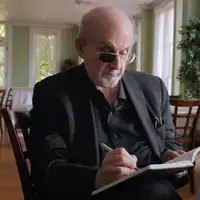
Salman Rushdie writes in a notebook in a frame from Alex Gibney’s documentary Knife: The Attempted Murder of Salman Rushdie.
Salman Rushdie says he never intended The Satanic Verses to provoke the reaction that followed its publication, in a new documentary revisiting Ayatollah Ruhollah Khomeini’s 1989 fatwa calling for his death and the attempt on his life 33 years later.
Rushdie argues that fiction should not be treated as a literal statement of reality. If a novelist writes that a horse can fly, he says, it is an act of imagination and does not mean that a horse is actually flying.
The documentary traces the decades-long consequences of the fatwa, from the controversy surrounding The Satanic Verses and the years Rushdie spent in hiding to the 2022 knife attack that nearly killed him.
Directed by Alex Gibney and based on Rushdie’s bestselling memoir Knife, Knife: The Attempted Murder of Salman Rushdie includes previously unseen footage of his recovery and reflections on a threat that appeared to have receded after Iran publicly distanced itself from efforts to kill him in 1998.
Among the most affecting images are those filmed by Rushdie’s wife, poet and writer Rachel Eliza Griffiths, as he lies in hospital after the attack. When he regains consciousness, despite his condition, Rushdie gives permission for the filming to continue.
“This isn’t just about me; it’s about freedom,” he says.
The documentary returns repeatedly to Iran, showing archival footage of Khomeini’s fatwa being announced on Iranian radio and demonstrations in London where protesters carried photographs of the Iranian leader.
It also recalls the multimillion-dollar reward offered for Rushdie’s killing. The man who attacked him in 2022 later told a court that he admired Khomeini.
Rushdie reflects on people who condemned a book they had barely read and remarks that many devils pretend to believe in God.
He also places the fatwa in the political circumstances of Iran at the time, saying the revolution had not gone well and that the war with Iraq had left the government in a difficult position. He says he ultimately became a casualty of that situation.
For years, Rushdie lived under protection and in hiding. That appeared to change in 1998, when Iran and Britain reached an understanding that paved the way for improved relations.
Iran’s foreign minister publicly declared that the government would neither threaten Rushdie’s life nor encourage others to do so. Two years later, Rushdie moved to the United States and gradually began leaving behind the security arrangements that had defined much of his life.
Looking back after the attack, he asks: “Did I make a mistake?”
The documentary also shows how the 2022 stabbing was received in Iran, including a front page of the newspaper Jam-e Jam depicting Rushdie in the form of the Devil.
The attack itself is initially reconstructed, with the actual footage appearing only near the end. Rushdie was repeatedly stabbed while preparing to speak at an event in New York state, leaving him blind in one eye and with severe injuries.
Rushdie later returns with Griffiths to the site of the attack and stands where he was nearly killed.
“Now I am standing in the place where I once fell,” he says, adding that he does not believe in miracles but describes his survival as “miraculous.”
The contrast with his attacker is one Rushdie also reflects on: he has continued to live and write, while the man who attacked him at the age of 24 is now in prison.
More than three decades after Khomeini’s fatwa transformed his life, the documentary finds Rushdie still defending the freedom at the heart of the original controversy: the freedom of a novelist to imagine.
Montenegro will extradite Iranian-Turkish hacker Amir Barati to the United States, where he faces charges over a sweeping cyber campaign that US prosecutors say stole research and data for Iran’s Revolutionary Guards and other entities.
The High Court in Podgorica approved Barati’s extradition under a simplified procedure and notified Montenegro’s Justice Ministry, local newspaper Vijesti reported Tuesday.
“The Ministry of Justice has informed the US Department of Justice,” Justice Minister Bojan Božović told the newspaper, adding that the remaining procedures would be carried out with police.
Barati, 39, was arrested on June 25 while visiting the coastal Montenegrin town of Kotor, in an operation involving local police and the FBI. He holds both Iranian and Turkish citizenship.
His extradition brings US authorities closer to putting on trial a man whose hacking career Iran International previously traced from underground cyber groups to alleged work for Iran’s Intelligence Ministry.
US prosecutors last month named Barati among 17 people charged over their alleged work with the Tehran-based Mabna Institute, which the Justice Department says conducted hacking operations for Iranian government entities, including the IRGC.
The Justice Department alleges the group targeted more than 100,000 professors and compromised about 8,000 accounts at 144 US universities and 178 universities abroad between 2013 and 2017. More than 31 terabytes of academic data and intellectual property were stolen, according to prosecutors.
Barati specifically helped track spearphishing campaigns, exchange credentials from compromised accounts, prepare lists of targets, conduct network reconnaissance and craft phishing messages, prosecutors said.
He faces seven counts, including conspiracy to commit computer intrusions and wire fraud, computer fraud, wire fraud and aggravated identity theft. The indictment remains allegations, and Barati is presumed innocent unless convicted.
‘Kinglet’
An Iran International investigation published after his arrest traced Barati’s hacking career much further back.
Born in Mashhad in 1986, Barati founded the Iran Black Hats Team in his early twenties and later co-founded Digital Boys Underground Team, operating online under the alias “Kinglet.”
Archived records reviewed by Iran International linked the groups to hundreds of attacks on academic, commercial and government websites, including systems associated with NASA, Microsoft, MIT and the US military.
His relationship with Iran’s security establishment appears to have shifted after his arrest by the Intelligence Ministry in 2010.
Multiple sources familiar with his activities told Iran International that authorities subsequently recruited Barati rather than pursuing him, turning him into an intelligence asset.
Court records reviewed by Iran International showed that a one-year prison sentence against him was never enforced despite reaching the enforcement stage. Iran International could not independently verify claims that the Intelligence Ministry intervened to protect him.
Barati left Iran for Turkey in 2021. He later obtained Turkish citizenship and changed both his first and last names through a Turkish court.
Sources told Iran International he subsequently avoided travelling to Europe until June, when he was arrested while on holiday in Montenegro despite travelling under his new identity.
The Justice Department’s August indictment later publicly confirmed Barati’s alleged role in the Mabna network for the first time, resolving a question raised after his arrest over how his case was connected to the long-running IRGC-linked university hacking campaign.
A general view of the Australian Senate chamber at Parliament House in Canberra.
Four senior Australian opposition politicians have backed a role for Reza Pahlavi in a political transition in Iran and urged closer engagement with the exiled prince, telling Iran International they have invited him to visit Australia.
The Coalition politicians said they supported peaceful political change in Iran and planned to meet Pahlavi virtually. No date has been announced for the meeting or a possible visit.
“We want to see peaceful political change in Iran. We don't support the current regime,” Senator Dave Sharma, Shadow Assistant Minister for Citizenship and Multicultural Affairs, told Iran International.
“We think it's done immense harm not only to its own people, but to the neighbourhood, the region, and even to the world here in Australia.”
Iran International also spoke to Senator Andrew Bragg, Shadow Minister for Environment; Senator Jessica Collins, Chair of the Senate Foreign Affairs, Defence and Trade References Committee; and Julian Leeser, Shadow Minister for Education.
Coalition seeks engagement with Pahlavi
Engagement with Pahlavi is one of the Coalition's most important foreign policy objectives because of the role it believes he could play during a transition, Bragg said.
Senator Andrew Bragg, Australian Shadow Minister for Environment
“For the coalition, having a meeting with the Crown Prince is one of the most important foreign policy objectives that we have, because we believe that meeting with this key transitional figure is the best way to move the conversation on to a new government for Iran,” Bragg told Iran International.
Bragg described the Islamic Republic as “probably the worst government and the worst regime on the planet” and accused it of crimes against Iranians and sponsoring terrorism abroad, including in Australia.
The senator argued that political change would be difficult without serious international engagement with an alternative.
“This government will never be moved on unless we engage seriously with an alternative, and the alternative that we have as a transitional figure is the Crown Prince,” Bragg said.
Collins also described Pahlavi as “an important symbol of anti-regime and pro-democracy” and said the Coalition would continue engaging with him and hearing about the challenges facing Iranians.
The four lawmakers plan to hold a virtual meeting with Pahlavi ahead of a possible visit to Australia. The Coalition has extended an invitation for the visit, but no date has been announced for either the talks or the trip.
Peaceful political change
Pahlavi is an influential voice in Iranian politics, with many Iranians around the world looking to him for leadership, Sharma said.
The Coalition’s outreach aims to build a clearer picture of events inside Iran and support political forces seeking change, said Sharma, a former Australian ambassador to Israel.
“I think having the Crown Prince visit Australia will help show the Australian people that there are prospects for a brighter political future in Iran,” Sharma said.
“There are many Iranian people who want this to happen, and that he will play an important part in any transition.”
Senator Dave Sharma, Australian Shadow Assistant Minister for Citizenship and Multicultural Affairs
A visit could also renew Australian public attention on Iran following the authorities' deadly suppression of nationwide protests in January, Sharma said.
Leeser said the invitation was intended to give Australian politicians an opportunity to hear Pahlavi's assessment of conditions inside Iran and his vision for the country's future.
“The coalition has decided to invite Reza Pahlavi to Australia at this time because Reza Pahlavi has been advocating for freedom and democracy for the people of Iran, and we want to hear his perspective of what's happening on the ground and his hopes for the future of Iran,” Leeser told Iran International.
Leeser drew parallels between the invitation and Australia’s past engagement with figures in overseas political struggles, including Archbishop Desmond Tutu and Winnie Mandela during South Africa’s anti-apartheid struggle, and Xanana Gusmão and José Ramos-Horta during East Timor’s campaign for independence.
Julian Leeser, Australian MP and Shadow Minister for Education
“Reza Pahlavi would come to Australia in that tradition to provide us with his perspective and to provide us with important information that will help us develop our foreign policy in this area,” Leeser said.
Support for Iranians
All four politicians used the interviews to express support for Iranians seeking political change.
Collins said the Coalition shared what she described as the fundamental values sought by protesters, including “freedom, liberty and security.”
“We stand with you all the way, and I want you to know, I want all the Iranian people in Australia to know, and around the world, that we stand with you,” Collins said.
Chair of the Australian Senate Foreign Affairs, Defence and Trade References Committee
Sharma echoed that view, saying the Coalition’s engagement with Pahlavi reflected its support for Iranians seeking democratic change.
“The message this will send to the people of Iran is that you are not alone, that your fight for freedom and democracy is a fight that we share and that we are equally committed to, and that your success is our success,” Sharma said.
Starlink terminals becoming available in newly legal markets on Iran’s doorstep could make the Islamic Republic’s internet shutdowns harder to enforce, potentially lowering the cost of equipment that has become an increasingly important route around government blackouts.
Within six weeks, two of Iran’s neighbors have opened their markets to the satellite internet service. Iraq authorized Starlink on July 17. The United Arab Emirates granted it a 10-year general license on Aug. 28, and public sales began on Sept. 3.
SpaceX reportedly waived subscription fees for terminals operating inside Iran during the January 2026 internet shutdown, leaving access to the illegal hardware itself as one of the main obstacles.
Until now, Starlink terminals reaching Iran have largely had to pass through black-market supply chains involving multiple intermediaries. Legal sales in two nearby countries could shorten those chains, increase the supply of terminals and ultimately drive down prices inside Iran.
A standard Starlink kit now sells for around $400 in the UAE. At the end of August, the same model was selling for around $2,100 on Iran’s black market, while the smaller Starlink Mini was selling for around $1,850, according to data collected by Starlink4Iran.
During the January shutdown, the price of a standard kit surged to around $3,000, while the Mini reached around $2,300.
The premium reflects more than profit. Equipment entering Iran passes through intermediaries facing the risks of confiscation and punishment, along with the costs of moving devices covertly across the border.
Legal markets next door will not eliminate those risks. But they could reduce the number of intermediaries involved and make terminals cheaper and more plentiful.
A new route from Iraq
The potential impact is particularly significant in Iraq, which shares a long land border with Iran and has extensive trade and passenger traffic with its neighbor.
Ahmad Ahmadian, an internet freedom activist and director of the nonprofit Holistic Resilience, which works to expand Iranian access to Starlink, said Erbil has already been an important source of communications equipment reaching Iran through informal channels.
Legalization could broaden that network to include traders and people who regularly travel between the two countries, he said.
During periods such as Arbaeen, the annual Shiite pilgrimage when millions of travelers move between Iran and Iraq, thoroughly inspecting everything they carry becomes more difficult, Ahmadian said.
Ahmadian expects some travelers to bring Starlink equipment into Iran for their own use or resale. The devices, he said, could even become a kind of “souvenir” brought back from Iraq.
The smaller Starlink Mini could prove particularly attractive. Roughly the size of a laptop, it is easier to transport than a standard dish, although its official availability in Iraq has yet to be confirmed.
There are still significant obstacles to an Iraqi Starlink market.
The license was issued by Iraq’s Communications and Media Commission, but the Communications Ministry says it has not signed a separate agreement with SpaceX and has raised objections over pricing and routing traffic through Qatar.
The Kurdistan Region has separate regulations, and as of early September no final agreement with SpaceX had been announced.
According to Iraqi officials, around 40,000 unauthorized terminals were already operating in the country before the license was issued, reportedly serving around 200,000 people, including government and security users.
Regulatory disputes may therefore slow the development of the legal market, but they are unlikely to eliminate an existing network of sellers, installers and users.
The UAE offers another potential source.
Starlink equipment was already available in Dubai’s free-trade zones before the general license was issued, and some terminals in Iran have previously been sourced there through intermediaries. Legal public sales could make the equipment easier to obtain.
One dish, many users
More terminals inside Iran would not necessarily benefit only those wealthy enough to buy one.
Some Starlink owners already share their connections with other users, including through VPN and other circumvention services.
Tools such as NasNet Connect can use Iran’s own National Information Network, or NIN, to connect users to a local gateway whose route to the international internet is provided by Starlink. That matters because Iranian authorities have repeatedly cut access to the global internet during periods of unrest and crisis while leaving the NIN and approved domestic services functioning.
A user’s connection to the local gateway can therefore still travel over Iranian telecommunications infrastructure, while the gateway’s route to the outside world exits through Starlink, beyond conventional international connections controlled by the state.
For relatively light uses such as messaging and web browsing, a single terminal can potentially support around 20 to 30 users, according to Ahmadian. Video calls, streaming and large downloads substantially reduce that number.
There is also a financial incentive.
Dish owners can sell VPN or other internet access to recover their costs or even generate income. If cheaper hardware reduces the initial investment, more terminals could potentially become gateways for groups of users rather than individual connections.
None of this makes such networks invisible. Iranian authorities can attempt to identify servers and dishes, disrupt communications and interfere with satellite signals.
But a growing number of privately operated connections would make the task of sealing Iran off from the international internet more complicated.
Free, for now
There is another important limitation: a Starlink terminal bought legally in Iraq or the UAE is not guaranteed to work once brought into Iran.
SpaceX retains control over which terminals are activated and whether they remain connected. It reportedly waived subscription fees for terminals operating in Iran during the January 2026 blackout but did not say how long the arrangement would last.
Ahmadian said active terminals in Iran have continued to operate without subscription charges in recent months. Some accounts previously disconnected for non-payment have also been restored, he said.
It remains unclear whether that policy will continue indefinitely or whether newly arrived terminals bought in Iraq or the UAE will automatically receive free service.
Using Starlink also carries significant personal risk inside Iran. The Islamic Republic considers the equipment illegal and has sought to disrupt satellite connections, locate terminals and punish users.
Nor can satellite internet come close to replacing Iran’s conventional internet infrastructure. Even if black-market prices fall substantially, the hardware will remain beyond the reach of many households.
But for journalists, activists, businesses and families who have lived through repeated internet shutdowns, Starlink increasingly serves as something different: a backup route to the outside world when Tehran cuts conventional connections.
The arrival of legal Starlink markets in Iraq and the UAE does not take Iran’s internet kill switch out of the government’s hands. But it could mean fewer doors close when the switch is thrown.
Merchants protest in Tehran in December 2025 as security forces stand nearby.
A rights group has asked German prosecutors to investigate crimes against humanity by Iranian authorities, presenting evidence of thousands of killings and mass detentions during nationwide protests that began in late 2025 and early 2026.
Human Rights Activists in Iran (HRA), supported by legal group UpRights, submitted the request to Germany’s Federal Prosecutor General on August 31, according to an executive summary released Thursday.
The nearly 100-page submission draws on more than 60 interviews with victims, witnesses and relatives, alongside documentary and digital evidence. It identifies 48 suspected perpetrators and examines their positions and links to specific cases and command structures.
HRA said its evidence provided sufficient indications that Iranian state authorities committed acts potentially amounting to crimes against humanity under Germany’s Code of Crimes against International Law.
Thousands killed, rights group says
The protests began on December 28, 2025, with shopkeepers and merchants closing businesses before spreading to at least 203 cities across all 31 provinces, according to HRA.
People gather around burning debris on a street in Iran in during January 2026 protests.
Thousands were killed and arrested or detained during the crackdown, HRA said. Its documented cases include unlawful killings, torture, enforced disappearances, sexual violence, arbitrary detention and forced confessions.
The submission also describes the involvement of the Revolutionary Guards, Basij, Law Enforcement Command, intelligence agencies and the judiciary.
HRA documented what it described as recurring patterns across different parts of Iran, including the use of live ammunition and pellet-firing weapons against protesters and bystanders. It also linked a nationwide communications blackout and the shutdown of street lighting to an escalation in the use of force.
Why Germany
HRA argued Germany is well placed to open a structural investigation because victims and witnesses are already present in Europe and suspected perpetrators could eventually enter or transit German territory.
Iran is not a party to the Rome Statute, leaving the International Criminal Court without jurisdiction over crimes committed inside the country unless jurisdiction is otherwise established, including through a UN Security Council referral.
HRA said a German investigation could therefore provide an avenue for preserving evidence and pursuing accountability over the alleged crimes when jurisdictional opportunities arise.
Pedestrians walk along a street in Iran in this undated file photo.
The UN’s fact-finding mission on Iran called for the immediate withdrawal of legislation that could expose Iranians to up to 30 years in prison for contact with foreign individuals and organizations, according to a statement released Thursday.
“We are appalled at the steps by the Government of Iran to subject everyday Iranians to blanket criminalisation for any contact with the outside world when people are already suffering from isolation due to long-standing international sanctions, the Government’s repression of recent protests, the longest ever Internet shutdown, and the US-Israeli airstrikes,” Sara Hossain, chair of the Independent International Fact-Finding Mission on Iran, said.
The draft “Countering Foreign Infiltration” bill would allow cooperation or interaction with designated foreign states, media organizations, academic institutions, human rights defenders and civil society groups to be prosecuted as major security offenses, the mission said.
Broad activities require approval
The legislation would require Iranians to declare and register activities involving foreign agents or nationals and obtain authorization through an online system that prioritizes security considerations from the Ministry of Intelligence and the Intelligence Organization of the Revolutionary Guards.
Publishing books or articles, sharing data and analysis, academic cooperation, interacting with foreign or designated “hostile” media, and operating newspapers or websites could require prior approval.
The requirements would also cover workshops, scientific conferences, artistic festivals and some film, music and visual-arts activities, as well as certain commercial and financial transactions.
“If implemented, this bill would subject all interactions with the outside world to Government control and sanction, the law also would further curtail the rights of citizens, with consequences for commerce, education, freedom of expression and the pursuit of justice among other areas,” mission member Viviana Krsticevic said.
UN contacts could face punishment
The mission warned that the bill could also criminalize communication with its investigators and said punishment for such cooperation would constitute a reprisal.
Students attend a lecture at a university in Iran in this undated file photo.
“Punishing any interaction by Iranians or persons living in Iran with the Mission under this bill constitutes a reprisal and the threat of criminalising such activity is a form of intimidation and oppression,” mission member Max du Plessis said.
The UN Human Rights Council established the mission in 2022 following protests sparked by Mahsa Amini’s death. Its mandate was extended for another two years in January 2026 to investigate allegations of recent and continuing serious human rights violations in Iran.