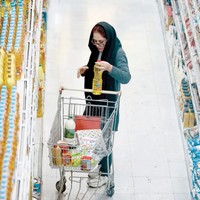
The International Monetary Fund expects Iran’s economy to contract by 6.1% in 2026, after an estimated decline of 1.5% last year. Average consumer-price inflation, already above 50% in 2025, is forecast to accelerate to 68.9%.
The combination matters more than either number alone. A recession means the economy is producing less, companies are selling less and opportunities for work and investment are narrowing. Inflation approaching 70% means the income that remains loses value at extraordinary speed.
For Iranian households, the result is a squeeze from both directions: fewer ways to earn money and far less purchasing power once they receive it.
The scale of the deterioration is also visible in the IMF’s revision. Only three months earlier, it had expected Iran to record modest growth of about 1.1%. It has now cut that estimate by 7.2 percentage points, one of the sharpest downgrades in the report.
“Growth in Iran in 2026 is revised downward by 7.2 percentage points, relative to January, to –6.1 percent,” the IMF said.
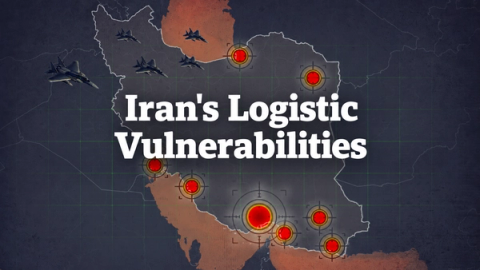
The fund links the reversal to damage to energy and transport infrastructure, diminished production and exports, and disruption around the Strait of Hormuz. It places Iran alongside Iraq, Qatar, Kuwait and Bahrain among the regional economies most directly exposed to the conflict.
The downturn is expected to reach the labor market. Unemployment is forecast to rise from 8% to 9.2%, though that figure captures only part of the pressure in an economy where informal work, underemployment and falling real wages are widespread.
The inflation data are even more severe. The IMF forecasts average inflation of 68.9% over the year and an end-of-year rate of 48.7%. The difference suggests the pace of price rises may slow later in the year, but not enough to restore anything resembling price stability.
It also means that a lower inflation rate would not make goods cheaper. Prices would still be rising rapidly from an already much higher base, leaving food, housing and other essentials increasingly beyond the reach of households whose wages have failed to keep pace.
The regional comparisons make Iran’s position clearer. Saudi Arabia and the United Arab Emirates are each expected to grow by 3.1%, while Oman is projected to expand by 3.5%. Their inflation rates are forecast at 2.3%, 2.5% and 1.7% respectively.
Qatar and Iraq face even deeper contractions, at 8.6% and 6.8%, largely because of damage and disruption to energy production. But inflation in both is expected to remain close to 3% or 4%. Iran’s particular crisis is that it combines a wartime recession with an inflation problem that was already deeply entrenched before the fighting.
Türkiye offers another useful comparison. It has struggled with years of high inflation, yet the IMF still expects its economy to grow by 3.4% in 2026 while inflation averages 28.6%. Iran’s inflation rate is more than twice as high, while its economy is moving sharply in the opposite direction.
Iran’s external position is also weakening. The current account – the broad measure of money flowing into and out of the country through trade and other transactions – is expected to move from a surplus of 0.6% of GDP to a deficit of 1.8%.
For a major oil and gas producer, that reversal points to lost export earnings, damaged production and less access to foreign currency. By contrast, the UAE is expected to retain a surplus of 11.4%, Qatar 11% and Oman 7.5%, giving those governments far larger financial cushions.
The figures should still be treated with caution. The IMF’s Iran data depend partly on national accounts, inflation and balance-of-payments information supplied by the Islamic Republic’s finance and monetary institutions. The fund also uses staff estimates where complete information is unavailable and says the timeliness, accuracy and completeness of its database cannot be guaranteed.
That makes the report an informed estimate, not an independent audit of Iran’s economy. Official statistics under the Islamic Republic are often delayed, incomplete or shaped by a system with several exchange rates and limited transparency.
The IMF itself uses the NIMA (an acronym for integrated system of foreign exchange) trade-related rate to convert Iranian GDP into dollars from 2018 onward, rather than the official rate that is lower, because it considers NIMA more representative of transactions.
Even that does not fully reflect the much weaker market rate experienced by many Iranians because it still overstates the rial’s value compared with the open market: the dollar is about 1.48 million rials at the NIMA rate today, against roughly 1.78 million rials on the street, a gap of about 21%.
South Pars carries the shock beyond Iran
The damage is not confined to Iran. The IMF says strikes on the South Pars gas field sharply reduced the prospect of a quick recovery in regional gas supplies and were followed by Iran’s attacks on Persian Gulf energy facilities, including Qatar’s Ras Laffan complex.
European benchmark gas prices rose 61% between August 2025 and March 2026, while Asian LNG prices jumped by more than 80%. Asia is particularly exposed because more than three-quarters of LNG shipments passing through the Strait of Hormuz are bound for Asian markets.
The IMF’s central forecast still assumes a relatively short conflict and a gradual restoration of production and transport. Under that assumption, global growth slows to 3.1% and inflation rises to 4.4%. But the report says a longer disruption could push global growth close to 2% and inflation toward 6%.
The same warning applies more acutely to Iran: the forecast contraction of 6.1% is not a worst-case estimate, but one built on the assumption that the war’s economic damage begins to ease.