Conscripts say commanders abandoned them in bases after Khamenei’s killing
Following the killing of Ali Khamenei and dozens of military commanders, some officers have abandoned their barracks, leaving soldiers in dangerous conditions and forcing them to remain on guard duty under ongoing bombardment, multiple conscripts have told Iran International.
After Khamenei was killed in Tehran on February 28, confusion and divisions have emerged within the command structure of Iran’s military forces, the conscripts said.
In a military base in Lorestan province, several soldiers reported uncertainty over the chain of command and growing security concerns after the recent developments.
In a message, one soldier said many commanders left their posts to avoid potential US and Israeli strikes, leaving ordinary conscripts behind in the barracks without support.
According to the soldier, fear of bombardment has led some troops to spend nights outside the base, resting in nearby open areas despite the cold weather.
The soldier also criticized what he described as a lack of attention to the situation of ordinary troops and called for authorities to address their conditions.
Protesters hold pre-1979 Iranian flags during a rally against Islamic Republic, in Munich, Germany on February 14, 2026.
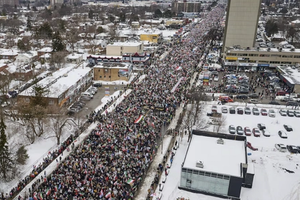
Widespread rallies by Iranians abroad, held in response to a call by exiled Prince Reza Pahlavi, drew an outpouring of support from inside Iran, with many describing the gatherings as a renewed source of hope and unity.
German authorities said nearly 250,000 people attended the Munich rally, calling it the largest protest by Iranians in Europe to date. Organizers and local officials also reported large turnouts in Toronto and Los Angeles, each estimated at around 350,000, as well as 50,000 in London and 45,000 in Vancouver.
Speaking at the Munich event, Prince Reza Pahlavi addressed people inside Iran directly. “Know and see that you are not alone and that your voice has reached the world,” he said.
Messages sent to Iran International and widely shared on social media described what contributors called an unprecedented display of cohesion and discipline across continents.
Messages from inside Iran
One viewer wrote: “Salute to our honorable compatriots outside Iran. Seeing the beautiful images of unity, harmony, civility and order brought tears of joy to our eyes inside the country.”
Another message read: “We were tired and disappointed, but when we saw you in the gatherings abroad, we cried for all of us. Who can separate us from each other?”
A resident of Tehran wrote, “We bow our heads in respect to all our compatriots around the world. We saw your gatherings everywhere and wept.”
From Shiraz, a viewer addressed the authorities, writing: “Every bullet you fired at our young people united our hearts more. We are now united, aware and full of faith.”
Others described the rallies as a turning point after weeks of pressure at home. “Yesterday, after 37 days, for the first time we were not sad or hopeless. Everyone was talking about you, and there was excitement in their eyes,” one message said.
Several framed the demonstrations as evidence of a shared national purpose transcending borders. “It was proven that the power of love for Iran and Iranians does not fit within political and geographical boundaries,” one viewer wrote.
“With seeing you, every moment was tears and emotion. We hope to celebrate our freedom soon on our own soil,” another message said.
Support extended beyond messages sent directly to Iran International. Similar posts circulated widely across social media platforms, echoing themes of unity, perseverance and anticipation of political change.
The scale of the February 14 rallies prompted criticism from state media, officials and pro-government online activists, who questioned attendance figures and accused organizers of exaggeration.
Responses ranged from attempts to downplay the gatherings to verbal attacks on participants abroad. Supporters inside Iran, however, portrayed the demonstrations as a morale boost amid continuing domestic restrictions.
“Your presence is a bridge of hope and solidarity that lights many hearts inside the country,” another Tehran resident wrote.
A tightening security atmosphere inside schools across several Iranian cities has prompted a new wave of student absences, according to messages sent to Iran International, with families saying classrooms no longer feel like safe spaces for their children.
In recent weeks, parents and students from Mashhad, Gorgan, Tehran and other cities across Iran have described schools shifting from educational environments to spaces marked by heightened monitoring and questioning.
A student in the religious city of Mashhad said school officials and affiliated forces had searched students’ mobile phones and, in some cases, searched schoolbags.
After this started, a few of my classmates stopped coming to school, the student added.
Similar accounts have emerged from girls’ schools in Gorgan, northern Iran. Several students told Iran International that inspections were accompanied by what they described as an atmosphere of intimidation, leading some families to temporarily withdraw their children from classes.
Rising absenteeism amid safety fears
No official figures have been released on attendance rates, but interviews with teachers in Tehran and Alborz province suggest that classroom numbers have dropped in some schools.
“In a class of 25, some days fewer than half are present,” a high school teacher in Tehran said, requesting anonymity due to the sensitivity of the issue. “Parents say they do not consider the situation safe.”
Schoolgirls in Iran raise fists in protest; a handwritten sign reads, “This is the final battle, Pahlavi will return.”
A mother of an eighth-grade student in eastern Tehran said she had allowed her child to stay home for several days. “School should be the safest place for a child,” she said. “When I hear about inspections and questioning, it is natural to hesitate.”
The latest reports follow earlier accounts of security forces and Basij members entering schools in cities including Abadan in the south, Arak and parts of Mazandaran province, north of Iran.
Families previously reported that students were asked to sign written pledges without their parents present. In Bandar Abbas, Malayer and Gorgan, students were questioned about their families and protest-related activities. In Arak and Sari, some educational facilities were said to have been used as bases for security forces.
‘Deep rupture' between families and schools
Saba Alaleh, a Paris-based clinical psychologist and socio-political psychoanalyst, told Iran International that the developments point to a structural break in trust.
“We are witnessing a profound psychological and social rupture between families and schools,” she said.
“This rupture is not limited to recent events; it is the result of years of accumulated distrust.”
Experiences during the Woman, Life, Freedom protests in 2022, when schools were described as spaces of fear and pressure, intensified that mistrust, Alaleh said.
“A school should provide a sense of security. When it becomes associated with surveillance and threat, it transforms into a source of anxiety,” she added.
She warned that exposure to inspections and questioning could have lasting consequences for children. “When students experience constant monitoring, education can lose its meaning,” she argued.
“This can lead to declining motivation, deeper distrust and even identity confusion.”
Healthy psychological development, Alaleh explained, depends on a functional partnership between family and school.
“When that bond collapses, children may find themselves caught between conflicting value systems, complicating their social and identity development,” she added.
Long-term consequences for education
Nahid Husseini, a London-based researcher on women’s affairs and education, said the recent developments reflect a broader crisis within the education system.
“When an educational environment is perceived as unsafe, it is natural for parents to withhold their children,” she told Iran International. “But the result is the deprivation of millions of students from their right to education.”
With Iran’s student population estimated at more than 15 million, Husseini said sustained absenteeism and declining trust in schools could have far-reaching social and economic consequences.
“Schools should be spaces of stability and growth. When they become associated with fear, the cost is borne not only by students but by society as a whole.”
A sanctuary no longer certain
For many families, the issue is no longer limited to temporary absences but to a broader shift in how they view the institution of schooling.
“In the past, even if there were problems, we still believed school was fundamentally safe,” a mother in Tehran said. “Now I feel my child is under pressure there.”
In the absence of transparent communication about the scope and purpose of security measures inside schools, distrust appears to be widening.
Experts warn that once a school loses its standing as a safe haven, rebuilding that trust may prove far more difficult – with implications that could shape a generation’s relationship with formal education for years to come.
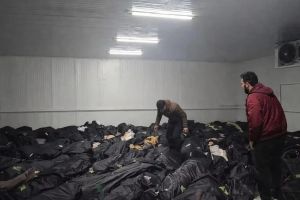
Bulldozers moved piles of bodies of those killed in the Gohardasht district of Karaj during the January crackdown on nationwide protests, in what witnesses describe as a deliberate attempt to instill fear after corpses were stacked in public squares.
A resident of Gohardasht told Iran International that on the nights of January 8 and 9, large numbers of armed forces were lying in ambush in alleyways as heavy gunfire echoed through the area.
According to the witness, teenagers struck in the head and face by pellet rounds sought refuge inside residential buildings. The resident said at least 16 people were killed in the alley where he lives, adding that security forces also fired at the doors of apartment buildings.
Another eyewitness said that around a nearby hospital, injured women with severe facial wounds were seen seeking help. On Dariush Street, he said, a DShK heavy machine gun was deployed and crowds were sprayed with gunfire.
He said that at the First Square of Gohardasht, bodies were piled on top of each other to create an atmosphere of terror before being moved away with bulldozers.
The witness said the bodies were collected around midnight on January 8, but freezing temperatures left congealed blood visible on the ground. The following night, January 9, the killings intensified, he added.
President Donald Trump holds a cabinet meeting, Thursday, January 29, 2026, in the Cabinet Room. (Official White House Photo by Molly Riley)
Hundreds of messages sent to Iran International from Iranians inside the country urge US President Donald Trump not to negotiate with the Islamic Republic, warning that talks would legitimize repression and betray protesters killed by security forces.
The messages from people inside Iran appeal directly to Trump to abandon diplomacy and instead support what they describe as a nationwide struggle for freedom and democracy.
“If you want to help the people of Iran, what does negotiating with our enemies mean?” one message from Tehran said, adding: “Negotiations with this regime only buy time for repression.”
Other messages from inside Iran cite recent protests and the deadly response by security forces, saying negotiations would legitimize a government they say has blood on its hands.
“Negotiating with this clerical government means trampling on the blood of young people killed in the streets,” one message reads.
Messages received from the city of Qazvin warn that talks would demoralize protesters and undermine months of resistance. “We came to the streets to free Iran from these criminals,” one message said. “Trading with this regime is trading with the blood of the people.”
Several messages from Tehran reference Trump’s past statements and promises, saying many Iranians trusted his rhetoric about standing for freedom.
“You said you support liberty,” one message from Tehran reads. “Please be the voice of the Iranian people. We are dying in the streets for freedom.”
A message sent from Iran’s southeastern province of Sistan and Baluchestan offers condolences to families of those killed and urges Trump to “stand with the Iranian nation, not the Islamic Republic.”
Other messages from inside Iran warn of what they describe as a long pattern of deception, saying past deals with Iranian authorities helped ease international pressure on the Islamic Republic even as repression continued at home.
Some messages stress that the protest movement will endure even without foreign assistance. “Even if there is no outside intervention, we will stand together,” one message says.
'Not our representatives'
Across the messages, a shared demand emerges that world leaders not view the Islamic Republic as representing the Iranian people and avoid negotiations that could confer legitimacy on it.
“Please negotiate with the brave people of Iran, not with this suppressive regime,” one message says. “Do not turn a blind eye to these crimes.”
“Tell Trump that no one negotiates with a killer; killers should only be punished,” another message said.
An eyewitness has described what he called an organized and deadly crackdown on protesters in the city of Najafabad in Iran’s Isfahan province, saying security forces opened fire on crowds from both a police station and a mosque.
In an audio message sent to Iran International on Sunday, the witness said large numbers of people took part in protests on January 8 and 9, and that authorities responded with what he described as a “massacre.”
He said plainclothes agents infiltrated the crowd on the evening of January 8 and steered protesters toward the governor’s office and a police station, where forces positioned inside the station opened fire.
Despite the bloodshed, he said protesters returned to the streets the following evening. He described the city on January 9 as resembling a “war zone,” saying security forces were deployed with heavy weapons and fired at demonstrators from Safa Mosque on Shariati Street.
He added that authorities later withheld victims’ bodies, forcing families to break into morgues to search for their relatives, and said Najafabad was effectively placed under conditions resembling martial law after the crackdown.