US-Israeli strikes aimed at removing Iran regime, Senator Cruz says
Republican Senator Ted Cruz told Eye for Iran podcast this week that the US-Israel military campaign aims to remove the Islamic Republic from power.
Republican Senator Ted Cruz told Eye for Iran podcast this week that the US-Israel military campaign aims to remove the Islamic Republic from power.




US Senator Ted Cruz told Iran International this week that the US-Israel military campaign aims to remove the Islamic Republic from power and diminish Tehran’s ability to “terrorize” or harm its neighbors.
“It is not simply enough to degrade part of their arsenal,” Cruz told Eye for Iran podcast, adding that strikes have weakened Iran’s military capabilities and limited its ability to project force abroad.
Asked whether victory would mean regime change, he said: “Yeah, I believe this regime needs to be removed from power,” and argued that doing so would serve US national security interests and support Iranians seeking freedom.
Cruz said the United States and Israel had acted in coordination in recent days.
"We've seen the United States working hand in hand with Israel taking out, number one, the Ayatollah, number two, the senior military leaders of the regime, number three, a great percentage of the missile reserves of the drones,” he said.
“We have seen steadily the regime's ability to project force, to terrorize the Iranian people, to murder their neighbors, to murder Americans, all of those have been reduced dramatically.”
His comments come as the Trump administration signals the campaign could intensify. US Defense Secretary Pete Hegseth said this week the United States has “only just begun to fight,” while Iran’s Revolutionary Guards warned attacks across the region would escalate.
Freedom “on the doorstep”
Cruz argued that removing Iran’s ruling regime would serve both US national security interests and the aspirations of Iranians living under the tyrinical government.
“Removing from power a government that is seeking to kill Americans is overwhelmingly in America's interest,” he said, adding that it was also “overwhelmingly in the interest of the people of Iran of 92 million people who have suffered under tyranny and oppression for 47 years… and I believe freedom is on the doorstep and it is in sight before us.”
More than 36,500 Iranians were killed by security forces during the January 8-9 crackdown on nationwide protests, making it the deadliest two-day protest massacre in history.
The Republican Senator also suggested Iran’s military response across the region is backfiring and strengthening opposition to the regime.
“Well, Iran is doing a great job of building a coalition against this regime,” Cruz said. “You look at their military strategy, their military strategy appears to be try to murder as many people as possible and in as many countries as possible.”
Iran’s missile and drone attacks have spread across the region in recent days, with projectiles reported over or targeting Israel, the United Arab Emirates, Qatar, Bahrain, Kuwait, Jordan, Iraq, Saudi Arabia, Syria and Cyprus.
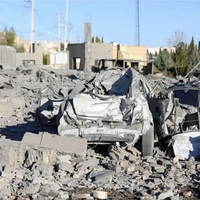
Some strikes and falling debris have also hit residential areas, highlighting how the conflict is spilling beyond military targets and affecting civilians across the region.
Limited ground engagement possible
Cruz also addressed speculation about whether the United States could deploy ground troops, saying he does not foresee an Iraq-style invasion but did not rule out limited ground action.
“Look, what we're not going to see is an extended presence of American troops on the ground. We're not going see a replay of what happened in the war in Iraq. That is not on the table,” he said.
“The president has been clear he has not ruled out some limited ground engagement… I could envision it is possible the president will order some sort of limited ground engagements, but I would expect the overwhelming majority of the American engagement on this to be in the air through bombs and missiles and other means.”
Iran’s leadership question
The question of Iran’s leadership has taken on new urgency following the death of Supreme Leader Ali Khamenei.
Iran’s clerical body, the Assembly of Experts, has elected Mojtaba Khamenei — the son of the late supreme leader Ali Khamenei — as the Islamic Republic’s new Supreme Leader, according to informed sources who spoke to Iran International.
The decision would keep power firmly within the ruling system of the Islamic Republic and extend the authority of the clerical establishment that has governed Iran since 1979.
President Donald Trump signaled strong opposition to Mojtaba Khamenei assuming power.
“Khamenei's son is a lightweight. I have to be involved in the appointment, like with Delcy Rodriguez in Venezuela,” Trump said.
“We want someone that will bring harmony and peace to Iran.”
Asked during his interview about who should lead Iran next, Cruz said he would not speculate about specific figures but noted there were multiple possible contenders.
“Look, I don't know, and I think that's a decision for the people of Iran to make. And so there are various contenders,” Cruz said.
Cruz said he believes Iran’s current ruling system should ultimately be replaced by leadership chosen by the Iranian people.
“Yeah, I believe this regime needs to be removed from power,” he said.
“What I would like to see is a free and fair election, let the people of Iran choose their leaders.”
Message to the Iranian people
Cruz also spoke about his personal connection to people who have lived under authoritarian rule.
“My father was born and grew up in Cuba. My father fought in the Cuban revolution. My father was imprisoned and tortured in Cuba,” he said. “My family knows suffering the people of Iran have experienced.”
He ended with a message to Iranians protesting the government.
“My message to the Iranian people is your courage is inspiring… You have a moment to reclaim your country, to reclaim your future and to move into an era of prosperity.”
A senior member of the European Parliament is calling for a fundamental shift in Europe’s approach toward Iran, arguing that continued negotiations with the Islamic Republic are no longer defensible after Tehran’s deadly crackdown on protesters.
Daniel Attard, a Maltese Member of the European Parliament who serves as Vice-Chair of the European Parliament’s Delegation for Relations with Iran, urged European governments to move beyond statements of concern and adopt concrete political and economic measures against Tehran, he said in an interview on Eye for Iran podcast.
“Responsibility to protect is not just a slogan, it is a commitment,” Attard said. “When a regime turns on its own people, when the regime kills its own people to stay in power, sovereignty cannot be used as a shield.”
Rising tensions amid military buildup
Attard’s remarks come as tensions surrounding Iran continue to escalate, with Washington increasing its military posture in the region.
In recent weeks, US naval assets, including aircraft carrier strike groups and advanced fighter aircraft have been repositioned closer to the Middle East, a move analysts say is intended to deter further escalation while signaling readiness should diplomacy fail.
The heightened military presence coincides with ongoing diplomatic talks in Geneva and growing concern in Europe over Iran’s ballistic missile program, which US officials warn could eventually threaten both European territory and American forces abroad.
Against that backdrop, Attard argued Europe cannot remain a passive observer.
“The time for negotiation is over,” he said. “We should be decisive, we should show leadership, we should match the courage of the people of Iran — the students, the women, the youth, the elderly — who have showed great courage.”
A full-spectrum pressure strategy
Attard outlined what he described as a comprehensive pressure strategy targeting the regime politically, economically and diplomatically.
“We need to halt all trade incoming from Iran either directly or indirectly,” he said. “Iranian embassies are still operating like it was business as usual in Europe. So we need to be more decisive. No more business as usual — be it politically, be it economically, and be it diplomatically.”
The European Parliament has already pushed for the designation of Iran’s Islamic Revolutionary Guard Corps (IRGC) as a terrorist organization, a step Attard described as “very long overdue.” But he stressed that enforcement now matters as much as designation.
“We should enforce those sanctions without any possibility of any loopholes,” he said.
He added that EU member states have the authority to take further steps immediately.
“Governments can decide to close or to restrict severely the operation of Iranian diplomatic embassies within the Union. This is something which member states can actually do, and they can do it right now.”
Europe’s credibility at stake
Attard acknowledged that divisions among EU member states and competing geopolitical interests have slowed action in the past but warned that Europe’s credibility now depends on consistency.
“We cannot claim to defend human rights if we look away to what’s happening on the streets of Iran,” he said. “Our credibility demands consistency.”
He expressed confidence that pressure from lawmakers would continue to grow.
“As long as the Iranian regime thinks it can silence its people, we will echo and amplify their voices,” Attard said.
Message to Iranians and to Tehran
Addressing Iranians directly, Attard praised protesters’ resilience and framed their struggle as one rooted in universal values.
“Your courage is seen and we shall not look away,” he said. “This is a fight about universal values — human rights, dignity and equality.”
His message to Iran’s leadership was considerably shorter.
“My message is clear,” Attard said. “Your time is up.”
President Donald Trump’s recent remarks on Iran, including his State of the Union address and frustration with ongoing nuclear talks, signal a shift beyond diplomacy to national security and human rights concerns, analysts told Eye for Iran.
A panel of security and policy analysts said the tone and structure of the administration’s messaging suggest Washington is increasingly reframing the Iran challenge around multiple justifications simultaneously, including ballistic missile threats, regional destabilization and mass killings inside Iran.
Janatan Sayeh, a research analyst focusing on Iranian affairs at the Foundation for Defense of Democracies (FDD), said the speech reflected three distinct pillars that historically have shaped US decisions to escalate foreign policy crises.
“If you look at all these three pillars,” he said, referring to nuclear ambitions, ballistic missiles and human rights violations, “they have been historically used to explain why the United States would get involved in a foreign conflict.”
According to Sayeh, the evolving rhetoric reflects growing pessimism in Washington about the prospects for diplomacy.
From nuclear file to broader threats
For years, US policy discussions surrounding Iran largely centered on the nuclear program. But Trump’s recent remarks placed greater emphasis on Tehran’s missile capabilities, warning they could eventually threaten the US homeland as well as American bases overseas.
“They’ve already developed missiles that can threaten Europe and our bases overseas, and they’re working to build missiles that will soon reach the United States of America," said Trump during his State of Union address this week.
Shayan Samii, a former US government appointee, said the messaging appeared designed to build a political and public framework for possible escalation.
“President Trump tried to create basically a framework for what a military intervention would be and why there is a need for a military intervention,” Samii told Eye for Iran.
He added that referencing the reported killing of tens of thousands of protesters carried particular significance.
“When he validates the number 32,000, that basically is telling the world that a massacre has occurred and we need to have a collective response for it,” Sami said.
The framing, he argued, was aimed not only at Trump’s political base but also at building broader bipartisan support in Washington.
Tehran’s defiant posture
Despite increasingly forceful rhetoric from Washington, analysts said Tehran appears to be continuing escalation while dismissing the significance of US warnings.
Middle East historian and political analyst Shahram Kholdi said Islamic Republic leaders are behaving as though the shift in tone does not signal imminent action.
“They are reacting as if they have not heard anything that President Trump has said,” Kholdi said.
He described Iran’s posture as a pattern of “passive-aggressive… escalatory behavior,” arguing that the regime is rebuilding military capabilities damaged in earlier confrontations during the 12-day war in June.
“They are rebuilding everything… the ballistic missile program, air defense systems,” he said, adding that Tehran appears to view Washington as “all rhetoric and no action.”
Diplomacy meets deterrence
The day after the latest round of talks concluded Thursday, Trump signaled growing frustration with negotiations.
“I’m not happy with the fact that they’re not willing to give us what we have to have… We’ll see what happens,” Trump told reporters Friday. “No, I’m not happy with the way they’re going.”
The remarks come amid a substantial US military deployment already positioned in and around the Middle East, including carrier strike groups, advanced fighter aircraft and additional naval assets — a buildup analysts say increases pressure while diplomacy continues.
Sayeh argued that extended negotiations may serve a strategic purpose by demonstrating that diplomatic avenues have been exhausted.
“As the talks drag out… it signals to the world that the West has exhausted all diplomatic options,” he said.
The combination of military buildup, shifting rhetoric and bipartisan concern marks a notable turning point in how Iran is being discussed in Washington.
Historian and political analyst Shahram Kholdi described the US military buildup as “a world war scale force,” comparing it to the kind of power Washington brought to bear during World War II’s Operation Torch.
As negotiations continue alongside escalating military signaling, the central question remains unresolved: whether the current posture is intended to force concessions from Tehran or to prepare the ground for a more decisive action.
"Shame on the UN for inviting murderers", UN Watch executive director Hillel Neuer said on Iran International's Eye for Iran podcast, urging the world to stop granting legitimacy to Iran's regime by welcoming it at the UN after it killed tens of thousands last month.
"Kazem Gharibabadi, deputy foreign minister of the murderous Islamic Regime in Iran, is now listed to address the United Nations Human Rights Council on Monday, Feb. 23, at 2:00 pm. We call on all democracies: As soon as he begin to speak, you must stand up and walk out," Neuer said in a post on his X account on Saturday.
The breathing tube was already in his mouth when, according to his father, the final shot was fired. It is one of many accounts emerging from Iran’s January protest crackdown.
Seventeen-year-old Sam Afshari had been taken to Madani Hospital in Karaj, near Tehran, after being shot on January 8 during protests near Mehran Square in the city’s Azimieh district. Witnesses later told his family that doctors were attempting to save him and that he was still conscious when asked his name.
“He had the breathing tube in his mouth. They came and shot him. A final bullet,” his father, Parviz Afshari, told Iran International’s English podcast Eye for Iran.
That day, protests spread across Iran as demonstrators took to the streets demanding an end to the Islamic Republic. Sam was among them.
“They went for a free Iran,” Parviz said. “They went out to protest with bare hands. But they returned to their families with bullets in the back of the head and bullets in the back.”
Sam was his only child—an unimaginable loss, his father said, that many Iranian families are now struggling to understand and explain.
Sam was born in 2008 in Karaj and had turned 17 just weeks before his death. He was studying computer networks and hoped to continue his education abroad.
“This year he was supposed to come here so we could sort out his papers,” his father said, speaking from Germany. “He wanted to continue his studies, go to university and study computer engineering.”
His father described him as cheerful and ambitious.
“He joked a lot. We laughed so much,” Afshari said. “We were always in video contact, talking about the future.”
“I don’t think he went out because of poverty,” he added. “He went out because of his beliefs. He wanted democracy and the right to speak his mind.”
According to accounts later gathered by the family, Sam was shot from behind near a security police post at Mehran Square. Residents in a nearby apartment building attempted to pull the wounded teenager into their parking area to protect him.
Security forces arrived shortly afterward and took him away, his father said.
“They took my child with them.”
A hospital employee later informed the family that Sam had been transported to Madani Hospital along with other injured protesters. Witnesses told relatives that when medical staff asked his name, he answered “Sam,” indicating he was still conscious.
Hours later, he was dead.
"At the hospital they finished him off with a shot to the back of the head. The bullet came out through his cheek," Parviz said.
Because internet access had been cut during the unrest, Afshari said he did not learn what had happened until days later, when communication was briefly restored. Family members searched hospitals and morgues before his brother located the name “Sam Afshari” on a list of the dead at Beheshte Sakineh morgue in Karaj.
When Sam’s mother was brought to identify the body, she initially could not recognize him because of severe injuries.
“One side of my child’s face was destroyed,” Afshari said. “The back of his head too.”
She confirmed his identity only after asking officials to uncover a tattoo on his chest bearing the word “Mother” written in Latin script.
“When they saw the tattoo, they realized, yes, tragically — it was Sam.”
According to the family, authorities initially ordered that Sam be buried quietly at night in a remote area. After negotiations and payments, relatives secured permission to bury him closer to Karaj, but cemetery space was scarce.
“There were so many graves,” his father said. “They said there was simply no space.”
At Kalak-e Bala cemetery in Karaj, Sam was buried above another young protester because burial plots were already filled.
“Under his grave there is another martyr, Amir Bayati, and above is my son, Sam Afshari,” Afshari said.
Relatives described morgue halls crowded with bodies and refrigerated trucks waiting outside — scenes they said reflected the scale of deaths families were confronting in the days after the crackdown.
'He wanted a free Iran'
As the interview continued, Afshari’s grief gave way to anger and appeals for accountability.
“This is no longer the time for my tears. Now I feel rage,” he said. “If nothing happens, the blood of our children will be trampled. Our people—90 million human beings—are now hostages. Hostages of the Islamic Republic.”
He urged the international community not to remain silent. “The terrorist Islamic Republic must be brought to an end,” he said.
Throughout the interview, he returned repeatedly to the future his son never had.
“He had so many dreams, and I had so many dreams for him,” he said. “We buried this child with thousands of dreams.”
For Afshari, the story ends where it began—with a teenager who left home hoping for a different future. “He went for a free Iran,” his father said. “And we buried him instead.”