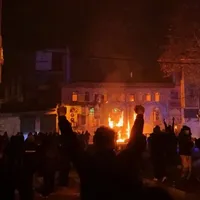
Mexico has deployed thousands of troops after coordinated attacks erupted across at least 20 states following the capture and death of Jalisco New Generation Cartel leader Nemesio Oseguera Cervantes, known as El Mencho.
Cartel fighters torched buses, blocked highways and clashed with security forces, leaving dozens dead and forcing authorities to mobilize nearly 10,000 personnel nationwide.
While Mexican authorities frame the unrest as cartel retaliation, security analysts say such episodes increasingly unfold within transnational financial and trafficking systems that extend beyond Mexico’s borders.
Those systems, experts say, have in some cases intersected with Iranian state-aligned networks operating across Latin America.
“There are longstanding money-laundering and trafficking ecosystems that connect Latin American cartels, Iranian state-aligned networks and global criminal finance,” investigative journalist Sam Cooper told Iran International, pointing to investigations linking criminal actors across North and South America.
Cooper who has reported extensively on transnational crime networks, stressed that the overlap does not necessarily indicate direct operational control by Tehran but reflects a convergence of interests that could benefit the theocracy during periods of heightened pressure.
“I don’t have direct evidence their intelligence would be involved in helping the cartel push back against the Mexican state,” he said. “But I do believe the Iranian regime would want to benefit very much from increasing the turmoil in Mexico.”
That convergence of illicit finance and geopolitical competition, analysts say, creates openings for states such as Iran to benefit from regional instability.
'Using gangs for dirty work'
Janatan Sayeh, a research analyst at the Foundation for Defense of Democracies focusing on Iranian domestic affairs and regional influence, says the Islamic Republic frequently advances its objectives indirectly, relying on criminal intermediaries to apply pressure while maintaining distance from direct involvement.
“They (Iran's regime) do try to put a distance between themselves and their criminal activity, specifically assassination plots,” Sayeh said.
“They increasingly are leveraging some of these gangs… to do the dirty work.”
In 2011, US officials brought charges against several Iranian nationals, among them an operative linked to the IRGC’s Quds Force, accusing them of conspiring to kill the Saudi ambassador in Washington.
According to prosecutors, an Iranian go-between attempted to recruit individuals he thought were tied to a Mexican drug cartel, offering payment to carry out the assassination. Those individuals were in fact informants working with the U.S. Drug Enforcement Administration.
Networks built over decades
Analysts say many of these connections trace back decades, particularly through Iran’s partnership with the former regime ruling Venezuela, where Iranian Revolutionary Guard-aligned networks and Hezbollah operatives established financial and logistical footholds across Latin America.
Hezbollah has long been accused of running criminal networks in Latin America that intersect with drug trafficking routes.
Dr. Walid Phares, a foreign policy expert and co-secretary general of the Transatlantic Parliamentary Group, said those networks gradually expanded into cooperation with organized crime groups operating across the region.
“Hezbollah had developed relationships with similar organizations across Latin America, Brazil, Colombia and beyond,” Phares told Iran International. “But the most important move backed by the IRGC regime was in Mexico.”
According to Phares, access to trafficking routes and financial channels allowed militant networks to expand their reach while maintaining distance through criminal intermediaries.
“The most important goal of Hezbollah was to get to the American and Mexican border,” he said.
Sayeh added that Western governments often mischaracterize the threat by treating such activity solely as organized crime rather than part of a broader national security challenge.
“A lot of times when it comes to the Americas it is treated as a criminal network, not a terrorism network,” he said. “Accurately labeling it for what it is important.”
For Iran, "it’s anything anti-America… and cartel is just part of that paradigm for them,” he said. “Any opportunity just to exert pressure on the Americas.”
Crime and geopolitics converge
Security specialists say the convergence has blurred the traditional boundary between criminal activity and geopolitical competition. Networks originally built for sanctions evasion and terror financing can also serve narcotics trafficking and money laundering operations, creating mutually beneficial partnerships between state and non-state actors.
For Cooper, the violence unfolding in Mexico reflects a wider shift in the Western Hemisphere, where criminal networks increasingly intersect with global rivalries.
“The level of threats that are emerging in the Western Hemisphere right now,” he said, “is all related.”
As Mexico contains the fallout from El Mencho’s death, experts say the episode highlights how criminal violence in the Western Hemisphere increasingly intersects with global power competition.