The night air on Jan. 8 in northeastern Tehran filled with chants rising in defiance. Among them stood Pooya Faragerdi, a violinist whose life was measured in music and a heart that beat for Iran. Then came the gunfire.
Faragerdi, 44, was shot by security forces near a police station in Pasdaran that night.
Videos verified by Iran International from Pasdaran on Jan. 8 showed wounded protesters lying bloodied on the street as others tried to help, with gunfire audible in the background.
“At first we thought he had been killed in Majidiyeh… but later I learned he went to Pasdaran and was shot there,” his brother Payam Fotouhiehpour told Iran International.
A bullet pierced the right side of his abdomen around 11 p.m., and he was taken to a hospital. He died the following day, Jan. 9, his brother said, but for days the family did not know where he was.
Nearly 12 days later, they learned his body was at Kahrizak — a forensic medical complex south of Tehran where many protest victims were taken.
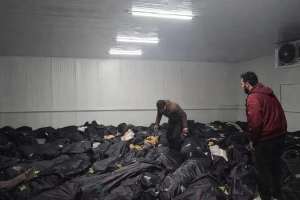
Footage verified by Iran International from Kahrizak showed families searching among rows of black body bags as the complex filled with protest victims.
Searching through darkness
While Faragerdi joined protests in Tehran, his brother was in the United States, cut off by a nationwide internet blackout imposed on Jan. 8 as demonstrations intensified.
Connectivity dropped to near zero, with tens of millions cut off from global internet access and phone communication severely disrupted. Rights groups said the shutdown aimed to prevent information from leaving the country and obscure the scale of the crackdown.
“I was unaware of everything,” he said.
Only days later, when limited international calls were partially restored, he learned his brother was missing.
“I convinced myself he had gone somewhere with a friend… I told myself he would show up and I would scold him for ten or fifteen minutes.”
He never did.
“Every moment his image was in front of my eyes. I had to go into the storage room or my office to cry so my wife and daughter would not lose themselves.”
On Jan. 20, authorities informed the family that Faragerdi’s body was in Kahrizak. He was buried the following day at Tehran’s Behesht-e Zahra cemetery.
“These days, images of his childhood come to my mind more and more. Even his childhood voice is in my ears — ‘Dada Payam.’”
Defiance through music
Long before the protests, Faragerdi had resisted Iran’s cultural licensing system, which requires artists to obtain approval from the Ministry of Culture and Islamic Guidance before performing or releasing music.
Born on Sept. 7, 1981, he trained in violin from childhood, developing a foundation in classical performance. Though he held a degree in agricultural machinery engineering, music remained central to his life.
“He decided to play the violin professionally - and teach,” his brother said. “He taught my daughter Baran as well.”
Faragerdi played classical music—from Baroque to modern—and had a taste for all types, his brother said: jazz, blues, rock.
But the permit system pushed him away from formal stages.
“He hated that,” his brother said. “It was insulting to him that these creatures would decide what he could do.”
Faragerdi redirected his creativity into craftsmanship. Skilled with tools, he began carving wooden instruments by hand, including ocarinas he built and played himself.
A fellow musician who performed with him, speaking on condition of anonymity, said Faragerdi had once been part of an independent orchestra in Tehran.
“He was part of an independent orchestra—meaning no government body oversaw it. It was private,” the musician said.
Following the 2019 crackdown, during which at least 1,500 protesters were killed, many artists moved away from orchestras requiring ministry permits, the musician added.
'Your bow is still, but not our rage'
Tributes from fellow musicians and students have surfaced across social media.
“We shared a stage, a stand, a country. We played side by side for years, and we still hear your velvet voice in the pauses between movements,” two of his fellow musicians told Iran International.
“On January 8, you were shot for daring to breathe free… They might have silenced your body but not your echo. They killed a musician, not sound itself. Your bow is still, our rage is not.”
Faragerdi’s final Instagram post showed him burning an Iranian banknote bearing the image of Ruhollah Khomeini, founder of the Islamic Republic, holding it over a toilet before dropping the ashes into the bowl. The clip was captioned: “Let us count the life that has passed,” and set to “The Final Countdown” by Swedish band Europe.
In text messages, his brother shared memories with care.
Asked why Pooya joined the protests, his brother said he was not someone who would stay home while others took to the streets.
“I think on Jan. 8 he fell in love with his people again,” he said. “I wish he had lived to see freedom as well.”
The last sounds Pooya heard were not drawn from his violin, but from chants rising through the streets. Perhaps that was the music he had wanted to hear all along — a chorus of voices rising through the streets.
Iranians took to social media on the anniversary of the 1979 Revolution to challenge the Islamic Republic’s claims of overwhelming public support, sharing videos of anti-government chants and questioning the authenticity of state broadcasts.
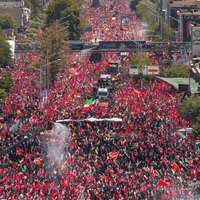
Authorities said “tens of millions” rallied nationwide to back Supreme Leader Ali Khamenei and the Islamic Republic’s ideology on the 47th anniversary of the revolution. Opponents—many still grieving the deaths of thousands shot during January protests—argued that attendance was often compelled and official imagery exaggerated.
State television aired long processions of marchers chanting pro-government slogans.
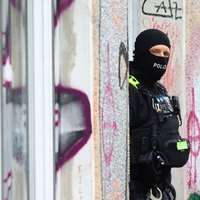
In Tehran, special police units and armored vehicles were deployed in what officials described as a show of stability. Critics said the heavy security presence signaled coercion rather than confidence.
What was presented as a unified celebration instead revealed competing narratives. While state media depicted unwavering loyalty, many Iranians online asserted that genuine political support cannot be measured in choreographed crowds or tightly controlled broadcasts.
Fireworks and counter-chants
Tuesday evening’s commemoration began with fireworks across Tehran and other cities. As in previous years, mosque loudspeakers and Basij bases urged citizens to step outside at 9 p.m. on the eve of the anniversary to chant “Allah-u-Akbar” from rooftops and streets.
But videos posted online from several cities, including Tehran, showed opponents raising anti-government slogans such as “Death to the dictator”, at times drowning out pro-state chants amplified through megaphones.
Clips shared on X and Instagram captured competing chants echoing across neighborhoods, reflecting a contested public atmosphere rather than a single unified voice.
Social media users also accused authorities of pressuring public employees, teachers, conscripts and others to attend the marches. Some alleged that participation was encouraged through incentives, including paid leave or material benefits—even implied threats to job security.
In several cities, critics said buses transported families to designated gathering points despite the anniversary being a public holiday.
One widely circulated claim alleged that relatives of those detained during the January unrest were told that sharing photos or videos of their families attending anniversary rallies could help secure the release of their loved ones. The claim could not be independently verified.
Staged testimonials?
Accusations extended to state media broadcasts. Opponents pointed to a now-viral clip in which the same woman—holding portraits of Khamenei and revolutionary founder Ruhollah Khomeini—appeared in live footage from Qazvin and Khorramabad, cities hundreds of kilometers apart.
One user wrote that the anniversary had produced “a woman teleporting on state TV.”
Others questioned the authenticity of official images, alleging digital manipulation or the reuse of footage, though no conclusive evidence has been publicly presented.
State media also aired interviews with participants including women without traditional hijab expressing loyalty to the leadership. Opposition voices dismissed the segments as staged propaganda.
In one broadcast from Isfahan, a woman said she had joined the marches after 30 years “for love of the Leader, to support the country and Islam against threats.”
In another clip released Wednesday, a woman without a headscarf declared: “Many enemies of Iran said the Islamic Republic would not see this anniversary—we’re glad it didn’t happen because if it had, surely Iran would have split.”
Critics argued such testimonials were carefully selected to project enthusiasm that may not reflect the broader political mood.
During state-organized rallies marking Iran’s 1979 revolution anniversary, demonstrators in several cities burned large statues of a horned, bull-headed figure identified by organizers as “Baal,” an ancient deity referenced in biblical and Islamic tradition.
The burnings, some reported to have taken place at the same time in different cities, were presented by organizers as a symbolic protest linked to renewed online conspiracy theories surrounding the late financier Jeffrey Epstein and alleged child abuse by Western elites.
Iranian news agency Mehr said the effigy represented “the idol of Baal,” described in religious texts as a false god associated with deviation from monotheism.
Participants, chanting “Death to Israel” and “Death to America,” were quoted as saying the act symbolized resistance to what they described as corrupt Western systems and Zionist ideology.
Images circulated by Iranian and foreign media showed a giant statue with a bull’s head engulfed in flames in Tehran’s Azadi Square. Some versions included additional imagery such as the number “666” and references to US President Donald Trump.
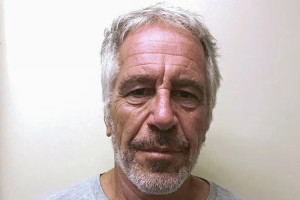
Hardline outlets and channels said the burning was a symbolic reference to documents recently released by the US Justice Department related to Epstein, who was charged in 2019 with running a sex trafficking ring involving underage girls. Epstein died in jail later that year.
Online speculation in recent weeks has revived unverified allegations linking Epstein to ancient deities such as Baal or Moloch, figures that in some traditions are associated with child sacrifice.
Fact-checkers and mainstream media have previously reported that many such claims stem from misinterpretations of financial documents or from longstanding internet conspiracy theories, including allegations about a “temple” on Epstein’s private island that US media said was designed as a music pavilion.
Baal, a title meaning “lord” in ancient Semitic languages, was worshipped by Canaanite peoples in the ancient Near East and is portrayed in Jewish, Christian and Islamic texts as a false deity. Some scholars say there is limited archaeological evidence of child sacrifice practices in parts of the ancient Levant, though interpretations remain debated.
Iranian organizers described the statue burning as a “symbolic protest” aimed at drawing attention to alleged moral corruption in the West.
One conservative outlet linked the initiative to the Masaf Institute, a group associated with propagandist Ali Akbar Raefipour, which has promoted anti-Western and anti-Zionist narratives.
The coordinated burnings formed part of broader anniversary events that included anti-US and anti-Israel slogans, flag burnings and displays criticizing Western governments.
While state media framed the act as a message from Tehran to the world, some Iranian clerics expressed concern about the symbolism, and online users debated whether the act itself risked unintended religious connotations.
The European Parliament on Thursday condemned what it described as systematic repression by Iran’s authorities against protesters and civil society, warning that reported killings during recent unrest could amount to crimes against humanity.
Lawmakers said that the death toll from the latest wave of protests may have reached around 35,000 and called for alleged atrocities to be independently documented by United Nations bodies, with evidence preserved for potential future prosecutions.
In a resolution adopted by 524 votes in favor, three against and 41 abstentions, members of the European Parliament (MEPs) demanded an immediate end to violence against civilians, including arbitrary detentions, enforced disappearances and torture.
They also urged Iranian authorities to stop prosecuting doctors and healthcare workers over treating injured protesters.
The resolution reaffirmed solidarity with the Iranian people, saying they are the “sole legitimate source of sovereignty” in the country, and called on the European Union’s Council and Commission to expand targeted sanctions.
MEPs further pressed the EU and its member states to develop a counter-strategy to support families of detainees and to prevent what they described as Iran’s use of hostage diplomacy.
Lawmakers emphasized that the Islamic Revolutionary Guard Corps (IRGC), designated by the EU as a terrorist organization, plays a central role in the repression.
They also demanded the immediate release of detainees, particularly women activists, including Nobel Peace Prize laureate Narges Mohammadi, and condemned what they called the regime’s oppression of women and minorities.
The parliament adopted similar resolutions on the human rights situations in Türkiye and Uganda on the same day.
The United Nations said a congratulatory letter sent by Secretary-General António Guterres to Iranian President Masoud Pezeshkian on the anniversary of Iran’s 1979 Revolution was a routine diplomatic gesture and should not be interpreted as an endorsement of Tehran’s policies.
UN spokesperson Stéphane Dujarric told Iran International that the message, sent on Iran’s national day, followed a decades-long protocol applied uniformly to all UN member states.
According to the spokesperson’s office, each country receives an identically worded letter on its national day. The messages are prepared in advance and do not signal any shift in the United Nations’ position toward a particular government.
“The letter should not be interpreted by anyone who receives it as an endorsement of whatever policies that government may be putting in place,” Dujarric said during the UN’s daily noon briefing.
The clarification came as Iran faces renewed scrutiny over crackdowns, arrests and reports of repression.
In recent weeks, families across the country have mourned losses, while human rights groups have documented detentions and what they describe as heavy-handed security measures.
News of the letter triggered backlash from activists and members of the Iranian diaspora, who argued that even if the message followed established administrative practice, its timing appeared insensitive given the political tension and public grief inside Iran.
They said the congratulatory tone risked being seen as disconnected from the reality faced by many Iranians demanding accountability and political change.
State-affiliated media in Iran widely amplified the letter, portraying it as a sign of international legitimacy. The coverage further fueled criticism from those who say such messaging can be instrumentalized for domestic political purposes.
The United Nations has repeatedly raised concerns about Iran’s human rights record, including through reports by the Office of the High Commissioner for Human Rights and discussions at the Human Rights Council and General Assembly.
UN officials maintain that diplomatic protocol operates separately from the organization’s human rights monitoring mechanisms.
Still, the episode underscores the tension between institutional diplomatic practice and the sensitivities surrounding governments facing sustained domestic unrest and international criticism.
This keeps it firmly in straight news territory, sharpens the opening, clarifies the backlash, and tightens the language without shifting tone.
One month after a sweeping and deadly crackdown on nationwide protests, Islamic Republic marked its anniversary with state-organized rallies that appeared designed to project strength even as anti-government chants reverberated across neighborhoods nationwide.
The annual commemoration of the 1979 Islamic Revolution has long served as a showcase of mass loyalty. This year, however, it unfolded under the shadow of what critics describe as a deepening crisis of legitimacy following the January bloodshed.
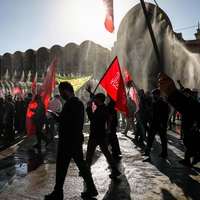
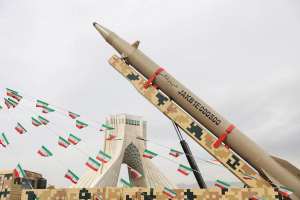
In Tehran, security forces and Basij units maintained a visible presence as supporters gathered in Azadi Square. State media broadcast images of families and children waving flags, and highlighted what it portrayed as festive participation across the country.
Among the more striking displays were symbolic coffins bearing the names and photos of senior US military officials, including US Army Chief of Staff Randy George and CENTCOM Commander Brad Cooper. Cooper was part of the US delegation that recently held talks with Iranian officials in Oman.
American and Israeli flags were also burned during the rally.
The imagery of defiance came as Iranian officials engage in renewed diplomatic contacts with the United States. The juxtaposition reflected a dual message: confrontation abroad and consolidation at home.
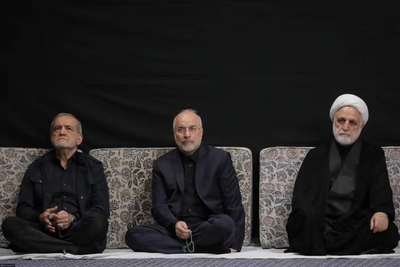
President Masoud Pezeshkian, addressing the rally, repeated the government’s narrative about the recent unrest, accusing protesters of sabotage and violence and saying “no Iranian takes up arms to kill another Iranian.”
Iranian President Masoud Pezeshkian speaks during the 47th anniversary of the Islamic Revolution in Tehran, Iran, February 11, 2026.
He acknowledged widespread dissatisfaction but said the government was prepared to “hear the voice of the people,” while emphasizing loyalty to Supreme Leader Ali Khamenei and adherence to his “red lines” in diplomacy, a tacit reference to Iran’s uranium enrichment, missile program and support for regional militia groups.
State television placed particular emphasis on images of children and families at the rallies, a move that analysts say may reflect efforts to soften the government’s image after weeks of reports about civilian casualties.
Rights advocates have long criticized the use of minors in political events, arguing that it instrumentalizes children for propaganda purposes.
The commemorations took place roughly a month after a violent suppression of protests that erupted in late December.
The editorial board of Iran International said earlier this month that more than 36,500 people had been killed in a targeted crackdown ordered by Khamenei.
Even as the government staged its anniversary spectacle, dissent surfaced in other forms. On the eve of 22 Bahman, residents in multiple neighborhoods of Tehran – including Narmak, Ekbatan, Majidieh and Naziabad – shouted slogans such as “Death to Khamenei” and “Death to the dictator” from rooftops and balconies. Similar chants were reported in cities including Mashhad, Arak, Qazvin, Kermanshah and Shahriar.
Videos circulating online showed nighttime fireworks lighting the sky as anti-government slogans rang out.
In one clip from Arak, residents could be heard chanting against Khamenei in response to mosque loudspeakers broadcasting the traditional “Allahu Akbar.”
In Tehran, one resident said the fireworks were so loud “we thought America had attacked.”
In isolated incidents, pro-government speakers appeared to inadvertently repeat anti-Khamenei slogans during live broadcasts, prompting abrupt cuts in coverage.
One state reporter in Sistan and Baluchestan was heard listing “Death to Khamenei” among rally chants before the feed was interrupted.
Political analyst Iman Aghayari told Iran International that the anniversary had become “an arena of confrontation between the government and the people,” adding that unlike in previous years, authorities seemed less concerned with demonstrating broad public backing and more focused on asserting control.
“This time,” he said, “the regime is not trying to prove people are with it. It is simply declaring that it rules.”
As Iran navigates renewed diplomacy abroad and mounting pressure at home, the 22 Bahman (February 11) anniversary appeared to reflect a widening gap between official displays of unity and the anger that continues to surface beyond the state’s stage-managed events.