Iran says it backs Maduro government after US operation
Venezuelan President Nicolas Maduro shakes hands with Iranian President Masoud Pezeshkian on the sidelines of the BRICS summit in Kazan, Russia October 24, 2024.
Iran’s Foreign Minister Abbas Araghchi told his Venezuelan counterpart Ivan Gil Pinto in a phone call that Tehran supports the people and the elected government of Venezuela, Iran’s foreign ministry said on Sunday.
Araghchi strongly condemned the “US military aggression against Venezuela and the abduction of the country’s legitimate president and his wife,” according to Iran’s foreign ministry.
The statement described the US move as a “clear example of state terrorism, and a blatant violation of Venezuela’s sovereignty and the national will of the Venezuelan people.”
Iran on Saturday denounced the US military attack on Venezuela, accusing Washington of violating international law following reports that American forces had captured Venezuelan President Nicolas Maduro in a military operation.
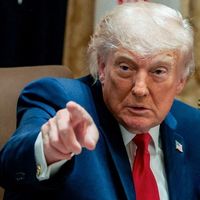
The United States carried out an overnight operation targeting Venezuela and detained Maduro, US President Donald Trump said on Saturday, adding that Washington would assume control of the country for the time being and could deploy American troops if required.
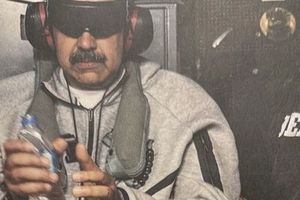
A photo released by US President Donald Trump shows Venezuelan President Nicolas Maduro in handcuffs aboard an aircraft after a US military operation on Saturday, January 3, 2026.
Iran on Saturday denounced the US military attack on Venezuela, accusing Washington of violating international law following reports that American forces had captured Venezuelan President Nicolas Maduro in a military operation.
The United States carried out an overnight operation targeting Venezuela and detained Maduro, US President Donald Trump said on Saturday, adding that Washington would assume control of the country for the time being and could deploy American troops if required.
In a statement, Iran’s Foreign Ministry said the United States had carried out a military aggression against Venezuela, calling it a blatant violation of the country’s sovereignty and territorial integrity.
It said the action breached fundamental principles of the United Nations Charter, including the prohibition on the use of force enshrined in Article 2(4), and described it as a clear act of aggression that should be condemned by the international community.
The statement said the US action undermined regional and international peace and security and warned that its consequences would extend beyond Venezuela, further eroding the international order based on the UN Charter.
Iran's Foreign Ministry urged the United Nations and other states to respond clearly to what it called an unlawful use of force, calling for measures to hold accountable those who planned and carried out what it described as crimes committed during the operation.
Foreign Ministry spokesman Esmail Baqaei also called Iran's ambassador to Caracas, emphasizing "Tehran’s principled position in condemning the US military aggression and the violation of that country’s national sovereignty and territorial integrity."
Baqaei also expressed confidence that "the Venezuelan people, by maintaining national unity and cohesion, will safeguard their independence and national interests and continue on the path of development and progress."
Elon Musk on Saturday congratulated Trump on the capture of Maduro, a staunch ally of Iran's Supreme Leader Ali Khamenei, calling it "a win for the world and a clear message to evil dictators everywhere."
Maduro’s capture has fueled widespread debate on social media about the possibility of a similar scenario in Iran, as Trump has issued warnings to the country’s leadership during nationwide protests.
Iran’s supreme leader on Saturday called the nationwide protests the work of foreign-backed agitators and urged a harsher crackdown, in his first public speech since demonstrations began seven days ago
“A number of agitated people, enemy mercenaries, had positioned themselves behind bazaar merchants and chanted slogans against Islam, against Iran and against the Islamic Republic,” Ali Khamenei said, according to state media.
“Protest is legitimate, but protest is different from rioting,” Khamenei added. “Officials should speak with protesters. Speaking with a rioter is pointless. Rioters must be put in their place,” he said.
The comments marked Khamenei’s first public response to the latest wave of demonstrations, which have intensified amid economic strain and currency volatility.
Khamenei’s language echoed his stance during earlier nationwide protests, including the 2022 “Woman, Life, Freedom” uprising and demonstrations in November 2019, when security forces used lethal force to suppress unrest.
At least eight protesters have been killed so far after being shot by security forces during the current unrest, according to human rights groups. Independent organizations, including Iran Human Rights Organization, previously documented 551 deaths – among them 68 children – during the 2022 protests.
Currency crisis blamed on ‘the enemy’
Khamenei also attributed the protests to economic grievances while assigning responsibility for the currency crisis to foreign adversaries. “These gatherings were mainly by bazaar merchants,” he said, adding that sharp and unstable exchange-rate swings were “not natural” and were “the work of the enemy.”
He accused unnamed actors of exploiting merchants’ complaints to cause “damage and insecurity,” saying such actions were “unacceptable.”
The remarks came as protesters in several cities have chanted for the overthrow of the Islamic Republic and mainly voiced support for the exiled prince Reza Pahlavi.
Confrontation with ‘the enemy’
Khamenei closed by insisting the Islamic Republic would not retreat. “The enemy will not sit quietly and uses every opportunity,” he said, adding that authorities “were and will be present in the field.”
On Friday, US President Donald Trump warned that if Iranian authorities shoot peaceful protesters, the United States would act to help the people.
"If Iran shots and violently kills peaceful protesters, which is their custom, the United States of America will come to their rescue. We are locked and loaded and ready to go," Trump wrote in a message published on his Truth Social account.
Iranian officials responded with warnings toward the United States and Israel.
US President Donald Trump warned on Friday that the United States is “locked and loaded” if Iranian authorities use lethal force against protesters.
Washington would step in if protesters are violently killed, Trump said in a post on Truth Social.
“If Iran shoots and violently kills peaceful protesters, which is their custom, the United States of America will come to their rescue,” he wrote. “We are locked and loaded and ready to go.”
Protests turn deadly
Trump’s remarks came as protests in Iran reached a fifth consecutive day on Thursday, with at least seven protesters reported killed by security forces. Demonstrations spread to new cities, including the clerical stronghold of Qom, where crowds openly called for the downfall of the theocracy.
Earlier, a US official said the protests reflect deep public anger at years of government failure. In a written statement on Thursday, a spokesperson for the United States Department of State described the unrest as an expression of the Iranian people’s “understandable anger.”
“The protests reflect the understandable anger of the Iranian people at their government's failures and excuses,” the official said, accusing Tehran of neglecting the economy, agriculture, water and electricity for decades while “squandering billions on terrorist proxies and nuclear weapons research.” The statement also cited Iran’s involvement in acts of “terrorism against the United States and its allies.”
Demonstrations were reported across dozens of locations, from Tehran and Isfahan to Lorestan, Mazandaran, Khuzestan, Hamadan and Fars. Protesters chanted slogans directly targeting the ruling system and Supreme Leader Ali Khamenei.
Pro-monarchy slogans dominated many rallies, highlighting how the unrest has moved beyond economic grievances into open political defiance. Security forces used live fire in several cities, including Nurabad in Lorestan and Hamedan in western Iran, where videos showed officers shooting at demonstrators who remained in the streets despite the crackdown.
Canada on Wednesday rejected Iran’s decision to designate the Royal Canadian Navy as a terrorist organization, calling the move baseless and politically motivated and reaffirming its sanctions and human rights pressure on Tehran.
John Babcock, a spokesperson for Global Affairs Canada, said the designation had “no basis in fact” and was a retaliatory response to Ottawa’s decision last year to list Iran’s Islamic Revolutionary Guard Corps (IRGC) as a terrorist entity under Canadian law.
“Iran’s announcement is a baseless political reaction to Canada’s lawful decisions regarding national security and international law,” Babcock said in a statement.
Iran’s foreign ministry said the move was taken under a 2019 Iranian law adopted in response to US sanctions, arguing that Canada’s June 2024 listing of the IRGC violated international law. Tehran said it was acting under the principle of reciprocity by applying its counter-terrorism legislation to the Canadian navy.
Canada said its decision to list the IRGC under the Criminal Code followed a “rigorous, evidence-based assessment” that found reasonable grounds to believe the force had engaged in terrorist activity, either directly or through proxies.
Ottawa maintains a policy of “controlled engagement” with Tehran, limiting official contact to Iran’s nuclear program, regional security, human rights and consular issues, Babcock said.
Canada has imposed sanctions on 215 Iranian individuals and 256 entities over what it describes as threats to international peace and security, human rights violations and support for terrorism.
The human rights situation in Iran remains deeply concerning, Babcock said, adding that Canada led a United Nations General Assembly resolution on Iran’s human rights record in 2025. Canada also imposed new sanctions on four senior Iranian officials in December over their alleged involvement in gross and systematic human rights abuses.
Babcock said Ottawa was monitoring reports of protests in Iran and urged Iranian authorities to respect freedom of expression and peaceful assembly.
Canada has no resident diplomatic mission in Iran and advises Canadians to consult official travel advisories before travelling there, citing limited consular capacity.
Iran’s foreign minister Abbas Araghchi (right) and US President Donald Trump
Iran’s foreign minister appealed directly to Donald Trump in a Guardian op-ed on Tuesday, urging him to reopen negotiations with Tehran, reconsider Washington’s alignment with Israel and acknowledge what he described as Iran’s invincibility.
“For those willing to go where no one has gone before, there is a brief window of opportunity,” Abbas Araghchi wrote.
Standing beside Netanyahu, Trump warned that renewed Iranian missile expansion or nuclear advances would trigger a US response.
"We’ll knock the hell out of them," said Trump. “Now I hear that Iran is trying to build up again, and if they are, we’re going to have to knock them down."
In June, Israel and the US carried out coordinated strikes on Iran that severely damaged several key nuclear facilities. Iran retaliated with missile attacks on a US base in Qatar and on Israeli targets. After 12 days of escalation, a ceasefire was reached under US pressure.
Israeli officials say Iran is quietly rebuilding systems damaged during the conflict.
Trump on Monday expressed his support for possible Israeli attacks on Iran if Tehran continues to develop its ballistic missile program.
Israel shaped US policy through 'myths'
Araghchi argued that what he called a “manufactured crisis” over Iran’s nuclear program has long been driven by Israeli narratives, misleading Washington into abandoning the 2015 nuclear deal and adopting a “maximum pressure” strategy that produced only resistance, according to the foreign minister.
“Those myths encouraged Washington to abandon a functional diplomatic framework in favor of ‘maximum pressure’ that only produced ‘maximum resistance’,” he wrote.
He also pointed to what he described as shifting opinion among Trump supporters, saying Israel is increasingly seen as a liability rather than an ally.
“A growing number of Americans – particularly those who want a focus on rebuilding the US – are publicly acknowledging what has been taboo: that uncritical acceptance of Israel’s narratives has drained American resources, undermined American credibility, and entangled the US in conflicts that do not serve American interests,” Araghchi wrote.
Araghchi also said recent conflicts across Gaza, Lebanon, Syria, Iran, Yemen and Qatar have led regional governments to view Israel’s actions as “a threat to us all,” opening space for new diplomatic alignments.
Iran open to negotiations
Araghchi said “mutual friends of Iran and the US” are prepared to help facilitate talks and guarantee implementation of any future agreement, without naming those mediators.
Iran, Araghchi insisted, remains open to negotiations but not to surrender.
“Despite Israel’s attack on diplomacy amid Iran-US nuclear negotiations, Iran remains open to an agreement that is built on mutual respect and mutual interest,” he wrote, warning that Iran’s restraint should not be mistaken for weakness.
Araghchi reiterated that Iran will not give up what it regards as its rights under the Nuclear Non-Proliferation Treaty, including domestic enrichment for civilian use, and said any future deal must include “tangible and verifiable sanctions lifting.”
The unrest, driven by the plunging rial and surging prices, is widening in scope against the leadership and some analysts warn it could threaten the Islamic Republic itself.