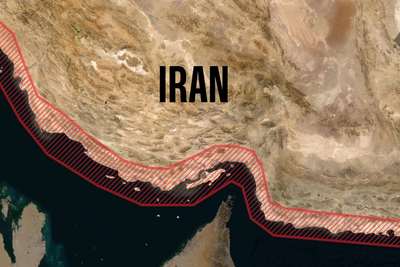
A rocky shoreline on Iran’s Abu Musa island in the Persian Gulf
China’s recent backing of the United Arab Emirates’ claims over three Iranian islands in the Persian Gulf has triggered unusually sharp public criticism of Beijing among Tehran’s hardline supporters.
Official reactions, however, were restrained. Iran’s Foreign Ministry called the claims “baseless,” directing its criticism at the UAE rather than China.
Even the state-run English-language broadcaster Press TV sought to soften Beijing’s position, saying China had merely supported a peaceful resolution “in accordance with the UN Charter and international law.”
No such diplomatic language was used by ultrahardliners.
“China must know that issuing a statement against Iran’s national sovereignty is a miscalculation in a strategic partnership,” conservative lawmaker Ahmad Naderi wrote on X.
He added that Tehran had so far contained its concerns over the treatment of Muslims in Xinjiang and “acted rationally,” but could reassess if its territorial red lines were crossed.
“Beijing cannot treat the One China principle and sovereignty over a rock in the South China Sea as a non-negotiable red line … and apply double standards when it comes to Iran’s territorial integrity,” he wrote.
‘No diplomatic slip’
Hossein Shariatmadari, the editor in chief of the hardline daily Kayhan, was even more direct. In a scathing editorial, he argued that by the same logic China’s sovereignty over Taiwan, Penghu, Kinmen and Matsu—administered by Taipei—could also be questioned.
Shariatmadari warned that Iran could respond by reviving claims over the islands of Ariana and Zarkuh, and even Bahrain, which remained under Iranian sovereignty until August 1971.
The semi-official Mehr News Agency struck a similar tone. “This is no longer an uninformed diplomatic slip, but a serious error—one that cannot be hidden behind words or justifications,” an editorial said, asking: “Is China itself willing to negotiate with other countries over islands under its sovereignty?”
Criticism also came from outside the hardline camp. The establishment daily Jomhouri-ye Eslami, funded by the office of the supreme leader but often skeptical of Iran’s ties with China and Russia, noted that Beijing had now, for the third time in two years, sided with the UAE.
“Even if one accepts such a hypothesis regarding the Chinese president the first time this mistake was made,” the paper wrote, “it cannot explain the second mistake or the foreign minister’s current action.”
It accused China of ignoring Iran’s ownership of Abu Musa and the Tunbs to “extract greater concessions from the UAE,” and faulted Iran’s Foreign Ministry for passivity in the face of similar positions taken by both China and Russia.
Self criticism
The online magazine Emrooz-o Farda described the episode as a test of Iran’s diplomacy and of its partners’ commitment to basic principles.
“From Beijing’s perspective, this may be economic and political balancing,” it wrote, “but from Tehran’s point of view, getting involved in the issue of territorial integrity crosses a clear red line.”
Former diplomat Kourosh Ahmadi, writing in Sazandegi in an article also published by the state news agency IRNA, called the trend deeply worrying. He linked China’s initial endorsement in December 2022 to similar statements by Russia in July 2023 and later European Union references to what they described as Iran’s “occupation” of the islands in October 2024 and October 2025.
“In the absence of negotiation and engagement with the West,” Ahmadi wrote, “Beijing and Moscow see no obligation to factor Iran’s sensitivities into their priorities.”
Journalist Ehsan Mansouri summed up the mood bluntly: “Unfortunately, we have become very weak—and Saudi Arabia and the UAE now matter more to China and Russia than we do.”
Iran is not a war-torn country, yet four decades of Islamic Republic rule have driven mass emigration. UN data show over five million registered refugees or asylum seekers since 1980, with millions more leaving legally – about one in every 15 Iranians now living abroad.
So why have millions of Iranians chosen to endure the hardship of life far from home rather than remain under the Islamic Republic?
This report draws on official United Nations figures for Iranian refugees and asylum seekers, which begin in 1980 – about a year into the Islamic Revolution.
The UN High Commissioner for Refugees (UNHCR) published no figures for Iranian refugees or asylum seekers before 1980, although UNHCR has been collecting refugee statistics since 1951.
Before the establishment of the Islamic Republic in 1979, there were no recorded asylum cases, aside from scholarship students and legal Iranian migrants.
There are, however, personal accounts involving a small number of members of the Tudeh Party – a pro-Soviet Iranian communist party – who fled to the former Soviet Union. One such account concerns Ataollah Safavi, a former Tudeh Party member who, after fleeing to the Soviet Union, was sent to Siberian forced labor camps.
Ali Khamenei kisses the hand of Ruhollah Khomeini, the founder of the Islamic Republic, in an undated image.
First decade: War years under Khomeini’s leadership
The first wave of Iranian asylum began in 1980. Shortly after the Islamic Republic was established, Iranians could still migrate relatively easily using passports issued under the previous government.
In this period, a large number of Iranians traveled legally to the United States.
From 1980, the registration of Iranian asylum seekers began with 44 cases, marking the start of a trend that would accelerate through the decade.
The first ten years, from 1980 to 1989, coincided with the eight-year Iran–Iraq war, the presidency of Ali Khamenei, and the premiership of Mirhossein Mousavi, while Ruhollah Khomeini served as Supreme Leader.
Over that decade, more than 312,000 Iranians were registered as refugees, according to United Nations data.
The peak came in 1985, when more than 88,000 refugees were recorded in a single year – the highest annual total of the decade.
(From left) Ali Khamenei, Akbar Hashemi Rafsanjani, and Mousavi Ardebili
Second decade: Khamenei takes charge
In 1989, Ali Khamenei began his tenure as Supreme Leader of the Islamic Republic, and Akbar Hashemi Rafsanjani took office as president – ushering in what Iran’s official political language calls the “reconstruction” era, a term used for the post–Iran-Iraq war drive to rebuild state capacity and the economy.
By the end of Rafsanjani’s presidency, inflation compared to his first year was up 478%, and the record for Iran’s annual inflation is still attributed to his government at more than 49%.
Against that economic backdrop, the trend in Iranian asylum intensified.
Over the 1990–1999 period, nearly 1.06 million Iranians were registered as refugees, with the peak in 1991, when 130,000 refugees were recorded.
After 1997 – often described in Iran as the start of the “reform era” – the pace of refugee registrations eased for a time, falling to below 100,000 a year.
Former presidents Mahmoud Ahmadinejad (left) and Mohammad Khatami
Third decade: Reform and Ahmadinejad
In 1997, the election of Mohammad Khatami ushered in a period often described as Iran’s “reform” era, bringing a measure of optimism to parts of Iranian society.
During the first three years of Khatami’s presidency, the number of Iranians registered as refugees and asylum seekers declined modestly, before reversing course and rising again.
From 2000 to 2009, nearly 1.1 million Iranians were registered as refugees or asylum seekers, although some cases initially recorded as asylum claims may have been reclassified as refugee status in subsequent years.
A similar pattern emerged under Mahmoud Ahmadinejad, whose early presidency also saw a year-on-year decline in asylum registrations. That trend, however, reversed after his first two years in office.
In 2009, as protests known as the Green Movement erupted following Iran’s disputed presidential election, refugee and asylum registrations reached their highest level of the decade.
The ministers of foreign affairs of France, Germany, the European Union, Iran, the United Kingdom and the United States as well as Chinese and Russian diplomats announcing the framework for a comprehensive agreement on the Iranian nuclear program (Lausanne, April 2, 2015)
Fourth decade: Nuclear tensions and the JCPOA
In the decade spanning 2010 to 2019, Iran’s migration pressures unfolded alongside an increasingly fraught nuclear dispute and repeated economic shocks.
Unlike earlier periods, the trend in Iranian asylum did not ease after Hassan Rouhani took office in 2013, remaining on an upward path even after the JCPOA – the 2015 nuclear accord formally known as the Joint Comprehensive Plan of Action – was signed between Tehran and world powers.
After Donald Trump became US president in 2017, asylum registrations by Iranians rose sharply, reflecting the renewed strain that followed his administration’s tougher posture toward Tehran.
The same period also coincided with the rise of ISIS in Syria and Iraq, adding another layer of regional instability.
Over the decade as a whole, around 1.5 million Iranians were registered as refugees or asylum seekers.
A scene of 2019 protests in Tehran
From Bloody November 2019 to today
“Bloody Aban” is the term commonly used by Iranians to refer to the November 2019 crackdown on nationwide protests, an episode that marked a turning point in the country’s recent political and economic trajectory.
From 2020, Iran’s economic conditions deteriorated further, adding to pressures already created by sanctions and domestic mismanagement.
In the years following 2019, the overall trend in Iranian asylum and refugee registrations moved upward, with the exception of 2022, when the numbers temporarily eased.
This period was also shaped by the COVID-19 pandemic, which compounded existing strains.
In Iran, pandemic-related restrictions were imposed in 2019 and were fully lifted in 2022.
Across the six years that followed, 1,266,000 people were registered as asylum seekers or refugees.
One in every 15 Iranians lives outside Iran
United Nations data show that trends in Iranian asylum do not closely track changes of administrations in Tehran, suggesting that leaving the country has been driven more by long-term structural pressures than by shifts between governments.
There is no single, definitive figure for the total number of Iranians living abroad.
Domestic sources such as Iran’s Migration Observatory estimate the number of Iranian migrants at around two million.
Iran’s Foreign Ministry places the figure at about four million, a total that includes people born in Iran as well as a second generation born abroad.
Even so, UN data show that from 1980, when registrations of Iranian asylum seekers began, until today, 5,183,000 Iranians have been registered as asylum seekers or refugees, reflecting the scale of forced or protection-based departures over more than four decades. Of that total, nearly 4,142,000 are recorded as refugees.
Taken together with estimates that nearly two million Iranians have also left the country through legal migration, the combined figures point to a stark conclusion: roughly one in every 15 Iranians now lives outside the country.
From the outside, Iran’s migration story can appear singular. In reality, it spans legal migration and forced displacement, driven by a combination of economic pressure and political anxiety.
Many Iranians describe the same trade-off: accepting language barriers, unfamiliar cultures, and separation from family in exchange for the belief that staying offers little stability or future.
Iranian President Masoud Pezeshkian gestures in this file photo
Iran’s president is facing growing heat as moderate allies turn against him, arguing that his promised government of national consensus has instead lost its authority and internal cohesion.
Over the past month, three senior aides have resigned, while persistent rumors point to the possible departure of Vice President Mohammad-Reza Aref and several cabinet ministers, either voluntarily or under pressure from the hardline-dominated parliament.
The wave began last month when Fayyaz Zahed, a member of the Government Information Council (GIC), resigned, citing restrictions on expressing his views and the appointment of well-known conservatives under the banner of “national consensus.”
“Whatever this is, it is not consensus; it is distortion,” Zahed wrote on X.
A university professor and head of the Tehran Journalists’ Trade Association, Zahed had repeatedly criticized limits on free expression, judicial independence and media freedom.
More departures
Within days, Mohammad Mohajeri, another GIC member and a prominent journalist, resigned, citing similar concerns.
The third departure came last weekend, when the sociologist Mohammad-Reza Javadi-Yeganeh announced on X that he was leaving the Center for Public Communications in the president’s office and returning to academia.
“The reality is that people suffer not only from countless economic problems but also from unnecessary restrictions and interventions,” Javadi-Yeganeh wrote on X, criticizing the administration for shelving a key promise to lift internet restrictions in the face of hardline pressure.
Javadi-Yeganeh had recently shared part of a confidential survey conducted by the Iranian Students Polling Agency (ISPA) on behalf of the presidency, which some political groups said suggested public dissatisfaction approaching 92 percent.
‘Political erosion’
Many moderates in Tehran have framed the resignations as an ominous sign for the administration’s political future.
“Reformists and media outlets supporting the government will no longer pass over this issue so easily,” the news website Rouydad24 wrote in an editorial.
Another editorial, published by the moderate outlet Rooz-e No, warned of a phase of “political erosion” that it said was now visible both outside the government and within the circles close to President Masoud Pezeshkian.
Rooz-e No argued that the resignations, combined with rumors of further departures, mounting pressure from a hardline parliament and the prospect of impeaching key ministers, point to a deeper crisis.
‘Limping’ government
The political strain is unfolding against a backdrop of worsening economic conditions.
Recent government measures aimed at stabilizing the exchange rate and raising gasoline prices have driven up the cost of goods and services, including food and transportation, while shortages of some medicines have worsened.
Critics say the deteriorating economy has not translated into changes in economic leadership, particularly where such moves could carry political costs for Pezeshkian.
They point in particular to Central Bank Governor Mohammad Reza Farzin, who Pezeshkian retained from the conservative administration of Ebrahim Raisi and appears unwilling—or unable—to touch.
"Not even a word about resignation or at least an apology,” journalist Hamid Shojaei exclaimed in an article in moderate daily Arman-e Melli, arguing that it was only the reform-minded like former economy minister Nasser Hemmati and former adviser Ali Tayebnia who pay for the crisis.
“The cycle of resignations will continue,” Shojaei warned Pezeshkian on X. “Is your national consensus not limping? Where are you headed to?”
Venezuela's President Nicolas Maduro points towards supporters, during a march to commemorate the Battle of Santa Ines, on the same day Venezuelan opposition leader Maria Corina Machado was awarded the 2025 Nobel Peace Prize in Norway, in Caracas, Venezuela, December 10, 2025.
A former Iranian lawmaker, citing the fate of Iran’s claims after the fall of Syria’s Bashar al-Assad, urged Tehran to move quickly to recover what he said were more than $2 billion of assets in Venezuela, as Washington escalated pressure on Caracas.
Heshmatollah Falahatpisheh said on Tuesday that Iran should urgently clarify the legal status of more than $2 billion in claims against Venezuela, warning that experience from Syria showed how quickly assets could become unrecoverable after a sudden political collapse.
Writing on X, Falahatpisheh said lessons from Syria showed the need to settle Iran’s outstanding claims with President Nicolás Maduro’s government while conditions allow.
His remarks come against a backdrop of sharply rising tensions between Washington and Caracas.
On Tuesday, US President Donald Trump ordered what he called a “total and complete blockade” of sanctioned oil tankers entering or leaving Venezuela.
The move is part of a broader US pressure campaign targeting Maduro’s main source of revenue and follows the seizure of a sanctioned tanker off Venezuela’s coast last week.
While Falahatpisheh’s warning was framed by the experience of Syria – where the scale of Damascus’s debt to Tehran only became public after the fall of Bashar al-Assad, estimated by Syrian officials at around $30 billion – his comments coincided with Trump’s latest order on Venezuelan oil shipments.
Iran and Venezuela, both under heavy international sanctions, have built extensive but opaque economic ties over the past two decades.
Public records do not clearly show how much Iran has invested in Venezuela, the exact size of Caracas’s debt to Tehran, or the value of Iranian assets in the country, according to an article by Iranian outlet Fararu last week.
Iranian lawmakers have previously flagged specific claims. In August, MP Ahmad Bigdeli said Venezuela owed about $1 billion to Iran’s national oil company, urging Iran’s oil minister to explain why the debt had not been recovered. No official update has since been provided.
Iran has launched or participated in a range of projects in Venezuela, many of which have struggled.
A large Iranian-backed supermarket in Caracas, Megasis – opened in 2020 and linked to Iran’s Etka retail chain – has faced logistical problems due to infrequent shipping and supply disruptions, according to Iranian business figures cited by Fararu.
Joint automobile production, launched in 2006 with Iran Khodro and Saipa assembling Samand and Pride models in Venezuela, was halted in 2015 after years of losses and unpaid deliveries, Iranian media have reported. The project was revived in 2023 during a visit by former president Ebrahim Raisi, though analysts again questioned its economic viability.
Iran has also announced agricultural, housing and industrial ventures, including claims in 2021 that Venezuela had allocated up to one million hectares of farmland to Iran for overseas cultivation.
Officials have not clarified whether those plans are active or how much capital was committed.
Venezuela's President Nicolas Maduro marches in a rally against a possible escalation of US actions toward the country, in Caracas, Venezuela, November 25, 2025.
Oil, gold and sanctions pressure
Energy cooperation has been central to the relationship. Iran has supplied fuel, refinery services and technical assistance to Venezuela, while Western media and sanctions authorities have alleged barter arrangements involving oil and gold.
Bloomberg reported in 2020 that Venezuela transferred around nine tons of gold to Iran in exchange for fuel – a claim both governments have framed as legitimate barter.
Since US sanctions were imposed on Venezuela in 2019, much of its oil – including shipments involving Iranian or Russian-linked vessels – has relied on a so-called shadow fleet to evade restrictions.
Trump’s latest order has already pushed oil prices higher on expectations of reduced Venezuelan exports, Reuters said, though enforcement mechanisms remain unclear.
Analysts warned that a prolonged blockade could sharply cut Venezuelan output, with potential spillover effects for Iran, which has used Venezuela as a distant logistical and commercial partner to manage sanctions pressure.
In an analysis for Iran International, Shahram Kholdi wrote earlier this month that Venezuela has functioned as a strategic “distant flank” for Tehran, facilitating oil swaps, financial channels and political support beyond the Middle East.
But expanded US military deployments, legal actions and sanctions enforcement are tightening scrutiny on those networks.
Further allegations have added to the sensitivity. Spain’s ABC newspaper reported this month – citing leaked documents now under US review – that Venezuelan state mechanisms may have funneled billions of dollars toward Iranian entities over nearly two decades, including groups linked to Iran’s nuclear and military programs.
The claims, which Caracas and Tehran have not publicly addressed, remain unproven but are being examined by US authorities, according to the report.
“Projects and funds explicitly linked to Iran total about $4.69 billion, with an additional estimated $3.13 billion allegedly diverted indirectly from a China-Venezuela fund. The combined total about $7.82 billion – represents money that investigators say reached Iran's state ecosystem directly or indirectly through Venezuela,” read a report by The Latin Times.
Venezuela's President Nicolas Maduro speaks at the Miraflores Palace in Caracas, Venezuela, November 11, 2025.
US Senator Lindsey Graham on Tuesday expressed disappointment that Washington had not more clearly committed to toppling Venezuelan President Nicolas Maduro, calling his continued rule a boon to Iran and terrorism.
Graham, a veteran foreign policy hawk representing South Carolina, was speaking to reporters after being briefed along with dozens of other senators on Venezuela strategy by Secretary of State Marco Rubio and Defense Secretary Pete Hegseth.
"If, after all this Maduro is still in power. That's the worst possible signal you could send to Russia, China, Iran," said Graham, "I want to reassert again, you cannot allow this man to be standing after this display of force."
The United States has ramped up a military deployment in the Caribbean as part of a pressure campaign on Venezuela and its leader Nicolas Maduro. US attacks on alleged drug boats there and in the Pacific have killed at least 87 people, in strikes which Democratic opponents and rights groups say violate the laws of war.
The Trump administration has branded Maduro a narco-terrorist and said drug flows from Venezuela kill innocent Americans and justify a wartime approach.
Trump has vowed to extend US attacks to the mainland and said in an interview last week that Maduro's "days are numbered," without elaborating.
His influential chief of staff Susie Wiles told Vanity Fair in an interview published on Tuesday that "(Trump) wants to keep on blowing boats up until Maduro cries uncle."
"I want clarity right here," Graham added in his remarks to reporters. "I want us to be level with the American people on what we're doing. I think we're doing a good thing. I think we're making us safer as a nation. We're cleaning up our backyard."
"Too many Americans have died ... he's aligned with Hezbollah. There's a million reasons you want Maduro to go, but just say it. Just say, this man in our backyard runs a narco-terrorist state along with international terrorists."
US Secretary of State Marco Rubio last week cast Venezuela as a regional platform for Iranian influence, describing Maduro’s government as a narcotics transit hub that hosts Iran’s Revolutionary Guards and its Lebanese ally Hezbollah.
Little public evidence exists about the security relationship Venezuela has with Iran or its armed allies. Tehran and Caracas boosted ties under Maduro's predecessor Hugo Chavez, who cast himself as a bulwark against what he called American imperialism.
Maduro has rejected US accusations that he runs a drug cartel and calls the military buildup in the region a bid to impose Washington's will on his oil-rich country.
Trump has presented himself as a peacemaker, as a leader who is ending wars as he puts it through a so-called peace through strength strategy.
The Trump administration's new National Security Strategy (NSS), released earlier this month, makes an argument for a hands-off approach to the Middle East, while showing clear willingness to lean into tensions with Venezuela.
While the Trump administration maintains their main efforts are about combatting alleged drug smuggling, Graham sees US posturing as signaling regime change, demanding clarity.
"I want clarity right here, President Trump is saying his days are numbered. That seems to me that he's got to go," Graham said.
IAEA chief Rafael Grossi shakes hands with Iranian foreign minister Abbas Araghchi at a ceremony in Cairo, Egypt on September 9, 2025.
Iran's mission to the United Nations signaled its opposition to the head of world body's nuclear watchdog becoming UN secretary general next year, saying Rafael Grossi's silence on US-Israeli attacks on Iran showed he did not value international law.
The replacement for António Guterres is due to be chosen next year and serve from 2027 to 2031. Argentina last month named its native son Grossi, 64, to fill the position and he is considered a top contender.
Since 2019, Grossi has led the International Atomic Energy Agency as it attempted to manage the still festering Iran nuclear dossier, which came to a head last year with surprise US and Israeli attacks on Iran's nuclear sites in a 12-day war in June.
Iran’s Ambassador and Permanent Representative to the United Nations, Amir Saeid Iravani appeared to single Grossi out without naming him in remarks to the Security Council on Wednesday.
“A candidate who has deliberately failed to uphold the UN Charter—or to condemn unlawful military attacks against safeguarded, peaceful nuclear facilities," he said, "undermines confidence in his ability to serve as a faithful guardian of the Charter and to discharge his duties independently, impartially and without political bias or fear of powerful States, as required under the Charter.”
Iran denies seeking a nuclear weapon but Israel and Western states doubt its intentions, especially after Grossi's IAEA flagged in the months running up to the conflict that Iran's enrichment activities were ramping up.
The country's uranium stock refined to up to 60% had hit nearly 275 kilograms, Grossi warned, which according to an IAEA yardstick was enough in principle for six nuclear bombs if enriched further.
No civilian purpose existed for such activities, Grossi warned.
The United States held five rounds of negotiations with Iran over its nuclear program earlier this year, for which US President Donald Trump set a 60-day deadline.
When no agreement was reached by the 61st day on June 13, Israel launched a surprise military offensive followed by US strikes on June 22 targeting key nuclear facilities in Isfahan, Natanz and Fordow.
The attacks killed nuclear scientists along with hundreds of military personnel and civilians. Iranian counterattacks killed 32 Israeli civilians and an off-duty soldier.
Grossi did not offer any assessment of the conflict but has worked to try to restore inspections of stricken sites in an effort Iran has largely opposed as diplomacy stays in a deep post-war freeze.
The United Nations has struggled to influence conflicts which have raged in the Middle East and Europe in recent years, earning the ire of both its critics and advocates who hope it can play a greater role in multilateral peace efforts.
Iran's intervention appeared to be the most substantive challenge yet to Grossi's bid.
Iravani said a UN secretary-general must have “a clear and non-derogable responsibility” to safeguard member states' rights and their equal participation in the global system.
“Failure to do so weakens the United Nations and erodes the principle of sovereign equality at the heart of the UN system,” he said.