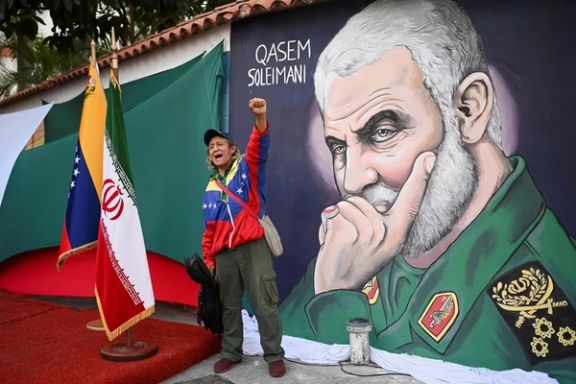
A man raises a fist alongside the flags of Venezuela and Iran, in front of a mural depicting slain commander of the IRGC's Quds Force Qasem Soleimani in Caracas
Tehran warily watches events in the Caribbean as its ally Venezuela faces the largest US military deployment in the region in decades, which US officials describe as a bid to confront narco-terrorism
The United States has accused figures close to Venezuelan president Nicolás Maduro of involvement in trafficking into the US.
Uncertainty spiked over the weekend after President Donald Trump declared Venezuela’s surrounding airspace “closed in its entirety,” though he later cautioned reporters not to “read anything into it” regarding immediate military action.
Over two decades, this “Axis of Necessity” has evolved into a channel through which each side supplies what the other lacks: technology, crude oil and refined fuel, political backing abroad and trade routes safe from sanctions.
Logistical artery
The partnership now functions as a dual-use logistical route linking Tehran and Caracas.
When Venezuela’s refineries faltered, Iran sent technical teams and arranged barter-based energy swaps; when Tehran needed additional outlets for crude, Venezuelan shipments helped maintain cash flow and reservoir management.
Western sanctions authorities say financial intermediaries on both sides have facilitated transactions designed to bypass traditional banking scrutiny.
Gold-for-fuel exchanges emerged as a way to secure hard assets where access to formal channels was limited. Cooperation has also extended into areas with potential military relevance.
These arrangements provided Iran a degree of strategic depth: a distant space where technology, training and covert finance could operate with reduced visibility.
That space is now tightening. With carriers, bombers and surveillance platforms operating near Venezuelan shores, the risk of disruption to sensitive shipments has grown.
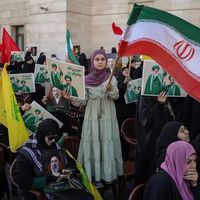
Protesters hold up posters in support of Venezuela, in front of the Swiss embassy in Tehran, which represents US interests in Iran, November 2025
The Hezbollah factor
Iran’s regional strategy depends heavily on non-state partners, especially Hezbollah.
Tehran’s adversaries accuse the group of fundraising in South America through smuggling routes, financial intermediaries and more recently, digital-currency channels.
As the group absorbs battlefield losses and financial strain, its reliance on overseas networks becomes more consequential.
Analysts of proxy finance argue that the Western Hemisphere offers strategic redundancy: if Middle-Eastern channels are disrupted, South American ones can help sustain the organization.
But those networks are themselves under renewed pressure.
Expanded US deployments near Venezuela increase exposure for facilitators who once operated with relative obscurity.
What was envisioned as a fallback corridor is now monitored by carrier strike groups, sanctions investigators and intelligence-sharing partners.
Legal reckoning?
If the Caribbean illustrates military deterrence, Buenos Aires represents a different form of constraint.
Argentine courts and prosecutors have advanced proceedings linked to the 1994 AMIA bombing, issuing findings that senior Iranian officials bear responsibility and designating the attack a crime against humanity.
Warrants and arrest-related measures have followed, some now proceeding in absentia so that non-cooperation no longer halts the process.
Tehran disputes these conclusions, but the judicial record being assembled carries growing diplomatic implications.
This legal trajectory erodes the old perception of Latin America as a permissive periphery. It raises personal risk for senior Iranian figures travelling abroad and increases potential financial exposure for entities linked to designated individuals.
Even without immediate enforcement, these foundations strengthen the prospect of future repercussions.
A less hospitable hemisphere
Three structural trends now converge: tightening maritime surveillance, expanding legal accountability and increased financial scrutiny through sanctions enforcement.
None of this suggests an imminent rupture. Oil can change flags; networks can adapt; facilitators can adopt new identities and routes. But the cost curve has shifted.
Iran has long viewed Latin America as a distant flank—a place where ideology, trade and covert influence could be pursued with limited friction.
That assumption is weakening. A hemisphere once defined by permissiveness is becoming a contested theatre shaped by US presence, judicial persistence and financial vigilance.
The logistical link between Caracas and Tehran still functions. It continues to serve both countries in their shared struggle against sanctions and isolation. But it now faces unprecedented pressure.
And if current trajectory hold, what was once adopted as an avenue of survival may, over time, become an axis of vulnerability.
Iran’s army has expanded electronic surveillance along its borders using advanced cameras and sensors, the commander of the army’s ground forces said on Tuesday.
Brigadier General Ali Jahanshahi told reporters that the upgrades are part of a broader effort to strengthen defenses and prevent illegal crossings. “In addition to new bases and watchtowers, border monitoring is being carried out electronically with advanced cameras and sensors,” he said.
He said construction of a border wall in eastern Iran is under way using domestic contractors and materials, combined with wire fencing and electronic detection systems. The aim, he said, is to curb smuggling and unauthorized movement across the frontier.
Jahanshahi added that the army’s ground forces, operating ten combat brigades, defend Iran’s western, southern and eastern borders alongside police and border guards. The joint operations, he said, have been effective in reducing drug trafficking and cross-border crime.
He also announced plans for a new “Eghtedar” (Power) military exercise in central Iran, saying recent drills have focused on upgrading weapons, tactics and coordination with other branches of the armed forces.
File photo shows visa applicants gathering outside the German embassy in Tehran.
Germany’s embassy in Tehran is operating with sharply reduced visa capacity and expects constraints to persist, the Foreign Office said, citing Iran’s restrictive accreditation of diplomatic staff and significant technical hurdles at post.
The ministry told Iran International that since the June 2025 Iran-Israel hostilities, the embassy has worked in a limited capacity, and both the embassy and its visa section “will, for the foreseeable future, have only a fraction of the personnel” they had before the temporary shutdown.
The reduction of operations “is due in particular to Iran’s restrictive policy on accrediting diplomatic personnel,” read the statement.
Despite the squeeze, Berlin said processing has been gradually expanded in recent weeks by outsourcing application intake to an external service provider and moving case handling to the Federal Office for Foreign Affairs.
“These steps have created additional processing capacity,” the ministry said, adding that the changes especially benefit student-visa applicants and Iranian physicians applying for visas to complete professional recognition procedures in Germany.
Appointment rules have also been adjusted “to ensure the largest possible number of applications can be accepted via the external provider,” the Foreign Office said.
It cautioned, however, that “despite these tangible improvements,” limitations at the Tehran post will remain for the time being.
Germany’s visa services in Tehran have operated at reduced capacity since the June 2025 Iran–Israel conflict, when the embassy temporarily closed, canceled appointments, and said new dates would be issued automatically as capacity allows.
Applicants report prolonged delays and uncertainty, staging weekly protests outside the embassy and TLScontact.
Iranian paper Shargh estimated more than 6,000 delayed cases, including about 4,000 family-reunification files, while IRNA previously put 3,000–4,000 Iranian passports as stuck in foreign missions after wartime closures.
Finnish tugboat Ukko sails near the Cook Islands-flagged tanker Eagle S off Porkkalanniemi, Kirkkonummi, in the Gulf of Finland, December 28, 2024, as authorities move the impounded vessel carrying Russian oil toward the inner anchorage of Svartbäck near the port of Kilpilahti.
Dozens of foreign tankers suspected of transporting sanctioned crude for Iran and Russia sailed under the Cook Islands flag in 2024-2025, according to an AFP analysis of US and UK sanctions data.
AFP reported that at least 34 ships linked to suspected sanctions evasion were Cook Islands–flagged over the period, including 20 cited on US sanctions lists and a further 14 on a British blacklist.
The flag is administered by Maritime Cook Islands, a private operator that runs the registry for the self-governing Pacific territory.
The analysis said shipowners could obtain Cook Islands papers without visiting the country, using a small beachside office – located next to a pizza shop – as their point of contact. The office serves as the headquarters for what AFP described as one of the world’s fastest-growing shipping registries.
New Zealand, which has a free-association relationship with the Cook Islands and retains responsibilities that include foreign affairs, said the findings show a policy divergence with the microstate and that Wellington has repeatedly raised concerns with its government.
“New Zealand continues to hold serious concerns about how the Cook Islands has been managing its shipping registry, which it has repeatedly expressed to the Cook Islands government over many years... This is a completely unacceptable and untenable foreign policy divergence,” said a spokesman for Foreign Minister Winston Peters.
Maritime Cook Islands said it does not harbor sanctioned vessels and that any ships accused of sanctions-busting are promptly deleted from the registry, adding that it conducts due diligence checks before registration.
Western sanctions aim to limit oil revenue for Tehran and Moscow.
Analysts say a “shadow fleet” uses reflagging, opaque ownership and ship-to-ship transfers to move cargoes outside mainstream maritime services – a practice that places added scrutiny on flag registries as enforcement widens to entities connected to suspect voyages.
A part of Iron Beam laser anti-missile interception system, developed by Israel, is seen in this handout image obtained by Reuters on September 17, 2025
Israel’s Iron Beam high-power laser interception system will enter initial operational service with the Israel Defense Forces by 30 December, officials announced on Monday.
Brigadier General Daniel Gold, head of the Defense Ministry’s Research and Development Directorate, confirmed the handover date at the International Defense Tech Summit in Tel Aviv.
“With development complete and a comprehensive testing program that has validated the system’s capabilities, we are prepared to deliver initial operational capability to the IDF on 30 December 2025,” Gold said. “The Iron Beam laser system is expected to fundamentally change the rules of engagement on the battlefield.”
‘Shoot down with light’
Yuval Steinitz, chairman of Rafael Advanced Defense Systems and former Israeli finance minister, described Iron Beam as a “laser revolution.”
“For the first time in human history, we are able to shoot down missiles, rockets, even artillery shells, mortar shells, cruise missiles, and airplanes, not with projectiles but with light,” Steinitz cited by the Misgav Mideast Horizons Podcast.
Steinitz said that Lite Beam, a smaller version, already intercepted around 50 Hezbollah drones in October 2024.
"Each Iron Beam interception costs about $3 - compared with $50,000 for an Iron Dome missile and $5,000–$10,000 for enemy rockets - and operates at the speed of light, enabling immediate interception over launch areas and reducing shelter alerts," Jewish Insider cited Steinitz as saying.
“Combined with Iron Dome and David’s Sling, the system will push interception rates close to 100 percent against threats from Gaza and Lebanon,” Steinitz said, adding that lasers will not fully replace kinetic interceptors in the near term due to weather and saturation issues.
Israel currently operates a multi-layered missile defense network comprising Iron Dome, David’s Sling, Arrow 2, Arrow 3 and the forthcoming Arrow 4.
The Iron Dome is a short-range system that intercepts rockets and artillery shells with a range of 4-70 km (2-43 miles). It uses radar to detect and track threats, and its interceptors destroy them mid-air.
Arrow 3 and Arrow 4 are long-range ballistic missile defense systems. Arrow 2 intercepts missiles in the upper atmosphere, while Arrow 3 targets them in space, making it effective against threats such as Iran’s ballistic missiles.
David’s Sling is a medium-range defense, intercepts tactical ballistic missiles, cruise missiles, and drones (40-300 km, 24-186 miles range).
Steinitz said Rafael likely might develop longer-range laser systems to counter missiles fired by Iran and Yemen’s Houthis in recent years.
Despite high rate of interception rate, some Iranian missiles penetrated Israel's multi-layered defense systems during a12-Day war in June.
US President Donald Trump and Israel's Prime Minister Benjamin Netanyahu talk in the midst of a joint news conference in the White House in Washington, US, January 28, 2020
US President Donald Trump and Israeli Prime Minister Benjamin Netanyahu discussed regional issues including Iran on Monday, CNN reported, as Israeli defense officials warned that a renewed conflict was possible.
Earlier, a statement from Netanyahu’s office said the Israeli prime minister spoke with Trump but did not mention the two leaders had discussed Iran.
The statement added Trump invited Netanyahu to a meeting at the White House in the near future.
CNN's report comes as Israeli media cited Israeli Defense Ministry Director-General Amir Baram as saying that the country is developing more new technologies to prepare for the next potential war against Iran.
"Enemies are learning and adapting. We are at a pivotal point before a new paradigm takes place," the Jerusalem Post quoted Baram as saying at the International DefenseTech Summit in Tel Aviv on Monday.
“Iran’s rapid force buildup in air defense and ballistic missile capabilities,” driven by “its extremist ideology” means that “all fronts are still open” and the Israeli military must be ready for another conflict, Baram said according to the Jerusalem Post.
Speaking at the same conference on Thursday, Daniel Gold, head of Israel’s Defense Ministry Directorate of Defense Research and Development (DDR&D), said the country’s new laser defense system will be rolled out by the end of December.
“The Iron Beam laser system is expected to fundamentally change the rules of engagement on the battlefield," Gold said.
"With development complete and a comprehensive testing program that has validated the system's capabilities, we are prepared to deliver initial operational capability to the IDF,” he added, referring to the Israeli military.
Speaking to Iran International, Farzin Nadimi, senior researcher on defense and security at the US-based Washington Institute think tank, said both Iran and Israel were seeking to shape their adversary's calculations with their public statements.
Iranian military and political leaders have vowed a punishing response to any renewed Israeli attack.
“In this war of long-range strikes, the psychological dimension and the battle of narratives are just as important as the missiles and bombs exchanged between Iran and Israel,” he said.
“They see it as an important part of the deterrence they are trying to create against the other side.”