• العربية
  • فارسی
Brand
  • Iran Insight
  • Politics
  • Economy
  • Analysis
  • Special Report
  • Opinion
  • Podcast
  • Iran Insight
  • Politics
  • Economy
  • Analysis
  • Special Report
  • Opinion
  • Podcast
  • Theme
  • Language
    • العربية
    • فارسی
  • Iran Insight
  • Politics
  • Economy
  • Analysis
  • Special Report
  • Opinion
  • Podcast
All rights reserved for Volant Media UK Limited
volant media logo

Western proposals to delay Iran sanctions were ‘humiliating’, Araghchi says

Sep 27, 2025, 18:55 GMT+1

"The three European countries and the United States expected Iran to give up all its nuclear material or hand it over to them, in exchange for delaying the activation of the snapback mechanism by three or six months, Iran's foreign minister said on Saturday.

"This is the height of a “brazen” approach toward us, and we will not submit to such humiliation," Abbas Araghchi told Iran's state TV.

"Iran will not accept the humiliating pressure over snapback. The European countries and the United States tried to extort concessions from Iran by creating fear of activating the snapback mechanism," he said.

"We have no doubt about the peaceful nature of our nuclear program, and we are ready to build trust, provided that the Iranian people’s inalienable right to enrich uranium is respected," the Iranian foreign minister said.

Legal battle at Security Council

Iran's foreign minister said Tehran will start a legal battle at the UN Security Council next month as it believes the snapback mechanism has not been activated and once Resolution 2231 expires on Oct. 18, all sanctions will be terminated.

"China and Russia also believe that the activation of the snapback is illegal, and on October 18 all sanctions on Iran will end as per UNSC Resolution 2231," Araghchi said.

Most Viewed

Iran diplomacy wobbles as factions compete to avoid looking soft on US
1
INSIGHT

Iran diplomacy wobbles as factions compete to avoid looking soft on US

2
ANALYSIS

The politics of pink: how Iran uses cuteness to rebrand violence

3

Scam messages seek crypto for ships’ safe passage through Hormuz, firm warns

4
EXCLUSIVE

Family told missing teen was alive, then received his body 60 days later

5
TEHRAN INSIDER

The future has been switched off here

Banner
Banner

Spotlight

  • Diplomacy tolls at Hormuz as conflict returns to its doorstep
    OPINION

    Diplomacy tolls at Hormuz as conflict returns to its doorstep

  • Opposition to US talks grows in Tehran as ceasefire deadline nears
    INSIGHT

    Opposition to US talks grows in Tehran as ceasefire deadline nears

  • Tehran moderates see ‘no deal–no war’ limbo as worst outcome
    INSIGHT

    Tehran moderates see ‘no deal–no war’ limbo as worst outcome

  • The future has been switched off here
    TEHRAN INSIDER

    The future has been switched off here

  • Lights out, then gunfire: Witnesses recount Mashhad protest crackdown
    VOICES FROM IRAN

    Lights out, then gunfire: Witnesses recount Mashhad protest crackdown

  • Is Iran entering its Gorbachev moment?
    INSIGHT

    Is Iran entering its Gorbachev moment?

•
•
•

More Stories

Germany says Iran sanctions will be reimposed later today

Sep 27, 2025, 18:38 GMT+1

"Since Iran clearly does not comply with its obligations under the Joint Comprehensive Plan of Action agreed to in 2015, we had no choice but to trigger the snapback of sanctions," German Foreign Minister Johann Wadephul said Saturday.

"Following a clear vote by the Security Council yesterday, sanctions will be effective later today," he told the UN General Assembly.

"But let me emphasize that we remain open to negotiations on a new agreement. Diplomacy can and should continue."

100%

Lavrov accuses West of sabotaging diplomacy after UN vote on Iran

Sep 27, 2025, 18:06 GMT+1

Russia's foreign minister told the UN General Assembly that the West's rejection of "a rational proposal by China and Russia to extend the 2015 Iran deal in order to allow time for diplomacy.. finally exposed the West's policy of sabotaging the pursuit of constructive solutions."

It also exposed the West's "desire to extract unilateral concessions from Tehran through blackmail and pressure," Sergei Lavrov said.

"We consider such a policy to be unacceptable and consider all manipulations to restore anti-Iranian UN sanctions as well as the sanctions themselves to be illegal."

100%

Iran’s intelligence mocked by allies and foes over 'secret' Israel files

Sep 27, 2025, 17:55 GMT+1
•
Maryam Sinaiee

A documentary released by Iran’s Intelligence Ministry claiming infiltration into Israel has drawn ridicule from both opposition groups and hardline loyalists of the Islamic Republic who criticized it for relying on public images and exaggerating its claims.

The documentary, The Spider’s Hideout, aired on state television on September 24, presenting alleged intelligence on Israeli nuclear sites, including Dimona.

Intelligence Minister Esmaeil Khatib described it as "a major infiltration yielding a treasure of top-secret intelligence," seemingly in response to criticism of his ministry’s failures during Israel’s June campaign.

Independent reviews, however, revealed that most images were publicly available online. Critics noted some visuals depicted Israel’s nuclear research collaboration rather than weapons programs, and the individuals named were publicly known Israeli Atomic Energy officials.

The incident has raised concerns about the inefficiency of Iran's intelligence apparatus and its propaganda methods.

Mehdi Kharratian, head of an Iranian think tank close to power circles, wrote: "Superiority must be shown not in the media but in the field—by raising levels of deterrence and increasing the costs to any enemy that acts against the country's security."

He also urged the establishment of a fact-finding committee to address inefficiencies and security gaps within the intelligence apparatus.

Guards-linked outlets admit use of online photos

Fars News Agency, affiliated with the Revolutionary Guards (IRGC), acknowledged using archival images, describing the choice as “poor judgment” that allowed critics to call the documentary “fabricated.”

It confirmed that all images, including archived ones, were labeled as “exclusive photos.”

Mashregh News, also linked to the IRGC, claimed the documents came from human sources inside Israel and were used in targeting sites during the 12-day war.

While admitting some images were available online, it alleged Israel had waged a Persian-language social media campaign to discredit the documentary.

Social media reactions

Iranian media largely avoided direct criticism of the intelligence ministry probably due to fear of prosecution, but X users from opposition and Islamic Republic loyalists were scathing:

“The Islamic Republic’s problem is that it thinks it is ruling over people aged 5 to 10… This is how the clerics have driven a great country into ruin," one user said on X.

"Calling (the documentary) a media stunt would be generous — it was more like a media toy; like a rattle handed to a child to distract them," reads another post.

Ghasem Mohammadi, a supporter of the Green Movement leader Mir-Hossein Mousavi, lamented wasted resources, writing: “Once again the people’s money has been squandered.”

“It is truly upsetting to see the state of the country’s intelligence apparatus like this! Some things are a matter of dignity.”

“Believe me, if the enemy wanted to ruin an institution’s reputation with a media operation, they couldn’t have done better.”

Why are ultra-hardliners criticizing the ministry?

Some ultra-hardliners’ criticism may reflect a structural conflict between Iran’s Intelligence Ministry and the IRGC’s parallel intelligence network, which aligns more with hardline factions.

Although appointed with the Supreme Leader's approval, the Intelligence Minister formally reports to the president and is intended to serve as the country’s main civilian intelligence body, while the IRGC’s intelligence organization reports directly to the Supreme Leader and the Guards’ command.

This dual structure creates overlapping responsibilities and frequent rivalries, with the IRGC often acting independently of—or even in opposition to—the ministry’s priorities.

The ministry has supported President Masoud Pezeshkian’s push for social and cultural relaxation, including resisting the enforcement of the new Hijab law. These changes, now increasingly irreversible, are seen as undermining hardline influence.
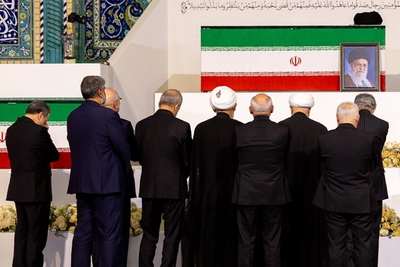

Pezeshkian says Europe backtracked on snapback deal after talks with US

Sep 27, 2025, 16:36 GMT+1

"On the snapback mechanism, we apparently reached an agreement with Europe, but when they spoke with the United States, they came up with various excuses," Iran's President Masoud Pezeshkian said upon arrival in Tehran.

“If today their issue is nuclear, tomorrow they will raise non-nuclear matters, because they do not want a powerful Iran," he told reporters in Tehran.

Pezeshkian returned from his visit to New York on Saturday and was welcomed in Tehran by Supreme Leader Ali Khamenei's chief of staff.

Iran does not accept Western pressure and threats, deputy speaker says

Sep 27, 2025, 13:16 GMT+1

The Islamic Republic does not accept pressure or threats from the United States and European countries, said Hamidreza Haji Babaei, deputy speaker of Iran's parliament on Saturday.

"The US and three European states blocked the path of diplomacy through force and unilateralism.”

The Islamic Republic, he said, "would continue its determined path,” including cooperation with the International Atomic Energy Agency and what he called the "legal enrichment of uranium."