UN chief urges diplomacy to avert snapback of Iran sanctions
United Nations Secretary General Antonio Guterres speaks during a press conference at UN headquarters in New York City, US, February 8, 2024
United Nations Secretary-General António Guterres on Tuesday called on Iran and Western countries to intensify diplomatic efforts to prevent the so-called snapback of international sanctions on Tehran initiated by European states last month.
Guterres said building trust through dialogue is essential, speaking in response to a question from Iran International's reporter at the UN on Tuesday.
“My appeal to Iran and to the other powers is to use diplomacy and to create the conditions of trust in order to be able to avoid it,” UN Secretary General said.
Guterres added that he has been in contact with both sides and aimed to facilitate discussions.
“Of course, offering my good offices, but it all depends on the diplomatic efforts that are made in order to establish the trust that is needed for the snapback to be avoided,” Guterres said.
Last month, France, Germany, and the United Kingdom triggered the UN snapback sanctions mechanism in a partly lapsed 2015 international nuclear deal with Iran.
The move initiated a 30-day window for diplomacy before sanctions are due to take effect on October 18.
Iran-IAEA cooperation
One of the demands of the three European countries is the immediate resumption of full work between Iran and the International Atomic Energy Agency (IAEA), the UN nuclear watchdog.
Iran and the IAEA signed an agreement in Cairo last week aimed at eventually resuming nuclear inspections in Iran. IAEA chief Rafael Grossi on Monday urged Iran to immediately implement the deal to resume inspections.
Iran's nuclear chief Mohammad Eslami on Tuesday criticized European powers for adopting an even more bellicose rhetoric against Tehran after the Cairo deal.
"From the very moment the agreement was signed between our esteemed foreign minister and the IAEA director general, we witnessed new and harsher positions from European countries," he told reporters in Vienna.
The Europeans also seek unconditional renewed talks with the United States severed since Israeli and US attacks on Iran in June.
Last month, Iran’s Supreme Leader Ali Khamenei rejected calls by Tehran moderates for direct negotiations with the United States, insisting that Washington’s hostility cannot be resolved through talks.
Colonel Joshua Wiitala, commander of the 509th Bomb Wing at Whiteman Air Force Base, Missouri, speaks to Fox News.
The commander of one of the most secretive and powerful arms of US power, the B-2 stealth bomber wing, described to Fox News what he called their "flawless" June 22 bombing on Iranian nuclear sites.
The planes are based at Whiteman Air Force Base, just south of Knob Noster, Missouri, home to all 19 operational B-2 Spirit stealth bombers.
Colonel Josh Wiitala, who commands the base, showed the reporters the bombers used in the roughly 30-hour mission dubbed Operation Midnight Hammer. Along with submarine-launched missiles, the American air attack targeted the Iranian nuclear facilities of Natanz, Fordow and Isfahan.
“It was just flawless performance,” Wiitala said. Shortly after the strikes, US President Donald Trump said they had "obliterated" Iran's nuclear program.
The mission marked the first known US deployment of 30,000-pound bunker-busting bombs or Massive Ordnance Penetrator (MOP) called the GBU-57.
“This team had flown Red Flag after Red Flag, major exercise after major exercise. I was watching the crews prepare and thinking about how many repetitions they’d had, how long they’d trained for this. It was a very seasoned crew,” Col. Wiitala said.
Each B-2 flew with two pilots so one could rest during the long mission.
“When I knew the crews were safe, when I knew they were in friendly airspace and secure, that was the biggest thing for me. In terms of mission success, it was 14 weapons on target. Again, it was just flawless performance,” Col. Wiitala added.
The B-2 is the only long-range stealth aircraft capable of carrying the 30,000-pound MOP and each aircraft carried two GBU-57s in their attack on Iran.
“We’ve used penetrators in the past, same concept as the penetrators you saw during the Iraq war, just on a much larger scale. The bigger the weapon, the deeper it penetrates,” Chief Master Sergeant Frank Espinoza said.
“We keep all the munitions on the far side of the base to ensure we meet explosive-safety standards,” Espinoza added. Weapons loaders undergo 21 days of training to become certified to maintain and load the 30,000-pound bombs, which secure to the aircraft at two steel touchpoints.
Of the 14 bombs carried by the B-2s, 12 were dropped on the Fordow nuclear site in Iran, a facility reportedly buried under roughly 300 feet of rock inside a mountain.
The US Air Force has ordered a new generation of advanced bunker-busting weapons as it seeks successor technology to the massive ordnance used in the strikes.
Iran has officially selected murky moral drama ‘Cause of Death: Unknown’ as its official submission for the Best International Feature Film category at the 98th Academy Awards due to be announced on March 2.
Directed by Ali Zarnegar, the 2023 film follows seven sojourners in the Lut Desert in southeastern Iran who face a moral dilemma after discovering a large sum of money on a deceased fellow traveler.
The story examines human ethics, survival and moral choices under pressure, and has drawn praise for its suspenseful narrative and minimalist storytelling.
The film’s path to recognition faced challenges. It was removed from the official selection of the 40th Fajr Film Festival in 2022 in Tehran, just days before the event.
Authorities pulled it from the state-run event for unclear reasons but allowed it to be screened elsewhere.
Zarnegar publicly criticized the decision, emphasizing that social cinema reflects society and lamenting the suppression of creative expression.
The movie won the Audience Award at the Iranian Film Festival in New York and received nominations for Best Film, Best Director, and Best Actor at the 2023 Shanghai International Film Festival where it also won Best Cinematography.
Iran has a history of submitting films to the Academy Awards, with internationally acclaimed works by Asghar Farhadi such as A Separation and The Salesman, which won Best Foreign Language Film in 2012 and 2017, respectively, and A Hero, which was nominated in 2022.
Before Farhadi’s success, 'Children of Heaven' by Majid Majidi became the first Iranian film to earn an Oscar nomination in 1999, though it lost to Roberto Benigni’s 'Life Is Beautiful'.
Iranian filmmakers Shirin Sohani and Hossein Malayemi won the Academy Award for Best Animated Short in March for their film In the Shadow of the Cypress at the 97th Oscars in Hollywood, dedicating the award to their fellow Iranians.
While Iranian cinema has global reputation for its exploration of social themes, independent filmmakers operate under a system of stringent censorship.
The government requires script approval and screening permits by the Ministry of Culture and Islamic Guidance, punishing those who challenge political or social taboos with bans, imprisonment or exile.
The US Treasury imposed sanctions on Tuesday on four Iranian nationals and more than a dozen companies and individuals in Hong Kong and the United Arab Emirates accused of helping Iran’s military move funds through oil sales and cryptocurrency.
“Iranian entities rely on shadow banking networks to evade sanctions and move millions through the international financial system,” Under Secretary for Terrorism and Financial Intelligence John Hurley said in a statement.
“Under President Trump’s leadership, we will continue to disrupt these key financial streams that fund Iran’s weapons programs and malign activities in the Middle East and beyond.”
The Treasury’s Office of Foreign Assets Control (OFAC) said Iranian nationals Alireza Derakhshan and Arash Estaki Alivand purchased more than $100 million in cryptocurrency for oil sales between 2023 and 2025.
Alivand, it alleged, also carried out transactions worth millions of dollars with Tawfiq Muhammad Sa’id al-Law, a Hezbollah-linked money changer who provided the group with access to digital wallets for funds tied to Iranian oil sales.
Also designated were Vahid Derakhshan and Leila Karimi, whom the Treasury said were involved in the financial activities of UAE- and Hong Kong-based firms tied to Derakhshan.
The action also targeted 13 UAE- and Hong Kong-based front companies, including Alpa Trading – FZCO, Powell Raw Materials Trading and Alpa Hong Kong Limited.
TheTreasury said the networks laundered hundreds of millions of dollars through front companies and digital assets to finance groups aligned with Iran and weapons programs including ballistic missiles and drones.
US revokes Chabahar sanctions waiver
Separately, the Secretary of State revoked a sanctions exception issued in 2018 under the Iran Freedom and Counter-Proliferation Act (IFCA) for Afghanistan reconstruction assistance and economic development, effective Sept. 29, 2025.
Afghanistan was overrun by Washington's Taliban foes in 2021.
“Once the revocation is effective, persons who operate the Chabahar Port or engage in other activities described in IFCA may expose themselves to sanctions,” State Department principal deputy spokesperson Thomas Pigott said in a statement.
The Iran Freedom and Counter-Proliferation Act imposes penalties on sectors of Iran’s economy linked to energy, shipping, and shipbuilding.
Chabahar Port, in southeastern Iran, had been exempted since 2018 to facilitate trade and reconstruction projects for Afghanistan.
Ecuador's President Daniel Noboa attends a ceremony to appoint the high military command, in the government palace, in Quito, Ecuador, November 30, 2023
Ecuador has designated Iran’s Islamic Revolutionary Guards Corps (IRGC), Hamas and Hezbollah as terrorist organizations in a decree signed by President Daniel Noboa on Monday.
It cited reports from Ecuador’s National Intelligence Center (CNI) warning of the groups’ presence in South America and possible ties to domestic criminal networks.
The three groups, the decree added, pose a direct threat to public security and sovereignty of Ecuador. Quito has grappled with rising crime as drugs gangs have gained clout and firepower in recent years.
Israel’s foreign affairs minister Gideon Sa’ar welcomed the decision and thanked the Ecuadorean government for the designations.
"Ecuador’s courageous step sends a clear message against Iran’s terror network and strengthens global security," Sa’ar said in a post on X. "We call on more countries in Latin America and around the world to follow suit."
The move brings Ecuador in line with the United States, which lists Hamas, Hezbollah and the IRGC as foreign terrorist organizations.
Canada, Israel, Saudi Arabia and Bahrain have similarly blacklisted the IRGC.
The United States has long urged other countries to blacklist the group, and Secretary of State Marco Rubio appeared to announce Ecuador's move prematurely on X following a visit to the country this month. The post was subsequently edited to remove a reference to Ecuador's terrorist designation of Hezbollah and the IRGC.
Ecuador’s designation of the IRGC comes less than a month after Australia announced plans to legislate its own designation of the group as a terrorist organization.
Australian Prime Minister Anthony Albanese said last month that intelligence gathered by the Australian Security Intelligence Organization showed Iran had directed attacks on a kosher restaurant in Sydney and a synagogue in Melbourne last year.
Iran denied the allegations and said Australia's move aimed to distract from righteous solidarity with Palestine among Australia's own citizens.
Paraguay designated the IRGC as a terrorist organization in April and expanded its classification of Hamas and Hezbollah to include all components of both groups.
In a presidential decree, Paraguay’s President Santiago Peña expanded the country’s 2019 designation of the military wings of Hezbollah and Hamas to also cover their political and social branches.
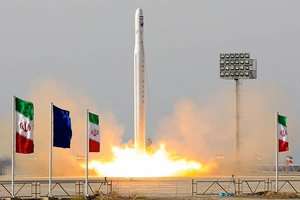
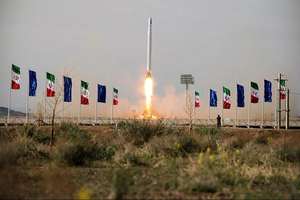
The "Simorgh" satellite carrier launched at an undisclosed location in Iran, in this handout image obtained on December 6, 2024. I
The head of Iran’s Space Research Center said on Tuesday that foreign global positioning systems (GPS) are not secure and that the country must develop its own national satellite navigation network to reduce dependence on foreign providers.
Vahid Yazdanian, who leads the Space Research Center under the Ministry of Communications, told the state-run ILNA news agency that GPS disruptions in Iran stem from the absence of indigenous navigation satellites.
He said Iran currently lacks any navigation satellites, relying instead on foreign systems.
“No global navigation system can be fully secure,” he said. “The ultimate solution is to develop a domestic satellite navigation constellation.”
Yazdanian added that the country needs to build its own infrastructure to secure applications ranging from urban transport to the navigation of trains, ships and aircraft.
He also pointed to broader uses of space technology, saying that Iran’s Earth observation satellites already provide images that help policymakers estimate crop yields and manage water resources.
According to Yazdanian, satellite imagery has allowed the government to monitor wheat, barley, maize and potato production, and to make decisions about imports or domestic procurement.
The comments come as Iran pushes ahead with an ambitious space program. The head of the Iranian Space Agency said earlier this month that Tehran plans to launch four satellites by March 2026 and begin operations at its new spaceport in Chabahar, on the country’s southeastern coast.
Among the planned launches are the Zafar, Paya, and a second model of the Kowsar Earth observation satellite, along with test units of the Soleimani narrowband communications constellation.
Western governments have repeatedly voiced concern that Iran’s satellite program could advance ballistic missile technology. Tehran says its activities are for peaceful purposes, adding the satellites will support civilian applications such as communications, agriculture and environmental monitoring.