Lebanese politician calls to sever ties with Iran over Hezbollah support
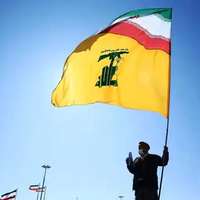
A man waves the flags of Iran and Hezbollah at a gathering in Tehran.
A Lebanese opposition figure has urged his government to expel Iran’s envoy in Beirut after senior Iranian official Ali Larijani reaffirmed Tehran’s backing for Hezbollah, deepening the controversy over Iran’s role in Lebanon.
Elie Mahfoud, head of the Change Movement, said on X that Larijani’s comments amounted to “shamelessly operating Hezbollah’s militia” and called on the Lebanese government to “immediately cut relations with the Islamic Republic of Iran and expel its ambassador and diplomatic staff.”
The remarks came after Larijani, secretary of Iran’s Supreme National Security Council, said in an interview with Supreme Leader’s website that Hezbollah was created by Lebanese themselves in response to Israeli occupation, but acknowledged Iran had provided and would continue to provide support.
“We do not deny that we helped; we say openly that we helped and we will help,” Larijani said.
He described Hezbollah as “a national asset for Lebanon,” stressing that the group had rebuilt after suffering losses and retained strong resolve among its younger members.
“I saw their leadership and their youth determined,” he said, citing his recent visit to Beirut where he met Hezbollah leader Sheikh Naim Qassem.
Larijani rejected accusations that Tehran controls Hezbollah, saying the group acts independently.
“They are connected to us because they are our brothers, not because they take orders,” he said. He added Iran respected Lebanon’s sovereignty, saying: “Our approach is not to impose. We believe Lebanon’s government must be strong, just as Iraq’s and Saudi Arabia’s should be strong.”
The interview followed Larijani’s trip to Beirut earlier this month, which drew official protests from Lebanese leaders who told him no group should bear arms outside the authority of the state. President Joseph Aoun said at the time that reliance on foreign backing was unacceptable.
Lebanon’s newspaper Nidaa al-Watanreported this week that Hezbollah had become “a tool of Iranian influence,” warning that the movement’s weapons threatened both national sovereignty and regional stability.
The paper described Lebanon as “a hostage to regional power struggles” and accused Iran of using Hezbollah to project influence beyond the country’s borders.
Hezbollah, founded in 1982 with help from Iran’s Revolutionary Guards, is Lebanon’s most powerful military force and has repeatedly fought Israel.
The Lebanese cabinet earlier this month ordered the army to devise plans to disarm the group, prompting sharp criticism from Tehran.
On Thursday, Lebanon began implementing the plan to disarm Palestinian factions in refugee camps, starting with the handover of weapons from Burj al-Barajneh camp in Beirut to the army, the prime minister’s office said.
The move, part of a wider push to establish a state monopoly on arms under a US-backed truce with Israel, is expected to extend to other camps in the coming weeks.
Larijani dismissed such moves, arguing Hezbollah’s arms were the product of Lebanese resistance. “People will not surrender. Why should they? To whom?” he said. “Hezbollah emerged when Israel occupied Beirut. That history cannot be erased.”
Earlier in August, Hezbollah leader Qassem warned that moves to strip the group of its weapons risk plunging Lebanon into war, vowing that the Iran-backed movement would not surrender its arsenal despite a recent government decision to disarm it.