Mossad’s chief David Barnea said on Wednesday that Israeli agents have been in Iran and will continue their operations in the country despite a US-brokered ceasefire that ended 12 days of fighting.
“We will [continue to] be there, like we have been there," Barnea said in a rare video excerpt to the public of an address to his Mossad agents involved in attacks on Iran.
Mossad has worked for months and years "to do all of the right actions to get to the right moment," he said, describing Mossad's achievements against Iran as "unimaginable".
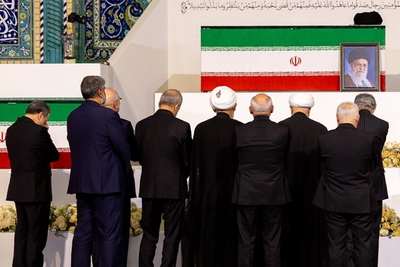
Ali Shadmani, the newly appointed commander of the Revolutionary Guard's Khatam-al Anbiya Central Headquarters, has succumbed to the injuries he sustained during an Israeli airstrike last week, the headquarters announced on Wednesday
On June 17, the Israeli military said it had killed Shadmani in an airstrike.


Donald Trump on Wednesday cited an Israeli government assessment to support his earlier remark that US strikes totally obliterated the Islamic Republic’s nuclear facilities, dismissing a conflicting assessment by the US Defense Intelligence Agency (DIA).
Early DIA intelligence assessments suggested the US attacks may have only delayed Iran’s nuclear program by a few months, falling short of the administration’s claims of long-term disruption.
President Trump and senior administration officials have rejected that conclusion.
"It is a manmade statement and if you read the document, the document said it could be severely damaged, but they did not take that. They said it could be limited or it could be very severe. You did not choose to put that, because it was soon after," Trump told reporters at a NATO summit in The Hague on Wednesday.

"Since then, we collected additional and we talked to the people who have seen the site, and the site is obliterated, and we think everything nuclear is down there."
Trump said Israel sent agents to Iran’s bombed nuclear sites to confirm their “total obliteration”.
“Israel is doing a report on it now, I understand, and I was told that they said it was total obliteration,” Trump told reporters.
“Iran’s nuclear program had been set back basically decades… It’s gone for years.”
The White House on Wednesday sent to reporters a statement by the Israeli Atomic Energy Commission (IAEC) that said American strikes on Fordow "destroyed the site's critical infrastructure and rendered the enrichment facility inoperable."
The move raised eyebrows as the Israeli government had not yet released the statement. However, Prime Minister Benjamin Netanyahu’s office, on behalf of the IAEC, officially published the assessment an hour later.
"We assess that the American strikes on Iran's nuclear facilities, combined with Israeli strikes on other elements of Iran's military nuclear program, has set back Iran's ability to develop nuclear weapons by many years," the statement read.
"The achievement can continue indefinitely if Iran does not get access to nuclear material."
White House spokeswoman Karoline Leavitt also denied the classified intelligence assessment by the Defense Intelligence Agency (DIA).
"The leaking of this alleged assessment is a clear attempt to demean President Trump, and discredit the brave fighter pilots who conducted a perfectly executed mission to obliterate Iran's nuclear program," she said in a post on X.
Rafael Grossi, Director General of the United Nations’ nuclear watchdog, told Fox News on Tuesday that the agency has not yet been able to fully assess the impact of the strikes due to lack of access.
He said Natanz was the first to be hit and sustained “very serious damage” in one of the centrifuge halls where enrichment was being carried out. He added that Isfahan also sustained damage but stressed that “nobody has been inside the halls to assess the damage.”
US President Donald Trump said he is not abandoning his maximum pressure strategy against Tehran but is also not aiming to cut off Iran’s oil revenues as it needs it to rebuild after the war with Israel.
"They just had a war. They fought it bravely. I'm not giving up (on maximum pressure policy). I could stop their oil business if I wanted. (But) I don't want to do that," Trump said in a press conference on Wednesday.
"They're going to need money to put that country back to shape. We want to see that happen. We're not taking over the oil. We could have. But putting that country back into shape desperate needs money."
Israeli Prime Minister Benjamin Netanyahu said "we have a great victory in the campaign against the tyrant who came to destroy us, and with this victory we have removed two immediate existential threats to ensure Israel's eternity."
Speaking at the beginning of the first government meeting since the ceasefire with Iran, Netanyahu said, "We thought it was important to destabilize the Iranian regime during the time we had.
"If there were assessments that this was possible - we would have continued."
However, he said "such a revolution needs to come from within."

Iran’s nuclear facilities were "badly damaged" in US and Israeli strikes, Foreign Ministry spokesperson Esmaeil Baghaei said on Wednesday, adding that the attacks dealt a serious blow not only to infrastructure but also to diplomatic efforts.
“Our nuclear installations were badly damaged, that’s for sure, because they came under attack by Israeli and American aggressors,” Baghaei told Al Jazeera.
The strikes, he said, caused “a detrimental blow” to international law, ethics, and diplomacy.
Baghaei said that while Iran has not abandoned diplomacy, it questions the intentions of Western governments. “They are talking about dialogue and diplomacy, but at the same time, they are committing acts of aggression. These contradictions have only created more and more problems,” he said.

Asked whether Iran is willing to resume talks with the US, Baghaei said Tehran is focused for now on internal security and the public’s anger after the attacks.
“We have nothing to say about those contradictory remarks regarding diplomacy or negotiations,” he said. “We have to make sure whether the other parties are really serious when they're talking about diplomacy — or whether it is, again, part of their tactics to make more problems for the region and for my country.”
He also defended Iran’s move to suspend cooperation with the International Atomic Energy Agency, saying the parliament’s decision was a direct and natural response to aggression. “Don’t you think it is only natural for the representatives of a nation that has come under an egregious act of aggression to reconsider the way they have been dealing with the IAEA?” he said.
Baghaei added that Iran’s right to peaceful nuclear energy remains intact and non-negotiable under the Non-Proliferation Treaty (NPT). “Iran is prepared to reserve that right under any circumstances,” he said.










