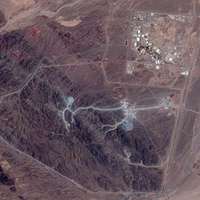
In photos: Fordow nuclear facility before and after US attack
A combination picture shows satellite images over Fordow underground complex, before and after the US struck the underground nuclear facility, near Qom, Iran, June 20, 2025 (L) and June 22, 2025. A closer satellite view shows holes and craters on a ridge at Fordow underground complex, after the US struck the underground nuclear facility, near Qom, Iran June 22, 2025. A closer satellite view shows the ridge at Fordow underground complex, after the US struck the underground nuclear facility, near Qom, Iran June 22, 2025. A closer satellite view shows the tunnel entrances to Fordow underground complex, before the US struck the underground nuclear facility, near Qom, Iran June 19, 2025.
The United States deliberately limited the scope of its military operation on Iranian nuclear sites, Defense Secretary Pete Hegseth said Sunday, adding that Tehran has received direct messages about the strike.
“We conducted a precision strike in the middle of the night against three nuclear facilities in Iran, Fordo, Natanz, and Isfahan,” Hegseth said, adding that the US “devastated the Iranian nuclear program, but it’s worth noting the operation did not target Iranian troops or the Iranian people.”
“This mission was not, and has not, been about regime change.”
Joint Chiefs Chairman Gen. Dan Caine also described the operation’s execution: bombers departed from the US, with some flying west into the Pacific as a decoy.
Approximately 75 "precision guided weapons" were dropped, including 14 “Massive Ordnance Penetrators,” also known as bunker busters.
Hegseth said no shots were fired at US forces and that the bombers are returning home.
Official graphic displayed in the Pentagon briefing room
The United States has received indirect communications from Iran in recent days, US Vice President Vance said Sunday, without elaborating on their content or source.
“Iran’s missile program has shown to be a failure,” he added.
"US has pushed Iran's nuclear program back by a very long time."
“Final decision on Iran strikes was made right before they happened,” he added.
Washington aims to "talk to Iran about a long‑term settlement," Vance noted, but said the US does not seek a regime change.
“We have no interest in boots on the ground,” he added.
Vance said US intelligence reporting motivated the decision to act against Iran, and dismissed fears of a prolonged conflict: “I don’t fear this is going to become a protracted conflict.”
Residents living near nuclear sites in Natanz, Isfahan, and Fordow face no immediate threat and can safely continue their daily lives, Iran’s government spokesperson Fatemeh Mohajerani said Sunday.
“These residents can continue their lives with confidence,” she said.
the U.S. strike on Iranian nuclear sites as an act of aggression, Iranian President Masoud Pezeshkian said Sunday, adding that Washington intervened only after Israel failed to counter Iran’s military response.
Pezeshkian said the attack confirmed the United States as the main driver of Israeli hostility toward the Islamic Republic.
“At first, they tried to conceal their role, but once they saw Israel’s failure, they had no choice but to step in,” he said.
Iran’s IRGC Aerospace Force will continue its operations and disrupt Israel’s security, IRGC chief Mohammad Pakpour said Sunday in a video from the command room.
“The Aerospace Force’s operations will not stop, and they have taken away Israel’s comfort,” he said.