A massive plume rises over Tehran after an apparent Israeli strike, June 17, 2025
"The contrast between the defiance projected on X by Iran’s Supreme Leader Ali Khamenei and his appearance in two recent video addresses—broadcast from what appears to be a bunker—could hardly be starker."
Since Israeli strikes began on June 13, Khamenei has appeared diminished: a man seated under dim lights, speaking slowly beneath a loosely worn black turban, behind him a photo of Ayatollah Ruhollah Khomeini clumsily clipped to a curtain.
His words aim to project resolve. But his faltering speech and visible frailty suggest something closer to strain.
In this setting, it is hard to reconcile the figure onscreen with the one who just days ago promised “an imminent conquest” and warned that “life will definitely become bitter for the Zionists.”
From defiance to disconnect
That gap—between rhetoric and reality—mirrors a broader disconnect.
While his social media account issues bold threats and AI-generated images of missile strikes, the scenes unfolding in Iranian cities tell a more uncertain story: smoke over Tehran, civilians fleeing, supplies dwindling, and a propaganda machine scrambling after its own headquarters was reduced to rubble.
Very few know the Supreme Leader’s location.
As of June 17, officials have been instructed not to use electronic devices to avoid detection. Some believe Khamenei has already been moved—perhaps through tunnels to a station outside the capital, then to Mashhad, his stronghold.
On Tuesday, Trump claimed he knows Khamenei’s exact location but said he has not decided to kill him—“for now.”
Even among insiders, communication is limited. Those managing his online posts may be working from past speeches or assumptions, unable to consult him directly.
“The Islamic Republic’s Armed Forces will deal heavy blows to the evil Zionist enemy,” read a June 14 post, as drone strikes and salvos filled Iranian skies.
A nation fractured, a reckoning in sight
But for many Iranians—whatever their politics—these slogans ring hollow.
The violence has not unified the country. Instead, it has laid bare deep divisions. Online, ideological arguments rage.
In official media, unity is scripted. Reformist figures—including former Presidents Mohammad Khatami and Hassan Rouhani, and ex-Majles Speaker Mehdi Karroubi—have been pressured into voicing support.
Yet even some longtime critics of the Islamic Republic are emotionally torn. Patriotism runs deep, and the sight of foreign attacks on Iranian cities—especially when cheered abroad—has stirred feelings of alienation.
Many who despise Khamenei feel repulsed by those who appear to welcome the war.
On June 13, Khamenei’s account wrote, “The Zionist regime will not escape safely from the heinous crime they’ve committed,” making no distinction between military and civilian targets.
Some fear Israeli responses may blur the same lines.
Phone calls between Tehranis and relatives abroad oscillate between cautious hope and grim resignation. Some believe this crisis may trigger change. Others, like London-based journalist Amir Soltanzadeh, lament the world's indifference.
“Iran came under military attack, Trump ordered the evacuation of Tehran, and yet no one in the world protested,” he posted on X. “There were no demonstrations, not a single line written in Arab or Western media. That’s how hated the Islamic Republic is.”
But many Iranians don’t experience that hatred in the abstract. They live its consequences—trapped between a regime that claims to speak for them and a world that often struggles to see them at all.
A firefighter looks out of a building impacted by Israeli strikes, Tehran, Iran, June 14, 2025
Five days have passed since the war began. Last night, Donald Trump told us to leave Tehran—but didn’t say where.
Unlike the jammed roads out of Tehran, the city itself is quiet—until it isn’t. Then come the missiles, the drones, the air defenses. Silence shatters. We brace. Then wait. Then do it all over again.
People’s reactions are far from uniform.
Some still cling to the idea that this war isn’t really theirs—that it’s between Israel and the Islamic Republic and will not touch their homes or families. They believe, somehow, they’ll be spared.
They have chosen not to let reality shake their belief, not to allow the mounting rubble and growing number of deaths register.
Today I overheard someone at the grocery store say Khamenei had fled to the mountains, and that the war would end by Tuesday. I told him this is Tuesday. He nodded and said, “Exactly—so it ends today.”
Others saw what was coming and hit the roads by Day 3, hoping to reach safety outside the capital. Many didn’t get far.
The highways are still choked with cars; people are running out of fuel, out of options. Many are stuck—no way forward, no way back. Tehranis are heading north, toward the Caspian provinces that have neither the space nor the infrastructure to absorb them.
There’s fear of what’s waiting on the other end: food shortages, fuel scarcity, and overcrowded shelters. And yet, people keep fleeing.
For those who stay behind, the fear is different but no less consuming.
Israel’s defense minister has declared that Tel Aviv will take revenge not just on the Islamic Republic—but on Tehran itself. And so the city waits.
It’s hard to grasp how fast everything collapsed. Just last week, we believed we were in a “tense but manageable” phase. Now, even that looks like a golden age.
Few believe the Iranian leadership will prioritize the people over their own survival. You can feel that abandonment hanging in the air.
I asked the grocer if deliveries are still coming. “So far, just dairy,” he said. “We’re waiting on bread and soda.” Most shops are shuttered. Workplaces are closed. It feels like the city is holding its breath.
The government says the metro can be used as a shelter. But for those who remain, home still feels safer—if only psychologically.
Most people I know or encounter just want the war to end—with a deal, a collapse, or just a pause in the strikes. “One way or another,” as my partner puts it.
Wasn’t this about nuclear facilities, many ask. Why target city ministries? Why strike targets nestled inside residential neighborhoods?
We’re friends of the Iranian people, Israeli officials say. Well, the dead and wounded beg to differ. So far, the casualties are overwhelmingly civilian. Homes have been flattened. Lives erased.
Tragic stories abound.
A young man is missing. His pregnant wife lies in a hospital bed, her body broken. A young poet and her entire family are gone. Painful images that the regime’s media machine tries to use and misuse.
On social media, the battle over the truth is as fierce as anything in the skies.
People are still hoping the power and water systems will be spared. Just imagine: no electricity, no water—on top of everything else.
I saw a woman today carrying water half her weight. Many are stocking up, but for a few days’ need only. They can’t imagine the war lasting longer than that.
But what if it does? Worried whispers are starting. What if this becomes another Ukraine? Or another Gaza?
We drift between disbelief and dread, clinging to the same fragile wish: that this nightmare ends—one way or another—soon.
Panic-stricken residents began fleeing Tehran on Sunday as Israeli strikes and air defense fire rocked the city, sending thick plumes of smoke into the skyline of a capital unprepared for war.
The latest wave of Israeli airstrikes, which began at midday, followed hours after a warning from Israel’s Ministry of Defense urging civilians to avoid areas near military and weapons facilities.
The attacks have sparked deep anxiety across Tehran, a city already struggling under energy shortages and economic malaise before the conflict.
“I can’t think straight. I’m packing as we speak. The whole city is under attack and the roads out are jam-packed with cars,” said Neda, a 37-year-old mother of two, struggling to hold back tears.
“My elderly parents are reliving the traumas of the Iran-Iraq war every time a missile lands,” she added. “I have very little hope that the Islamic Republic and Israel will stop anytime soon. I just hope our home is still standing when and if we return.”
Reported targets included the Justice, Intelligence, and Oil ministries located in densely populated residential and commercial districts.
Multiple residential buildings were also struck during the ongoing daytime raids.
“The first two days were incredibly terrifying because there are so many military facilities near my home. A missile could land on us with no warning any minute. I’m praying for all this to end soon,” said Ladan, a 46-year-old housewife who lives in northeast Tehran, after reaching Mazandaran in the Caspian region.
Bazaar shuttered
Tehran’s Grand Bazaar and many other businesses shuttered quickly as queues outside petrol stations grew longer. Authorities have now capped fuel purchases at 15 liters per private vehicle per day.
While Iran’s government has not released overall casualty figures, state media reported that ten children were killed overnight in a residential building in northeast Tehran.
Arash, a 48-year-old engineer, said his entire family is preparing to flee.
“Israel struck several places near our neighborhood this morning. One explosion blew the windows open. We’re heading to my parents’ home in the Caspian region—but I’m not sure it’s safe there either.”
Ali, a 38-year-old teacher, said he was still looking for somewhere safe to take shelter. “People with money have already left. For people like us, it’s hard to survive more than a few days away from home.”
Online, confusion and fear are spreading.
“Every [Telegram] channel that I check says to leave Tehran -- but where exactly should we go when we don’t have anyone [to stay with] or know any places [that are safe]?” @stillwjm97 posted on X.
Shelters, human toll
Outspoken former lawmaker Mahmoud Sadeghi echoed the urgency in a post on X.
“The war has truly begun. Declare a state of war. Prioritize protecting people's lives. Let’s minimize human casualties by preparing shelters and issuing warnings,” he addressed the authorities.
“So many missiles are landing in Tel Aviv and Haifa, but the human toll is not comparable to Iran.”
Tehran has no dedicated, fully stocked public bomb shelters like those in Israel. Some neighborhood bunkers built during the Iran-Iraq War remain unused and unprepared, and no sirens have been sounded ahead of the recent attacks.
The government on Sunday announced metro stations, mosques and schools would stay open overnight for shelter. But residents say that metro stations are not equipped as bomb shelters and lack basic amenities such as toilers.
Some social media users are expressing concern that most mosques and schools may be as vulnerable to bombs and missiles as their homes.
Iranian drivers at a gas station in Tehran, December 18, 2023.
A confidential report from Iran’s oil ministry appears to show a widening gap between domestic fuel production and consumption, highlighting growing pressure on the country’s energy infrastructure.
According to the ministry’s confidential annual report obtained by Iran International, diesel consumption in March 2025—the final month of the Iranian calendar year—hit a record 146 million liters per day, exceeding national production by 30 million liters.
The surge was largely driven by a severe and ongoing shortage of natural gas, which forced power plants and heavy industry to burn more diesel and fuel oil (mazut) to meet energy demands.
Diesel use rose 16% year-on-year in March, while production grew by just 1%. Daily mazut consumption also climbed 30%.
Despite holding the world’s second-largest natural gas reserves, Iran has faced persistent shortages since last year, especially during the winter months. The government’s failure to expand gas output has pushed annual mazut consumption up.
In total, Iran consumed 57 billion liters of mazut and diesel in the last year—roughly 1.28 million barrels per day. More than a third was used for power generation while the rest was absorbed by the industrial and transportation sectors.
Barter deals and toxic additives
Gasoline consumption also rose by almost 8% in a year.
To make up the shortfall, the government imported nearly 5 billion liters of gasoline and diesel over the past year, doubling the volume of fuel imports compared to the year before.
With cash and resources constrained by sanctions, Iran has leaned heavily on barter to meet fuel demand—trading part of its mazut exports for gasoline and diesel, particularly with the United Arab Emirates.
The report notes that of the 290,000 barrels per day of mazut exported last year, 40% was bartered for refined fuel, while the rest was sold to the UAE, China and other Asian buyers.
The report also sheds light on gasoline quality, revealing that Iran does not produce any gasoline that fully meets international standards.
Around 80% fails to comply with Euro 4 or Euro 5 benchmarks. The rest, labeled as “Euro gasoline,” contains the petrochemical additive MTBE (methyl tert-butyl ether), which is banned in many countries due to environmental and health risks.
Public spin versus internal figures
Iran continues to blend 2 million liters of MTBE into its gasoline daily.
Refinery output rose by 4.5% to 101 million liters per day, but the government raised that to 121 million by adding 20 million liters of MTBE and other chemical additives—a fourfold increase in additive use in recent years.
In March, Mohammad Sadegh Azimifar, CEO of the National Iranian Oil Products Distribution Company, said diesel output had risen by the equivalent of a 300,000-barrel-per-day refinery and that fuel production had increased by 11% overall.
However, the Oil Ministry’s internal report contradicts these statements, showing actual growth was closer to one-third of what Azimifar posited.
The discrepancy reflects a broader pattern of officials overstating achievements to project control despite mounting evidence that Iran’s energy crisis is worsening.
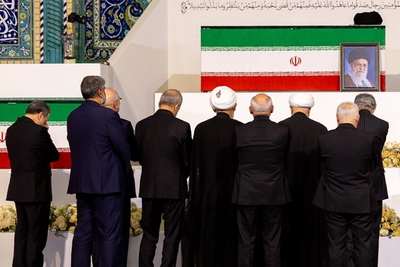
Iran's supreme leader Ali Khamenei meeting Iranian lawmakers, Tehran, Iran, June 11, 2025
Supreme Leader Ali Khamenei has publicly rebuked Iran’s parliament for excessive oversight and political infighting, urging lawmakers to ease off ministers and help the country strike a united front.
The rare criticism, delivered during a June 11 meeting with members of the Majles, was widely seen as an attempt to rein in hardline MPs amid growing tensions with President Massoud Pezeshkian’s administration.
"Not all these questions are necessary. Not all these summonses are necessary," Khamenei said. "When you summon a minister to a commission, it takes up time—two, three hours. Reduce the number of these. Cooperation with the government means minimizing such actions."
His remarks come as the United Nations nuclear watchdog rebuked Iran over alleged proliferation failings, the resumption of UN sanctions looms and President Trump warned on Thursday of a potential Israeli attack and "massive conflict".
The comments come amid ongoing efforts by hardliners to derail Pezeshkian’s cabinet appointments. Conservative MPs have targeted his nominee for economy minister, Ali Madanizadeh, under a law barring dual nationals or officials with immediate family holding foreign citizenship from senior posts.
Khamenei asserted that the Majles retains the right to question and investigate, but keeps it to a necessary minimum and not bring political or ideological differences into open conflict.
“On fundamental issues, the country must speak with one voice. Our nation and all its institutions—our political class, our management structure—must act as one hand,” he said.
Iran faces a delicate moment in its foreign policy with US nuclear talks stuck in a rut, while the UN’s nuclear watchdog is expected to issue a resolution declaring Iran non-compliant.
Khamenei made no direct reference to the nuclear stand-off, but appeared to have it in mind when saying public clashes at this time were “more harmful than ever.”
Domestic front
In recent weeks, hardliners have also called for Vice Presidents Mohammad Reza Aref and Mohammad Jafar Ghaempanah to resign under the same statute.
The hardline daily Hamshahri quoted MP Hamid Rasai insisting their cases were "more problematic" than that of former Foreign Minister Mohammad Javad Zarif, who stepped down under similar pressure.
Khabar Online accused Rasai and his allies of weaponizing the law to obstruct the government, while parliamentary vice president Majid Ansari said Khamenei himself believes the law needs revision.
Meanwhile, several hardline MPs have filed formal complaints against former Economy Minister Abdolnasser Hemmati, who accused some parliamentarians of seeking bribes to halt his impeachment in March.
The IRGC-linked Javan daily warned the complaints could further damage public trust, while former MP Davoud Mohammadi defended political deal-making as standard practice.
Though sidelined from nuclear negotiations and broader foreign policy, parliament hardliners remain intent on asserting influence. But Khamenei’s intervention may complicate their efforts.
Two women walk while being followed and harassed by a driver in Iran
The killing of 24-year-old Elahe Hosseinnejad by a driver from a ride-hailing app has deeply jarred Iranian women who say they live in daily fear on buses, in taxis and on the streets.
Hosseinnejad, a nail technician from Eslamshahr south of Tehran, vanished on her way home late last month, and her body was found days later riddled with stab wounds.
Police later arrested the man driving her, whose account of the murder varied from an altercation over payment to his alleged gendered slur that she had been "shameless", according to Iranian media citing police.
Voice messages and texts sent to Iran International's submissions line point to a deep well of shared trauma and anger in the male-dominated theocracy.
“I was nearly abducted in broad daylight,” one woman said. “I ran into a stranger’s house because I had no other way to escape. And this wasn’t even a remote place—this was a residential street.”
Dozens of accounts tell similar stories. One woman said her Snapp ride-hailing driver changed course three times, laughing when she protested. Another described how a man posing as a Tapsi driver sexually assaulted her on a highway outside Isfahan.
Snapp and Tapsi are Iran’s two leading app-based ride services modeled on Uber.
“These stories have always existed,” another woman said. “What Elahe’s death has done is rip the veil off.”
Hosseinnejad’s body was released under heavy security and buried without a public funeral.
Systemic fear and silence
In the messages submitted to Iran International, women described persistent sexual harassment in taxis, parks, workplaces and schools.
Some said they were assaulted while taking rides, others while walking to university or boarding a bus.
One woman described sitting quietly in a shared car when the driver suddenly pulled over and exposed himself. “I kicked the door open and ran,” she wrote. “But for weeks, he called me from different numbers, threatening to find me.”
“I went to file a complaint, and they asked if I had a witness,” another woman wrote. “I said if I had one, I wouldn’t be in this situation. They told me to drop it if I cared about my reputation.”
Two young women walk along a sidewalk while being closely watched and harassed by some men.
Several others shared versions of the same response: authorities demanding impossible evidence, mocking victims or advising them to stay quiet.
“The law is not on our side,” said another woman. “If something happens to you, they treat you like the criminal.”
Ride-hailing platforms in focus
Snapp and Tapsi, Iran’s dominant ride-hailing apps, came under renewed scrutiny following Hosseinnejad’s death.
Many contributors noted that both apps have faced growing criticism for weak driver vetting and limited response to complaints.
“I was 18, and the driver kept making crude comments,” one woman wrote. “When I reported him to Snapp, they told me they’d investigate. Nothing happened. He kept calling me from different phones.”
In several cases, riders said drivers had pressured them to adjust their clothing or implied they could be dropped off mid-trip to avoid fines under Iran’s hijab regulations.
“I wore my scarf just to avoid trouble,” wrote one student. “But the way they looked at me … it was like they were waiting for an opportunity.”
The cost of inequality
Women who contacted Iran International repeatedly returned to one point: gender-based inequality under the law.
“I don’t want revenge,” one woman said of Hosseinnejad’s accused killer. “I want justice. But how can there be justice when our lives are worth half as much under the law?”
Under Iranian law, murder is punishable by death, but when a man kills a woman, the victim’s family must first pay half the standard blood money—set annually by judicial authorities—to the killer’s family before an execution can take place. Activists say this devalues women’s lives and deters families from pursuing justice.
Elahe Hosseinnejad’s story has ignited anger—but also a grim sense of recognition. “She did everything right,” one woman said. “She worked, cared for her family, shared her beliefs—but still, she ended up dead."