Trump says Israeli attack on Iran 'could very well happen'
US President Donald Trump suggested at a White House press conference on Thursday that an Israeli attack on Iran was possible.
Responding to reporter's question, Trump said, "Well I don't want to say imminent, but it looks like it's something that could very well happen."
"Look, it's very simple, it's not complicated. Iran cannot have a nuclear weapon. Other than that, I want them to be successful. I want them to be tremendous. We'll help them be successful. We'll trade with them. We'll do whatever is necessary."
Trump said he aimed to avoid a conflict and sought peace.
"I'd love to avoid a conflict. Iran's going to have to negotiate a little bit tougher, meaning they're gonna have to give us some things that they're not willing to give us right now," Trump said.
"I've kept us out of wars ... I believe in peace through strength. We have the greatest military in the world."
U.S. President Donald Trump signs a resolution at the White House in Washington DC, June 12, 2025.
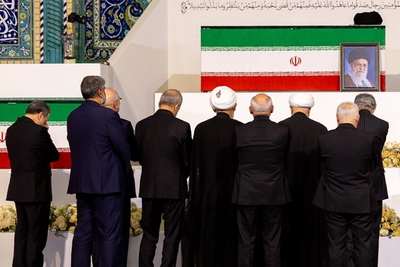
Iran's supreme leader Ali Khamenei meeting Iranian lawmakers, Tehran, Iran, June 11, 2025
Supreme Leader Ali Khamenei has publicly rebuked Iran’s parliament for excessive oversight and political infighting, urging lawmakers to ease off ministers and help the country strike a united front.
The rare criticism, delivered during a June 11 meeting with members of the Majles, was widely seen as an attempt to rein in hardline MPs amid growing tensions with President Massoud Pezeshkian’s administration.
"Not all these questions are necessary. Not all these summonses are necessary," Khamenei said. "When you summon a minister to a commission, it takes up time—two, three hours. Reduce the number of these. Cooperation with the government means minimizing such actions."
His remarks come as the United Nations nuclear watchdog rebuked Iran over alleged proliferation failings, the resumption of UN sanctions looms and President Trump warned on Thursday of a potential Israeli attack and "massive conflict".
The comments come amid ongoing efforts by hardliners to derail Pezeshkian’s cabinet appointments. Conservative MPs have targeted his nominee for economy minister, Ali Madanizadeh, under a law barring dual nationals or officials with immediate family holding foreign citizenship from senior posts.
Khamenei asserted that the Majles retains the right to question and investigate, but keeps it to a necessary minimum and not bring political or ideological differences into open conflict.
“On fundamental issues, the country must speak with one voice. Our nation and all its institutions—our political class, our management structure—must act as one hand,” he said.
Iran faces a delicate moment in its foreign policy with US nuclear talks stuck in a rut, while the UN’s nuclear watchdog is expected to issue a resolution declaring Iran non-compliant.
Khamenei made no direct reference to the nuclear stand-off, but appeared to have it in mind when saying public clashes at this time were “more harmful than ever.”
Domestic front
In recent weeks, hardliners have also called for Vice Presidents Mohammad Reza Aref and Mohammad Jafar Ghaempanah to resign under the same statute.
The hardline daily Hamshahri quoted MP Hamid Rasai insisting their cases were "more problematic" than that of former Foreign Minister Mohammad Javad Zarif, who stepped down under similar pressure.
Khabar Online accused Rasai and his allies of weaponizing the law to obstruct the government, while parliamentary vice president Majid Ansari said Khamenei himself believes the law needs revision.
Meanwhile, several hardline MPs have filed formal complaints against former Economy Minister Abdolnasser Hemmati, who accused some parliamentarians of seeking bribes to halt his impeachment in March.
The IRGC-linked Javan daily warned the complaints could further damage public trust, while former MP Davoud Mohammadi defended political deal-making as standard practice.
Though sidelined from nuclear negotiations and broader foreign policy, parliament hardliners remain intent on asserting influence. But Khamenei’s intervention may complicate their efforts.
Israel is weighing a potential attack on Iran within days, ABC News reported on Thursday citing three sources familiar with the situation.
The network cited the sources as saying they were unaware of any specific US role but added it was possible the United States could share intelligence or support logistics.
A sixth round of US-Iran nuclear talks were still due for Sunday, ABC News quoted a source familiar with the plans.
"Senior Advisor and Special Envoy Steve Witkoff plans to travel to Muscat on Sunday for a sixth round of talks with Iran. Discussions are expected to be both direct and indirect, as in previous rounds."
Crews work on an Israeli Air Force F-15 Eagle in a hangar, said to be following an interception mission of an Iranian drone and missile attack on Israel, in this handout image released April 14, 2024.
A top US Senator on Thursday said a resolution against Iran at the International Atomic Energy Agency meant it was time to trigger the so-called snapback of United Nations sanctions on Tehran.
"@IAEAorg’s findings prove the importance of @POTUS’s push for total dismantlement of Iran’s nuclear program," Senator Jim Risch wrote on X.
"The evidence is clear that Iran has violated its nuclear commitments and has no peaceful use for its current stockpiles. Time to trigger snapback sanctions," the Idaho Republican who serves as the Senate Foreign Relations Committee chairman added.
The United States is considering ways to provide military support for an Israeli attack on Iran's nuclear sites without taking a lead role, CBS News reported citing a US official and a source familiar with the matter.
The plans could include intelligence sharing or aerial refueling, but CBS News cited the US official as saying they were unaware of any commitment yet.
CBS news cited the source familiar with the coordination that Washington was unlikely to commit heavy bombers which Israel lacks and some analysts have said are necessary to penetrate Iran's nuclear infrastructure deep underground.
"Will you commit to us not bombing (Iran) ... unless we're directly hit?" California representative Ro Khanna asked US Defense Secretary Pete Hegseth at a House hearing on Thursday, referring to any preemptive preemptive attack.
"Would you agree ... that Netanyahu is itching for a fight? If Netanyahu uses American missiles to hit Iran, he's going to drag us into a war there," Khanna added, in a rare public intervention by a Democratic lawmaker on Trump's Iran policy.
"Our military knows that you cannot just throw hits (and) eliminate Iran's nuclear capability. They'll simply go underground, and they will then end monitoring," he said.
"Will you stand up today and make it clear to Netanyahu that the escalation that he's threatening just yesterday is not in the American interest, that you should not be dragging America into a war with Iran?"