FATF opponents are profiteers of Iran's isolation, economist says
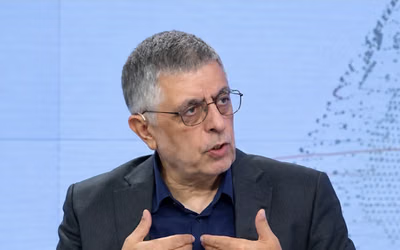
Economist Ali Ghanbari has criticized opponents of Iran joining the money laundering watchdog, the Financial Action Task Force (FATF), accusing them of benefiting from the country's isolation.
"Those who oppose Iran's joining the Financial Action Task Force are profiteers of sanctions and Iran's isolation and want to benefit from this isolation for themselves," he told ISNA in an interview published on Thursday.
He argued that claims that joining FATF would hinder oil sales are unfounded. "The claim that some individuals make, that joining FATF will make it impossible for us to sell oil, is an incorrect justification; because the whole world knows who our oil buyers are."
"Not joining FATF and selling oil through unofficial channels causes about 30% of the proceeds from exports to go into the pockets of intermediaries,” he added.
Ghanbari pointed out that out of 200 countries, only three—Iran, North Korea, and Myanmar—remain outside of FATF. "Even Russia, which has political and commercial relations with us, says join FATF, and if you do not do this, we cannot have economic and commercial exchanges with you," he added.
He expressed hope the Expediency Discernment Council would support FATF membership, which he said has traditionally had negative views about the organization.
The Expediency Discernment Council, which mediates disputes between parliament and the Guardian Council (a constitutional watchdog), became involved after parliament approved the legislation but the Guardian Council rejected the two bills concerning the Palermo and CFT conventions regulating money laundering and financing of terror groups.
The Financial Action Task Force (FATF), established by the G7 member countries to safeguard the international financial system, influences banking policies in most countries and guides businesses aiming to protect their own integrity and reputations.
Iran's status on the FATF blacklist has had a major impact on its international banking operations. The country remains on the list of high-risk countries with serious strategic deficiencies in countering money laundering, terrorist financing, and proliferation financing.
Iran needs to finalize legislation enabling the enactment of two international conventions: the International Convention for the Suppression of the Financing of Terrorism (CFT) and the UN Convention against Transnational Organized Crime (Palermo Convention).
The dispute between the parliament and the Guardian Council was referred to the Expediency Council in 2019 for arbitration.
The Expediency Discernment Council, which mediates disputes between parliament and the Guardian Council (a constitutional watchdog), became involved after parliament approved the legislation but the Guardian Council rejected the two bills concerning the Palermo and CFT conventions regulating money laundering and financing of terror groups.
The Expediency Council has stalled the matter since then, neither approving nor rejecting the bills. The inaction is apparently due to objections from hardliners, such as the Chairman of the Expediency Council Sadeq Amoli Larijani.
They argue that joining the conventions would harm Iran's national security by exposing its dealings with regional Tehran-backed allies—precisely the activities these international agreements are designed to address.
Iran will remain on the FATF's list of High-Risk Jurisdictions Subject to a Call for Action until it fully implements its action plan, including ratifying the Palermo and CFT. Only then will the FATF consider next steps, such as suspending countermeasures.