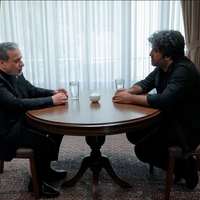
Photos published by Swedish media of Mahdi Ramezani and Fereshteh Sanaeifarid, involved in an IRGC plot to murder Swedish Jews in 2021
The Swedish foreign minister spoke to his Iranian counterpart following revelations of an IRGC plot to murder Swedish Jews, warning that the allegations are being treated as a "very serious" issue.
Tobias Billstrom spoke to Hossein Amir-Abdollahian on Thursday following a Swedish Radio report revealing the deportation in 2022 of two Iranians illegally in Sweden plotting to kill Swedish Jews.
“It is very serious that Iranian agents on Swedish territory have tried to murder Swedish citizens, and the fact that the targets were Jewish naturally makes it even more serious,” Billstrom stressed.
The couple, Mahdi Ramezani and Fereshteh Sanaeifarid, who had entered Sweden in 2015 on forged Afghan passports seeking asylum, were arrested in 2021 but deported in 2022 after police could not take proceedings further.
They intended to target three Swedish Jews including Aron Verständig, Chair of the Official Council of Swedish Jewish communities, who was informed of the plot in 2021. One of the other potential targets was a dual US citizen.
The suspects, believed to have been part of an IRGC plot, lived under fake identities in the country.
Deputy chief prosecutor Hans Ihrman said the FBI in the US was also investigating the couple. While there was not enough evidence to prosecute in Sweden, Ihrman said: “We have strong belief that they were here on a mission on behalf of Iran. They were seen here in Sweden as a very severe security threat. And that's the reason why they were expelled, even if we couldn't prosecute them."
Meanwhile, Daniel Stenling, head of counterintelligence in Sweden's security service, confirmed that the couple “prepared and pursued activities” with the aim of “being able to carry out physical attacks against someone or something in Sweden.”
Stenling further added that over the past years, the Swedish security services have managed to foil several other attacks planned by Iran against Sweden.
“It is already known that Iran also poses a major intelligence threat to Sweden, and that risk remains,” he went on to say.
Jews and Israelis abroad have increasingly been targets of the regime in recent years; several Iran-backed plots have been foiled in different countries including Greece, Cyprus, Azerbaijan and Argentina.
In September, the head of Israel's Mossad, David Barnea, said that Israel and its allies had foiled 27 attacks over the past year in Europe, Africa, southeast Asia and South America.
Tehran-Stockholm ties have been ever more strained since 2019 and the arrest of a former Iranian jailor, Hamid Nouri. Sweden sentenced him to life imprisonment last year over executions of political prisoners in Iran in 1988.
During the phone call, Billstrom also urged the immediate release of Johan Floderus, a Swedish diplomat of the European Union who was detained in April 2022 during a vacation in Iran on what appears to be trumped up charges of espionage.
In the fifth and concluding trial session of Floderus held at the Tehran Revolutionary Court in January, the prosecutor's representative demanded the strictest punishment for the 33-year-old Swedish citizen.
A screengrab from a video by Fardaye Eghtesad website
Three days after the detention of 30 journalists at the office of liberal-leaning website Fardaye Eghtesad in Tehran, five remain missing, raising fears they have been detained.
The newspaper's editor, Ali Mirzakhani, deputy editor, Behzad Bahmannezhad, and three video-journalists have not returned home since Monday and no information has been disclosed regarding their whereabouts and conditions.
On Monday evening, security forces raided the office of the economic news site, detaining and holding 30 journalists incommunicado inside the building overnight. They also confiscated all office computers and electronic devices, including mobile phones, and interrogated the staff.
The judiciary’s official news agency, Mizan, released a statement on Tuesday, claiming that the raid and journalists’ arrests were not linked to journalistic activities but were under investigation by a security agency.
A screenshot from Iran's ruler Ali Khamenei on Instagram
Meta, the owner of Instagram and Facebook, has removed the accounts of Iran’s Supreme Leader Ali Khamenei on the two platforms.
“We have removed these accounts for repeatedly violating our Dangerous Organizations & Individuals policy," Middle East Eye news website quoted a Meta spokesperson as saying.
Based on that policy, “organizations or individuals that proclaim a violent mission or are engaged in violence” are removed from Meta platforms.
According to IranWire news website, Meta’s recent action was taken in response to the accounts’ explicit support for Iran’s proxy groups in the region, such as Hamas and Hezbollah.
Many Iranian activists had previously called on Meta and X to disable Khamenei’s accounts over the flagrant violation of human rights in Iran under his rule.
Instagram, X, Facebook, Telegram and many other platforms are not accessible in Iran as a result of the government’s filtering policy.
Since the Iran-backed Hamas militia in Gaza invaded Israel on October 7, Iran's proxies in Iraq, Syria, Lebanon and Yemen have all acted in support of the group, attacking both Israel and US targets since the war broke out.
Emboldened by a modest US response to the killing of American soldiers, the former head of IRGC intelligence, Hossein Taeb, has claimed no country dares attack Iran.
Taeb, still a senior Revolutionary Guard official and an advisor to its commander-in-chief, said during an event on Thursday that the Islamic Republic is celebrating its 45th year since its establishment while no superpower has the courage for a military attack on Iran.
This week, the international community witnessed the US retaliation for approximately 160 attacks carried out by Iran-backed militia on US targets in the region since the Gaza war began on October 7, in strikes in Syria, Iraq and Yemen. On February 2, the US carried out airstrikes on more than 85 targets in Syria and Iraq , aiming at Iranian-backed forces including the group responsible for the Jordan strike that killed three American service members and injured over 40 others. A day later, American and British warplanes, with support from six allies, launched strikes at dozens of sites Houthi militants, one of Iran's biggest proxies.
The White House is under pressure mainly by the Republicans for a direct confrontation with Iran, though so far, has preferred to engage more directly with the proxies for fear of a wider conflict.
A Tomahawk land attack missile (TLAM) is launched from the US Navy Arleigh Burke-class guided missile destroyer USS Gravely against Houthi military targets in Yemen, February 3, 2024.
Every year in February, the government in Tehran holds about 10 days of nationwide events and gatherings to mark the anniversary of its establishment, the Islamic Revolution of 1979. The propaganda line has been the same for decades: Iran is a global powerhouse and is thriving despite growing international sanctions and a plethora of domestic problems.
Taeb claimed that “it is impossible for superpowers to escalate pressure on Iran to the point that economic problems and pressure on people's livelihoods lead to collapse.” Iran has been a scene of growing anti-regime labor and civil protests over economic woes and human rights abuses in recent years but the boldest uprising was the nationwide revolt that started after the death of 22-year-old Mahsa Amini in 2022 that came to be known as the Women, Life, Freedom movement.
The regime quashed months of rallies, killing about 600 people and arresting about 22,000. The crackdown on dissent and acts of social disobedience, mainly through women appearing unveiled in public, is intensifying day by day.
Taeb also downplayed the efficacy of measures to pressure Iran by the US and Israel, an idea that surprisingly resonates with countless officials in the US and other countries as well as Iranian dissidents and opposition figures. They concur that punitive measures are not enough to contain Iran in its destabilizing acts as it is advancing its nuclear and missile capabilities, with some saying that the international community’s appeasement with Tehran has only encouraged it. “America sought to confine Iran with the JCPOA (Joint Comprehensive Plan of Action), then with JCPOA 2... it aimed to restrict Tehran's military and regional power, consequently weakening Iran,” Taeb mentioned as instances of the US failure.
He boasted that Iran is now seen as a major threat against the US. "They wanted Iran to be only a normal country, but we turned into a regional power and threat. Now the world acknowledges Iran as one of the three countries challenging American hegemony,” he said, claiming, “Today, they say Iran has become a power of Islamic resistance and a regional force, meaning it will defeat American hegemony and itself become a hegemon."
Last year, Taeb claimed the US had sent messages to the regime through three neighboring countries of Iraq, Qatar and Oman, saying that it is not looking to overthrow the regime. The claims were not corroborated by Washington.
Taeb was pushed out as the head of IRGC’s intelligence in 2022, but maintains significant influence in the country’s intelligence apparatus, with political analyst Morteza Kazemian calling him as “one of the most feared men in Iran's security system.” Taeb has close relations with the Supreme Leader’s son Mojtaba Khamenei, a former comrade during the 1980s war with Iraq.
His dismissal came following multiple mysterious incidents in which IRGC officers and operatives were killed or died in unexplained circumstances. Iran blamed Israel for some of the incidents. Taeb was harshly criticized by social media activists and politicians for failing to detect and prevent Israel's operations in Iran. The fact that an Israeli news outlet, Kaan News reported Taeb's removal from his post several days before its confirmation by Iranian officials, was another indication that Israel had access to insider information from the IRGC Intelligence Organization.
A RAF Typhoon aircraft takes off to conduct further strikes against Houthi targets, February 3, 2024.
In two separate preemptive attacks, US forces targeted cruise missiles belonging to the Iran-backed Houthis in Yemen on Wednesday night.
The US military announced in apost on Xthat the attacks targeted two mobile anti-ship cruise missiles and a mobile land attack cruise missile which posed “an imminent threat to US Navy ships and merchant vessels” in the region.
“These actions will protect freedom of navigation and make international waters safer and more secure,” the post added. It is the fourth attack on Houthi targets in recent weeks following the militant group's campaign to target shipping lanes in the Red Sea, the Gulf of Aden, and the Bab el-Mandeb Strait began in November in allegiance with fellow Iran-backed militia, Hamas in Gaza.
The Yemeni militia, designated by countries including the US, hopes the blockade will force Israel into a ceasefire amidst a war in Gaza triggered by Hamas's invasion of Israel on October 7. Following Israel's relentless retaliation vowing to eradicate the terror group, Iran's proxies in Iraq, Syria and Lebanon have also joined the proxy war, targeting both Israel and US assets in the region.
Meanwhile, Germany announced Thursday that it has dispatched a frigate to the region as part of the EU naval mission. Tasked with protecting international ships in the Red Sea against Iran-backed Houthis’ raids, the mission is scheduled to be launched in mid-February.
“The current situation in the Red Sea has already caused bottlenecks in supply and forced some companies to stop their production,” said Jan Christian Kaack, the chief of the German navy, further stressing that “free sea trade routes are the basis of our industry and of our capability to defend ourselves.”
Iran’s ruler Ali Khamenei (center) and top Iranian officials during a meeting in Tehran, February 8, 2024
Iran’s Supreme Leader Ali Khamenei has reiterated his calls for a blockade of Israel while Tehran separately denies its role in the Gaza war.
“It is the duty of the governments to cut off political, propaganda and arms aid and not to send consumer goods to the Zionist regime,” Khamenei said on Thursday.
Back in November, Khamenei urged Muslim states to cease oil, food and goods exports to Israelto force Israel into a ceasefire amid its war on Gaza sparked by the October 7 Hamas attacks. At least 1,200 mostly civilians were killed and at least 250 more taken hostage in the single most deadly day for Jews since the Holocaust.
Iran's Yemeni proxy, the Houthis, have taken over the critical Red Sea, the Gulf of Aden, and the Bab el-Mandeb Strait trade route, launching dozens of attacks on vessels since November and forcing shipping to take longer, more expensive alternative routes.
It has since led to multiple retaliatory joint attacks by the US and UK in a bid to harm the Houthis' infrastructure. The Houthis claim they only target Israeli and Israel-bound ships, but its victims have been multinational. The Galaxy Leader, taken captive in November, has 25 crew taken hostage, hailing from the likes of Bulgaria and Romania.
Though Iran has avoided any direct military involvement in the Israel-Hamas conflict, the regime has used its proxy groups such as the Houthis and Hezbollah to attack Israeli and American targets in the region.