Iran Claims One Of Kerman Suicide Bombers Was A Tajik

Iran's Ministry of Intelligence released a statement on the Kerman twin blasts, claiming that one of the alleged suicide bombers held Tajikistani nationality.

Iran's Ministry of Intelligence released a statement on the Kerman twin blasts, claiming that one of the alleged suicide bombers held Tajikistani nationality.
In the statement released Friday evening, the ministry claims that it has arrested 11 people in six provinces who involved in the attack.
The Islamic State group claimed more than 24 hours after the bombing that two of its suicide bombers had detonated explosives that killed around 90 people earlier this week. However, it is not possible to verify the claim, with the Iranian government usually issuing contradictory and incomplete information.
The ministry also claimed that the security apparatus had found out about the role of the Islamic States terrorist group in the bombings right after the attack was carried out.
“The first operation to arrest the terrorists' supporters took place on the evening of the incident, and the residence used by the two terrorists was identified the next morning, leading to the arrest of two support elements,” read the statement. Later operations led to the arrest of nine suspects connected to the terrorist team in six provinces.
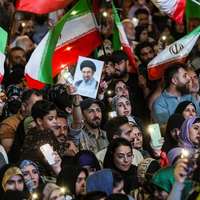
About 90 people were killed and 284 injured on Wednesday as two explosions targeted a commemorative event for Qasem Soleimani, the late commander of the IRGC's Quds Force.
Also on Friday, US intelligence apparatus confirmed that Islamic State's Afghanistan branch was behind the blasts. Communications intercepts collected by the US confirmed that ISIS-K carried out the bombings, two sources familiar with the intelligence told Reuters. "The intelligence is clear-cut and indisputable," one source said.
The main perpetrator of a similar attack on Shahcheragh, a funerary monument and mosque in Shiraz that was the site of a similar attack about a year ago, was also a citizen of Tajikistan, identified as Rahmatullah Nowruzov.


The Lebanese Hezbollah is conducting fierce attacks against Israeli targets to help Hamas in Gaza, the group’s leader Hassan Nasrallah said in a speech on Friday.
Following the targeted killing of Saleh al-Arouri, a top Hamas leader by Israel in Beirut’s Hezbollah-controlled southern suburbs, Nasrallah tried to convey a sense of strength and commitment to aiding Hamas.
“If we had not opened the northern front, forcing Israel to draw away brigades from Gaza, it could have more easily replaced and rotated their forces in Gaza…and the fighting there would have been much more difficult for the resistance,” Nasrallah who has lived in hiding for years said in a video address.
Following Hamas’ October 7 attack on Israel, many expected a full-fledged war to erupt also against Hezbollah, but the Iranian-backed force has limited its involvement to border skirmishes with Israel. Nasrallah claimed that Hezbollah has killed and wounded thousands of troops, that he said Israel keeps as a secret.
He also warned Israelis not to attack Lebanon. “I say to the settlers who call on Israel to launch a war on Hezbollah; this would be a wrong decision for you, and you would be the first one to be affected.”
Hezbollah’s patron, the Iranian regime, has also avoided direct involvement in the Gaza war, despite its decades-long rhetoric to destroy Israel.
Some observers have argued that Iran is not willing to risk Hezbollah, which is its strongest proxy force in the region. Tehran also does not have the financial resources to compensate losses, like it did after the 2006 Israel-Hezbollah war, when it had much higher oil revenues.

Iran's Statistical Center recently announced a decline in the country's unemployment rate to 7.6 percent this fall from 10.6 in the same period in 2019.
The report didn’t explain the reason for the decline, but, a comparison of the new numbers for the labor force (employed or seeking jobs) with four years ago indicates that in fact, 3.6 million job seekers have given up. This might explain the decline in the official unemployment rate.
The reason for the declining unemployment rate is not the creation of new jobs, but a decline of those seeking employment. This is more logical given deep recessions and an economic crisis since 2018, when the United States withdrew from the JCPOA nuclear accord and imposed economic sanctions.
The unemployment rate is defined as the ratio of unemployed individuals actively seeking jobs to the total active members of society, or the labor force. The unemployment rate can only decrease when either job seekers find jobs, or the unemployed give up looking for work. In Iran's case, the second scenario has occurred.
Iran's Statistical Center 's figures indicate that around 44.3 percent of individuals aged 15 and above were active (employed or in job search) during the fall of 2019. However, the recent report shows that the active labor force has declined to 41.5 percent.
If 3.6 million individuals were not discouraged from job hunting and remained active, the real unemployment rate this fall would have exceeded 18%.

Additionally, details from the Statistics Center's report indicate that two million of the country's 24.77 million employed individuals have incomplete employment, working less than 44 hours per week.
Earlier, the Parliament Research Center had highlighted that a large percentage of younger people had given up seeking employment, stating that the real unemployment rate in the country is 2.5 times higher than the official figures.
World Bank statistics also reveal a decrease in the ratio of employed individuals in Iran compared to the labor force population over the past four years.

President Ebrahim Raisi's administration, without acknowledging these realities, has claimed a significant reduction in the unemployment rate by only calculating unemployed individuals seeking jobs against the total active population.
Low Employment Rates among Educated Youth and Women
The details of the new report from the Statistical Center indicate that 43 percent of those seeking jobs hold higher education degrees.
This highlights a significant challenge for young graduates in finding jobs. Additionally, the economic participation rate of women is remarkably low, with approximately 11.4% of Iranian women in working age being employed.
In other words, nearly 91% of women above the age of 15 in Iran are without any occupation, even in family-related businesses such as farming and agriculture.
The World Bank statistics reveal that, among regional countries, only Iraq and Yemen have a worse employment situation than Iran.

In comparison, the employment ratio of working women to the total female population above 15 years of age is around 57% in Qatar and 49% in the UAE. A similar situation prevails in Kuwait and Bahrain, with the female workforce ratios above 56% in the Republic of Azerbaijan and Armenia.
Even in the traditionally conservative Saudi Arabia, which had a comparable employment ratio with Iran in early-2010s, the figure has now increased to more than 29%, surpassing Iran by 2.5 times. A similar situation is observed in Oman.
Economic Indicators: Inflation, Unemployment, and Wage Disparities
The combined rates of unemployment and inflation constitute the "misery index," with Iran consistently ranking among the top countries in the region, facing high misery scores.
It is evident that wage disparities in Iran are also the worst in the region, with the average income of employed individuals in Saudi Arabia, the United Arab Emirates, and Qatar being 7 times, 13 times, and 18 times higher than in Iran. Even in Azerbaijan and Armenia, the average wages are approximately double those in Iran.
This substantial wage gap exists while the Raisi administration has increased the minimum wage by about 20% for the coming fiscal year, starting on March 22. However, the increase is not even half of the the annual inflation rate in the country. Another notable point is that a significant portion of employed women in Iran do not receive wages as they work in family-related jobs, especially in agriculture.
The World Bank estimates that only 60 percent of employed women in Iran receive wages. In contrast, in Qatar, 100 percent of employed women receive wages, 94 percent in the United Arab Emirates, and in Saudi Arabia, it is over 88 percent.
Moreover, the International Monetary Fund (IMF) figures reveal that the gender pay gap in Iran is approximately 23 percent in public sector occupations and around 36 percent in non-governmental jobs, indicating a significant gender-based wage disparity in Iran.

Iran’s Interior Minister Ahmad Vahidi said Friday that a number of suspects have been arrested over the Kerman attacks claimed by Islamic State.
According to Vahidi, the country's intelligence bodies have found "very good leads" regarding individuals involved in the Kerman explosions. He added, "Some of those who played a role in this incident have been arrested."
Vahidi stated that comprehensive information on this matter will soon be communicated by the intelligence apparatus.
His remarks came in the aftermath of the twin bombings in Kerman, where a commemorative event for Qasem Soleimani, the late commander of the IRGC's Quds Force, was targeted. Nearly 90 people were killed in the incident and 284 were injured.
Majid Mohammadi, Vahidi’s deputy in security affairs, claimed later in the day that the suspects were arrested in five different cities.
The funeral for about half of the casualties was held on Friday.Crowds chanted "revenge, revenge" in state TV footage of the funerals in the city of Kerman, the scene of Wednesday's explosions, the bloodiest such attacks in Iran since the 1979 Islamic Revolution. The security lapses leading to the deadly attack have sparked public criticism and concerns about the Islamic Republic's ability to ensure the safety of its citizens during such events.
Despite the claim of responsibility by the Islamic State (ISIS), the Islamic Republic authorities, such as President Ebrahim Raisi and IRGC Commander-in-Chief Hossein Salami, blame Israel and the United States for the attack.

The Istanbul-based correspondent for the German public TV station ARD sparked anger over his report that claimed all Iranians worship IRGC’s late Qasem Soleimani.
“Every Iranian, whether opposition or not, worships him as a hero, “Markus Rosch told millions of viewers on Wednesday watching the popular ARD Tagesschau news program. Rosch’s comment about a man accused of fomenting bloodshed in the Middle East triggered widespread outrage on social media, prompting Rosch to walk back his statement.
Many Iranians view Soleimani as a destructive figure, labeling him a master terrorist, echoing the terminology used by the United States. Some critics argue that his primary focus was on developing Iran's regional proxy networks rather than addressing domestic concerns.
Rosch broadcasted his report following the terror attack at Soleimani’s gravesite in Iran this week.
Bomb explosions may have killed as many as 94 people and there remain conflicting reports about the perpetrators behind the mass murder in the city of Kerman.
Sheina Vojoudi, who fled the Islamic Republic of Iran to Germany to escape persecution, told Iran International “Statements like this disrespect thousands of innocent Iranian lives taken away by Qasem Soleimani. Soleimani was responsible for the mass killing of the Iranian protesters in Bloody November 2019. One of the IRGC’s high ranking commanders confirmed Soleimani’s key role also in suppressing the protests in 1999 and 2009 with violence and thousands of Iranians were murdered, tens of thousands were arrested and tortured in the Islamic Republic’s prisons. “
Germany’s largest mass circulation paper, Bild, reported “The outrage is now having an impact on ARD correspondent Markus Rosch.” Bild wrote that Rosch wrote on X, “I apologize for this mistake. Soleimani is only worshiped as a hero by the Islamic Republic regime and its supporters.” It is unclear if ARD disciplined Rosch for his journalistic misconduct.
After rising anger on X, ARD published a correction on its website about Rosch’s false information.
Vojoudi, an associate fellow for the Gold Institute for International Strategy, said about the myth that the US and EU-designated terrorist, Soleimani, was beloved by Iranians. “This is the Islamic Republic’s propaganda and shockingly the western media help the Islamic regime to spread it. The Iranian people are the main victims of the Islamic Republic’s terrorism.”
She added “Soleimani was in competition with Ali Khamenei to gain the first place in killing the Iranian people and spreading terrorism in the whole region.”
Vojoudi went on to say that “The regime still kills Iranians in his name and recently the regime’s supporters started to identify the Iranian students who expressed their happiness on Soleimani’s death anniversary and started a campaign to share the identity, address and the name of the universities of the these students and promised them to arrest and torture them in prison.”
Behrouz Asadi, the head of the Democratic Forum of Iranians in Mainz, Germany also expressed shock about the ARD broadcast. He told Iran International, “It is shameful to call him a hero of the people.”
Soleimani “belongs to a regime that only has terror, arrest, torture and executions on its record. He belonged to the IRGC terrorist organization and is not a representative of the Iranian people,” said Asadi, an energetic campaigner against the Islamic Republic.
He added, “The regime tries to present him as a hero in the sense of a totalitarian regime. The majority of the people have a clear stance against him and the regime. He was instrumental in maintaining the regime. The people stood up several times for freedom and democracy and human rights. He and his perpetrators tried to nip every cry for democracy in the bud.”
Asadi said Soleimani “set up mercenaries abroad for terror. He was involved in Assad's stability through wars against the Syrian people. The Iranian people are fighting for peace and freedom.”

Iran’s prosecutor-general has threatened legal action against individuals publishing norm-breaking content about the twin bombing in Kerman this week.
Mohammad Movahedi-Azad issued the stern warning to curb the dissemination of ideas or news that may be deemed contrary to the government's narrative.
"Given the necessity of taking decisive action against individuals who have disrupted the mental security of society by producing, disseminating, and republishing illegal content, it is essential for intelligence and security agencies to identify all involved parties and perpetrators and introduce them to the relevant judiciary."
Despite the warning, numerous individuals have taken to social media to express their dissatisfaction with the government's perceived inadequate security measures leading to the deadly incident in Kerman. Critics argue that the failure to ensure the safety of public gatherings resulted in this deadly attack.
The bombing targeted a large public gathering commemorating Qasem Soleimani, the late commander of the IRGC's Quds Force, who was killed by a US drone strike in January 2020. Nearly 90 people were killed in the incident and 284 were injured.
Iranian dissidents view Soleimani as a controversial figure, labeling him a master terrorist, echoing the terminology used by the United States. Some critics argue that his primary focus was on developing Iran's regional proxy networks rather than addressing domestic concerns.
Questions are being asked about the veracity of the claim that ISIS was behind the twin bombings in Kerman. No one claimed responsibility for the attack for almost 30 hours, when reports appeared that ISIS (or Daesh) had issued a statement posted on the chat app Telegram. Immediately, many Iranians began to express doubt about the ISIS claim, convinced that the Islamic Republic itself was somehow responsible for one of the worst acts of violence against civilians.