Iran's Prosecutor Warns People Against Discussing Kerman Blasts

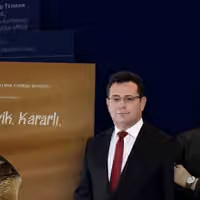
Iran’s prosecutor-general has threatened legal action against individuals publishing norm-breaking content about the twin bombing in Kerman this week.

Iran’s prosecutor-general has threatened legal action against individuals publishing norm-breaking content about the twin bombing in Kerman this week.
Mohammad Movahedi-Azad issued the stern warning to curb the dissemination of ideas or news that may be deemed contrary to the government's narrative.
"Given the necessity of taking decisive action against individuals who have disrupted the mental security of society by producing, disseminating, and republishing illegal content, it is essential for intelligence and security agencies to identify all involved parties and perpetrators and introduce them to the relevant judiciary."
Despite the warning, numerous individuals have taken to social media to express their dissatisfaction with the government's perceived inadequate security measures leading to the deadly incident in Kerman. Critics argue that the failure to ensure the safety of public gatherings resulted in this deadly attack.
The bombing targeted a large public gathering commemorating Qasem Soleimani, the late commander of the IRGC's Quds Force, who was killed by a US drone strike in January 2020. Nearly 90 people were killed in the incident and 284 were injured.
Iranian dissidents view Soleimani as a controversial figure, labeling him a master terrorist, echoing the terminology used by the United States. Some critics argue that his primary focus was on developing Iran's regional proxy networks rather than addressing domestic concerns.
Questions are being asked about the veracity of the claim that ISIS was behind the twin bombings in Kerman. No one claimed responsibility for the attack for almost 30 hours, when reports appeared that ISIS (or Daesh) had issued a statement posted on the chat app Telegram. Immediately, many Iranians began to express doubt about the ISIS claim, convinced that the Islamic Republic itself was somehow responsible for one of the worst acts of violence against civilians.
China's oil trade with Iran has stalled as Tehran withholds shipments, demanding higher prices from its top client, Reuters quoted refinery and trade sources as saying.
The cutback in Iranian oil, which makes up some 10 percent of China's crude imports and hit a record in October, could support global prices and squeeze profits at Chinese refiners.
Early last month Iranian sellers told Chinese buyers they were narrowing discounts for December and January deliveries of Iranian Light crude to between $5 and $6 a barrel below dated Brent, five traders who handle the oil or are familiar with the transactions told Reuters.
Those deals had been struck in November at discounts around $10 a barrel, the traders told Reuters.
The exclusive report did not say how Iran was going to manage its finances, as China is almost the sole buyer of its oil since the United States imposed full sanctions on Iranian crude exports in 2019.
Already Iran faces revenue shortfall despite shipments to China that the Biden administration allowed to surge from a low of around 250,000 barrels per day in 2019 to above one million barrels in 2023. Iran’s currency has fallen to near historic lows, trading at 510,000 rials per dollar, a 12-fold decrease since 2018.
In late December, Iran announced $26.5 billion in oil export revenues in nine months since March, but Iran International’s analysis indicated the number was closer to $22 billion.

A China-based trading executive told Reuters, "This is considered as an extensive default and the order to hike prices apparently came from the headquarters in Tehran, as they're holding back supplies also to the intermediaries."
An executive at a Chinese middleman that procures directly from Iran said Tehran was "holding back some shipments", leading to a "stalemate" between Chinese buyers and Iranian suppliers.
"It's not clear how things would end," this executive told Reuters. "Let's wait a bit and see if refineries are willing to accept the new price."
China has saved billions of dollars buying often deeply discounted oil from sanctioned producers Iran, Venezuela and, more recently, Russia - countries that supply almost 30 percent of China's crude imports.
The abrupt move, which one industry executive called a "default", could also represent the backfiring of an October US waiver on sanctions of Venezuelan oil, which diverted shipments from the South American producer to the US and India, elevating prices for China.
'TEAPOTS' SQUEEZED
It is not clear how extensive Iran's cutbacks to China are. At least one buyer has accepted higher prices: a Shandong-based refiner bought a cargo late last month at discounts between $5.50 and $6.50 on a delivered ex-ship basis, two traders said.
The discounts could narrow further, as the latest offer heard was $4.50, the traders said. Last year's average discount for Iranian Light, a key grade China buys with a high middle-distillates yield, was about $13, traders say.
"The buyers are still struggling to find a solution as the new prices are too high," said a Shandong-based buyer. "But since they have limited choices and the Iranian side is very tough, the room for price negotiations is difficult and is not favoring Chinese buyers."
China's smaller independent refiners, called "teapots", have become Tehran's top clients since first buying Iranian oil in late 2019. They replaced state-run refiners, which stopped dealing with Iran over concerns about falling afoul of US sanctions.
Teapots absorb about 90% of Iran's total oil exports, usually passed off as oil originating in Malaysia or the United Arab Emirates, trade sources say.
Amid the tussle over prices, Iran's overall exports and China's imports from Iran have fallen.
China imported about 1.18 million barrels per day (bpd) of Iranian oil last month, down from 1.22 million bpd in November and 23 percent off October's record 1.53 million bpd, tanker tracker Vortexa Analytics reckons.
That represents the bulk of Iran's global seaborne crude exports, which another tracker, Kpler, estimates at 1.23 million bpd for December, down from 1.52 million bpd in November. Floating storage off Iran and nearby waters rose by about 2 million barrels to 15.5 million barrels over the past week, Kpler says.
"The Iranians want to play catch-up in prices with (Russia's) ESPO. But they don't fully realize the extent of sanctions on Iranian oil is different from that on Russian," said a trading manager at an independent refiner.
Washington has sanctioned more than 180 people and entities related to Iran's petroleum and petrochemical sectors since 2021, identifying 40 vessels as blocked property of the sanctioned entities.
With Exclusive reporting by Reuters

Amnesty International has called for “urgent action” to stop the imminent execution of Reza Rasaei, a detainee linked to last year's nationwide protests in Iran.
In a Thursday statement, the international human rights organization urged individuals to appeal directly to Iran’s Chief Justice Gholamhossein Mohseni Ejei, urging him to "immediately stop any execution plans for Rasaei and overturn his conviction and death sentence."
The group also pointed out that international fair trial standards should be maintained in his case “without recourse to the death penalty and exclude 'confessions’ obtained under torture."
“I urge you to immediately grant Reza Rasaei access to his family, independently chosen lawyer, and adequate medical care," read part of the Amnesty’s model letter.
According to another report by the Amnesty, Rasaei underwent an "unfair trial" on October 7 in Kermanshah province, during which he was convicted of "murder" and subsequently sentenced to death, with his forced confessions tainted by torture serving as evidence.
Rasaei, hailing from Iran's marginalized Kurdish and Yarsan ethnic and religious minorities, faces accusations of "murder" in connection with the death of Nader Beirami, the head of intelligence in Sanandaj, during a protest in the city on November 17, 2022.
The Yarsan faith, also known as Ahl-e Haqq, is among the oldest Middle Eastern religious traditions, with an estimated three million followers in Iran, primarily in the western Kurdish regions, and an additional 120,000 to 150,000 in Iraq, known as Kaka'i.
Yarsan adherents have encountered various challenges, including difficulties in registering their children as Yarsan at birth, restrictions on constructing places of worship, and the constant fear of persecution for printing their holy book.

Questions are being asked about the veracity of the claim that ISIS was behind the twin bombings in Kerman, Iran, which killed between 84-94 people on Wednesday.
The bombing took place at an event commemorating Qasem Soleimani, the commander of the IRGC’s Quds force and Iran’s most powerful military figure, who was killed by a US drone strike in January 2020.
No one claimed responsibility for almost 30 hours, when reports appeared that ISIS (or Daesh) had issued a statement posted on the chat app Telegram.
Immediately, many Iranians began to express doubt about the ISIS claim, convinced that the Islamic Republic itself was somehow responsible for one of the worst acts of violence against civilians.

“How lovely of ISIS. They always come to the regime’s rescue at crucial moments,” wrote one dissident activist on social media. “The same thing happened last year [in Shiraz] during the protests, just as the regime was losing control.” This was a reference to a terror attack on Shahcheragh shrine at the height of anti-regime protests in 2022.
This sentiment is very common among Iranians. It is expressed in various forms and on various grounds, such as the fact that no official or figure of note, not even Soleimani’s family, were present at the ceremony. All such assertions arrive at the same conclusion that “it was the regime itself.”
https://twitter.com/JasonMBrodsky/status/1742877213391732857
So far there’s no evidence to validate such suspicion.
Curiously enough, the regime’s ultras (for once) seem to share the public’s view that it wasn’t ISIS, but they’re pointing in another direction.
“The ISIS statement has been issued with Zionists' supervision,” the IRGC-affiliated Tasnim proclaimed on its official X account. It then pointed out what it believed were inconsistencies and irregularities that proved the ISIS statement was not authentic.
https://twitter.com/james_bidin/status/1742994750641258562
But that post was deleted shortly after, creating more confusion and fueling speculations about the potential perpetrators and their motivation.
The question was then duly taken to US officials.
“We don't have any more detail in terms of how it happened or who might be responsible for it," said John Kirby, the spokesperson for the US National Security Council, in a press conference Thursday. "We have no indication at this time at all that Israel was involved in any way whatsoever."
The State Department’s spokesperson Matthew Miller seconded Kirby’s statement.
"It's too early, at least, for us to be able to say what might have caused it,” he said in the department’s briefing. “The United States was not involved in any way, and any suggestion to the contrary is ridiculous… and we have no reason to believe that Israel was involved in this explosion."
The US and Israel have not yet been officially blamed by the Iranian government – possibly because doing so would put the IRGC in a difficult position: do nothing and look weak or retaliate and risk a costly confrontation that it seems to want to avoid. But a host of officials, and government media have blamed Israel and some have also named the US.
Fears of a full-blown regional war are growing by the day.
Over the weekend, Yemen Houthis attacked yet another commercial vessel. Americans responded by sinking three Houthi boats. On Tuesday, Israel killed a senior Hamas official by a drone attack in Beirut. Then came the bombing in Kerman. And Thursday, the US military killed an Iraqi militia leader in Baghdad.
Politico reported Thursday evening that US officials “are drawing up plans… to respond to what they’re increasingly concerned could expand from a war in Gaza to a wider, protracted regional conflict.”
Inside Iran, activists are concerned that the bombing in Kerman –whoever the perpetrator– could be used as an excuse to further suppress dissidents and regime critics.
“These circumstances empower the government to justify and implement actions that would be unjustifiable under normal circumstances.” posted the human rights organization Hengaw on X. “This situation may lead to a reduction in government transparency and accountability, resulting in widespread human rights violations.”

Jordan stepped up its campaign against Iran-linked drug and weapons smuggling networks in Syria by launching air strikes at their warehouses and hideouts.
For months, Syria’s southern neighbor has been warning criminal groups that smuggle large quantities of drugs across it borders destined for other countries in the region.
The infiltrators have increasingly become more brazen by engaging the Jordanian military and using drones carrying drugs across the border.
Sources told Reuters that jets bombed the suspected home of a leading drug dealer in the town of Shaab in Sweida province while the other strike hit warehouses near the village of Al-Ghariya.Both locations are in the province of Sweida near the Jordanian border.
Jordanian officials, like their Western allies, say that Lebanon's Iran-backed Hezbollah group and other pro-Iranian militias who control much of southern Syria were behind a surge in drug and weapons smuggling.
UN experts and US and European officials say the illicit drug trade finances a proliferation of pro-Iranian militias and pro-government paramilitary forces created by more than a decade of conflict in Syria.
Iran and Hezbollah say the allegations are part of Western plots against the country. Syria denies complicity with Iranian-backed militias linked to its army and security forces.
Jordan has been promised more US military aid to improve security on the border, where Washington has given around $1 billion to establish border posts since the Syrian conflict began in 2011, Jordanian officials say.
With reporting by Reuters

Each year as Iranian officials extoll IRGC commander Qassem Soleimani on the anniversary of his death, they inadvertently affirm the reasons behind the US decision to assassinate him.
Lawmaker Mohammad Esmail Kosari -- who is a former Revolutionary Guards commander – said this week that it was Soleimani who convinced Russian President Vladimir Putin to join Iran-backed forces in Syria to support the government of Bashar al-Assad in its fight against opposition militias and Islamic State (ISIS).
“With the authority entrusted to him by the political officials of countries, Soleimani engaged in diplomatic efforts, addressing issues in the best possible way. For example, in a meeting with Putin regarding the ISIS issue, he conveyed the concerns and justified the need for Putin to intervene. Putin accepted and joined the Resistance Front,” he said, referring to Iran's proxy militias.
Russia and Iran did indeed become ‘strategic’ allies in Syria, propping up the Assad regime in a brutal campaign that killed at least 300,000 and brought total destruction to large parts of the country.
Kosari added that Soleimani's expertise in irregular wars was also used in Afghanistan. After Afghanistan, he focused on Lebanon, and then organized the forces in Iraq and Syria. “All of these missions were interconnected, and I must say that these missions were assigned to Soleimani by the Supreme Leader,” he added.

After the targeted Killing of Qasem Soleimani in January 2020, former US president Donald Trump described him as “the number-one terrorist anywhere in the world.” “For years, the Islamic Revolutionary Guard Corps (IRGC) and its ruthless Quds Force — under Soleimani’s leadership — has targeted, injured, and murdered hundreds of American civilians and servicemen,” he said, adding, “Soleimani has been perpetrating acts of terror to destabilize the Middle East for the last 20 years.”
In more than two decades at the head of the IRGC’s extraterritorial Quds forces, Soleimani managed to create a loose but effective coalition of forces spanning from Yemen to Lebanon, all with domestic interest but united in their enmity towards Israel and the US.
In the past few days, state-affiliated media in Iran have also published many other accounts of Soleimani’s “achievements” in the region and beyond, including a lesser-known story of his role in the Bosnian war in the early 1990s.
In an interview with the IRGC-affiliated Tasnim News, former commander of IRGC forces in Syria Mohammad Jafar Asadi described how Soleimani got involved in a European civil war almost immediately after taking charge of the Quds Force. He oversaw weapons shipped to the Balkans, where Iran was supporting Muslim Bosnians.
Soleimani’s name once more became ubiquitous in Iran’s state-affiliated media after Hamas’ rampage of Israel on October 7, with many officials hailing the attack as an ultimate fruition of his efforts, while at the same time denying any direct involvement in the planning or execution of the operation.
In a lengthy piece this week, the hardline paper Farhikhtegan said that Soleimani played a crucial role in supplying weapons to Gaza and even the West Bank -- revealed by the US State Department which estimated Hamas alone being funded to the value of $100m annually with tens of millions more to other militias such as Palestinian Islamic Jihad.
Farhikhtegan revealed how Soleimani stressed the importance of domestic production of weapons in Gaza and Yemen -- where Houthis have become a major concern, disrupting the flow of vessels in the Red Sea to and from the Suez Canal. However, this home-grown weaponry, in addition to that smuggled in, still comes in large part from Iranian funding and provisions in addition to training.
In 2021, Iran International published a three-hour confidential interview with Zarif meant to remain in government archives that led to a political storm in Iran. In the interview, Zarif criticized the extent of influence the Revolutionary Guards, particularly the late IRGC commander, had over Iran’s foreign policy. He also claimed that Soleimani's visit to Moscow immediately after the 2015 nuclear deal was forged as an attempt to destroy the nuclear deal. "That trip was made upon Moscow's initiative without the Iranian Foreign Ministry having any control on it. Its objective was to destroy the JCPOA."
On the fourth anniversary of Soleimani's death on Wednesday, twin bombings killed about 85 people who had gathered at his grave in Kerman, prompting Iranians to question how many more casualties the commander would cause even after his death. During Soleimani’s burial procession in 2020, about 60 people were crushed to death in a stampede.
One of the bloodiest incidents surrounding Soleimani’s death happened a few days after his assassination. Only hours after the IRGC had fired more than a dozen missiles at Iraqi bases hosting US troops in retaliation for Soleimani’s killing, the IRGC, responsible for the air defense of the capital Tehran and expecting retaliation from the US, shot down Ukraine's flight PS752 as it took off from Tehran’s Imam Khomeini International Airport, killing 176 people onboard.
Abdollah Naseri, a former CEO of state news agency IRNA, criticized the Islamic Republic authorities for the huge propaganda campaign to portrait Soleimani as a national hero, the commander all but deified by the regime in his absence, from busts and statues in his honor to homages paid to him since his death in 2020. He claimed he has actually been a 30-year burden on the nation without offering anything.
A lot of lives would have been saved if the US had killed Soleimani long ago, Trump said after killing Soleimani, emphasizing that Soleimani had been “perpetrating acts of terror to destabilize the Middle East for the last 20 years.”
“Soleimani is not an icon because he has done nothing for the people of Iran,” Naseri said.