Minister Says ‘Trump’s Sanctions’ Have Impoverished Iran

As two major corruption cases became the main headlines in Iran this week, the minister of economy blamed economic stagnation on “Trump’s sanctions.”
As two major corruption cases became the main headlines in Iran this week, the minister of economy blamed economic stagnation on “Trump’s sanctions.”
Ehsan Khandouzi, speaking to university students, reluctantly admitted that successive administrations have mishandled the economy, but insisted that US sanctions imposed in 2018, wiped out economic growth and “led to today’s high inflation.”
“The sanctions during the Trump era caused the country's economy to decline, and inflation is now the legacy of the sanctions in recent years. These sanctions have affected the purchasing power of households,” Khandouzi insisted.
No one truly knows the real annual inflation rate, since the government stopped issuing periodic reports in 2019, but occasional figures announced by officials show that inflation is above 50 percent, and food prices have increased much faster.
Khandouzi referred to 2011, when he said the national income had reached an all-time high, but he did not mention that skyrocketing oil prices were the reason why the country had disposable income more than a decade ago. In contrast, currently there is not enough foreign currency to import raw materials for producing medications and people must go from pharmacy to pharmacy to find a can of baby formula.
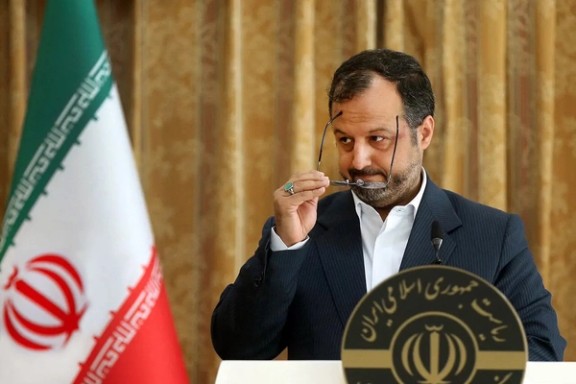
One student asked the minister if “you want to drag everyone into poverty,” to which the minister gave a condescending answer. “When I was a student like you 25 years ago, I was also a critic, but one expects students to ask more sophisticated and analytical questions,” Khandouzi replied. He then went on to tell the students that the ministry of economy has set up a summer school and they are welcome to attend the courses and learn economics.
Meanwhile, the minister admitted that the Islamic Republic in the past 20 years has completely mishandled its banking sector and now several institutions are on the verge of bankruptcy. He also acknowledged that the government is afraid of protests if banks go under, and depositors demand their money. For this reason, the government prefers to dissolve these institutions into the Central Bank of Iran, a strange arrangement for any country.
However, Khandouzi did not mention that there no true private sector banks in Iran. The so-called non-governmental banks are in fact institutions set up by public entities or by regime insiders who have political influence and therefore have immunity from supervision.
Insider dealings became once again public scandals this week. A company dealing with tea imports misused up to $3.5 billion it received from the government at preferential rate of exchange. Instead of importing tea and machinery as expected, the company sold dollars on the open market at much higher rates. Despite pledges by top officials to investigate and address the fraud, so far, no prominent person has been detained. Some local media outlets say that without the complicity of top officials such a fraud would not have been possible.
At the same time, members of Tehran’s municipal council are asking about more than $300 in city revenues that has “disappeared”, meaning there is no trace of the money in budget allocations. This is a substantial sum of money in Iran, equaling 170 trillion rials.
The minister of economy did not address the corruption scandals during his meeting with the students. He tried to argue that the economy has improved in the past two years during the reign of hardliners. President Ebrahim Raisi also presented rosy figures to parliament earlier this week. One lawmaker commented after the meeting that “The president seemed to be talking about a different country.”