Iran’s Delegation Walks Out Of UN Summit Over Israel's Presence

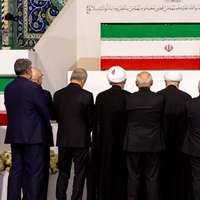
Iranian delegates walked out of UN climate talks in the United Arab Emirates Friday in protest over the presence of Israeli representatives.
Iranian delegates walked out of UN climate talks in the United Arab Emirates Friday in protest over the presence of Israeli representatives.
Energy Minister Ali Akbar Mehrabian, who heads the Iranian delegation, said Iran considers Israel’s presence at COP28 “as contrary to the goals and guidelines of the conference and, in protest, it left the conference venue.”
On Thursday, Iran's President Ebrahim Raisi also announced that he would not attend the UN Climate Change Conference (COP28) in Dubai, citing the presence of his Israeli counterpart.
It is not clear that why Tehran had sent the delegation in the first place as it knew about Israel’s participation in advance enough to cancel Raisi’s trip.
The UAE and Israel normalized relations during the presidency of Donald Trump in the United States when in 2020 the Abraham Accords opened diplomatic ties along with other Arab nations such as Bahrain.
During Herzog's inaugural visit to the UAE last year, the Iran-backed Houthis in Yemen sent a ballistic missile to the Persian Gulf state amidst a period of attacks which killed three. The missile was intercepted by the UAE. The Houthis' military spokesman said they fired Zulfiqar missiles at Abu Dhabi and launched drones at Dubai.



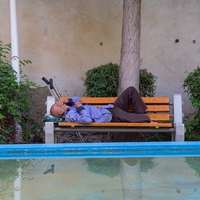

The government decision to increase the price of liquid gas (LPG) cylinders from $1.2 a cylinder to $8 this week has hit Iran's poor as winter takes hold.
The decision has hit hardest the poor southern provinces which do not have access to LPG at home. Ordinary workers barely make $150 a month and can't afford to pay the higher price for fuel they need for cooking and in some cases for heating their homes.
A local official with the Iranian oil ministry said that the inhabitants of Hormozgan are required to register in an electronic system in order to be given subsidized LPG but with many of the poor living in shanty towns, they remain locked out of the system.
If registered, each household will receive a quota of four subsidized LPG cylinders per month but a restaurant owner in the province told Aftab News that the allocated amount is still not enough and he has to find the extra fuel for his job in the black market at exorbitant prices.
Despite the criticisms, Iranian officials defended their decision, saying the distribution of LPG has been “adjusted” in an attempt to fight smuggling. The Iranian government has sold fuel and electricity at extremely low prices for decades, partly because of inertia and partly due to fears of popular protests. In 2019, a gasoline price hike led to days of nationwide protests. Security forces killed at least 1,500 people, which badly eroded the government's legitimacy. But as people's incomes have dwindled by high inflation since 2018, now the government faces even a tougher choice to raise prices.
The sharp increase in prices has also raised serious concerns among environmental activists.
Sirous Zareh, an environmental activist in Fars province warned that the drastic increase of the LPG price will practically leave no choice for the local communities living on the edges of habitats to use wood and tree trunks instead of the expensive gas.
Logging and deforestation will multiply as a result of the government’s new policy, Zareh predicted.
He stressed that while Iran’s large gas resources could serve as “a protective shield against indiscriminate deforestation,” the economically vulnerable sections of the society will have no other way but to stop gas consumption and start using forest fuel at their houses.
It comes while some of Iran's southern provinces such as Hormozgan and Khuzestan abound with gas resources, Iran the second richest gas nation in the world.
Iran has a serious shortage of natural gas which is in decline because of decades of inadequate investments and lack of Western technology to increase extraction in Iran's main underwater gas fields in the Persian Gulf. Years of various sanctions and mismanagement have prevented the necessary upgrades of gas platforms.
The government is juggling between ever-increasing domestic consumer and commercial demand and its need for power generation, exports and using needed gas for oil production.
Despite the celebratory and optimistic rhetoric of the Iranian regime officials about Tehran’s increasing ties with non-Western partners, even the Chinese and the Russians have not been willing to render any significant assistance to boost Iran’s gas and oil productions.
The UK, France and Germany have condemned Iran’s missile advances about a week after the unveiling of the Fattah-2, a ballistic missile that Tehran claims is “hypersonic.”
In a joint statement, the so-called E3 Iran continues to develop its missile program despite repeated international calls to halt it, and after years of disregarding UN restrictions.
Iran unveiled the new ballistic missile variant on November 19. Fattah II is reportedly equipped with an advanced warhead and hypersonic glide vehicle capable of maneuvering at high speeds to evade air defense systems. The missile was put on display at Ashura Aerospace Science and Technology University, a division of the Islamic Revolutionary Guard Corps (IRGC) in Tehran. Iran’s Supreme Leader Ali Khamenei visited the site to review an exhibition of new weapons systems, among them the Fattah II.
Highlighting the “grave threat Iran poses to global and regional security,” the countries decried Iran’s continued development of its ballistic missile program that “follows continued nuclear escalation, beyond all credible civilian justification, and previously conducted research on nuclear weapons delivery.”
The expiration of UN sanctions on Iran's missile program in October has raised concerns about the accelerated proliferation of potentially dangerous weapons. Iran is now free to sell its drones, ballistic missiles, and related long-range strike technologies to its anti-Western partners and clients and can also procure technology for further development.
The lifting of sanctions provides Iran with the opportunity to generate revenue from missile sales, potentially using the profits to finance militant and terror proxies in the Middle East.
Shortages of powdered milk and baby formula continue in Iran, as prices jump by at least 40 percent because the government has not provided foreign currency for imports.
The shortages began in March and reports in local media say most pharmacies and drug stores have run out of locally produced and more affordable powdered milk. Factories in Iran rely on imports of raw materials to produce powdered milk, which in turn need foreign currency allocation by the government.
Imports of major foodstuff, medication and other necessities depend on the government providing around $15 billion of foreign currency annually, but allocations have been slow in the past two years and prices have skyrocketed.
Reports indicate that baby formula packaged abroad and imported in small quantities is available, but each package costs up to $15, which most Iranians cannot afford. Average monthly wages for workers is $150 and food price inflation has been running at around 80 percent in the past two years.
Media in Tehran have also been reporting shortages of medication, while some government officials periodically deny any problems. The government allocates around $3 billion to import raw material for pharmaceutical products.
It is difficult to explain the government’s reluctance to provide sufficient foreign currency for imports of essential goods, when it says its oil exports have increased. The United States also agreed recently to allow around $16 billion of Iran’s frozen funds to be unblocked.
The US House of Representatives passed a bill Thursday that would permanently freeze Iran’s $6 billion, released as part of a prisoner swap deal in September.
The bill, named the No Funds for Iranian Terrorism Act, is yet another Congressional move aiming to pressure the Biden administration to harden its stance on Iran. Ninety Democrats joined all but one of House Republicans to pass the bill 307-119.
Rep. Michael McCaul, who introduced the bill, slammed the administration for making funds available to a government that sponsors Hamas, questioning the administration’s motive.
“There’s something else going on here,” McCaul said, “a deal we don’t know about,” suggesting that the Biden administration may have released the $6 billion to help bring about another nuclear agreement with Tehran.
Republicans have been opposing the ‘hostage deal’ ever since it was announced in August, but their opposition has intensified since October 7, when Hamas attacked Israel, killing 1,200 and taking more than 200 hostage.
“The idea that you can just take Hamas and keep it separate from Iran has always been a farce,” said House Majority Leader Steve Scalise. “Iran funds Hamas, and everybody knows it… We shouldn't even need the bill. The administration should be standing there saying we're not giving them the money anymore.”
But those close to President Biden argue that releasing the $6 billion had been necessary and key to securing the release of five Iranian-American hostages.
“Every member of Congress who was aware of these cases wanted our fellow citizens home,” said Rep. Gregory Meeks, ranking member of the House Foreign Affairs Committee. “Reneging on the deal would hurt U.S. global credibility.”
Biden critics say the deal has sent a signal that the US government would “reward hostage-taking”. They accuse Biden of emboldening the regime in Iran as well as its proxies across the Middle East.
Since mid-October, when Israel began its onslaught on Gaza, Iranian-backed groups have launched dozens of attacks on US forces in Iraq and Syria. And from Yemen, the Houthis have been launching drone and missile attacks.
Not surprisingly, the bill was amended Thursday to state the Iranian-backed Houthis are benefitting from the Biden administration’s failure to condemn them, and perhaps more importantly, prohibit the use of US federal funds for Iran.
“There is only one language that is understood by our adversaries,” Rep. Keith Self said on the House floor in support of the bipartisan bill, “that is strength.”
The bill will have to pass the Senate, which is not likely given the Democratic majority in the upper chamber. But if it were to pass and turn into law, it would impose new sanctions to prevent any transfer of money to Iran.
Republican lawmakers in both chambers are aggravated by what they see as President Biden’s soft approach to Iran. Some have gone so far as to call his policy “appeasement.”
“This administration has subverted Israel and boosted Iran for nearly 3 years,” Senator Ted Cruz posted on his X account. “Rob Malley, who headed up his nuclear negotiations with Iran, had Iranian spies working under him at the State Department.”
On Thursday, 25 Senators signed an open letter to oppose the administration’s sanctions relief to Iran.
Addressing the three secretaries of State, Defense and the Treasury, the Senators (led by Senator Tim Scott) conveyed displeasure at the fact that despite attacks on American troops, “it is business as normal on the economic front."
The letter reads: “We therefore request that your departments provide us with a classified assessment on the administration’s plan to deter Iranian aggression and prevent the escalation of conflict in the Middle East. This assessment should be provided in a member or staff-level briefing no later than December 7, 2023.”
The Belgian police are beefing up security measures to protect Darya Safai, an Iranian-born member of parliament, following death threats she received on social media.
In an interview with Iran International, Safai said that the death threats against her have increased following the Israel-Hamas conflict.
“I should be careful and report any suspicious events around me” to the police, the lawmaker wrote on X.
The police has launched a probe into the nature and sources of the threats.
Safai blamed Islamists for the threats, vowing that she will continue to stand up for freedom.
“It’s incomprehensible that people should make serious threats … instead of responding with substantive arguments. But that is just how Islamists operate,” read her post on X.
Speaking to Iran International, she accused the Iranian regime of orchestrating the threats by promoting Islamist extremism in Belgium and the whole of Europe.
Safai warned that Tehran is trying to target its opponents indirectly under the guise of backing the Palestinian cause.
The alarming rise of extremism and antisemitism have raised serious concerns among European countries, with many of them blaming the Islamic Republic for fostering such activities.
In October, The Times warned that Iranian agents are stirring up unrest in the UK through Gaza protests.
There is direct involvement of the Iranian regime through the physical presence of operatives at protests as well as through disinformation campaigns conducted online, the newspaper said.
Earlier in November, German authorities executed raids on 54 locations connected to the Islamic Center of Hamburg (IZH), suspected of supporting Iran-backed Hezbollah.
On November 4, Safai condemned attempts to silence her with the label of “Islamophobe,” especially since the current conflict began in the Middle East.
“What the world is experiencing today is much broader than a war between Israel and Hamas. It is a broad war that shows the direction for certain Muslims to ultimately achieve their goals,” she said earlier this month, highlighting the Muslims’ promised goal to conquer the world and establish an Islamic rule.
Last November, Iran International was warned by London Police that its journalists were under threat from Iranian agents and the police took measures to strengthen security around the network’s offices. A man was arrested in the vicinity of Iran International’s headquarters in February and charged with a terrorism offence.
Safai has been one of the most vocal European lawmakers critical of the Islamic Republic, advocating a tougher stance towards Tehran and its regional and international policies.
She is also one of the staunch supporters of listing Iran’s Revolutionary Guard (IRGC) as a terrorist organization.
Safai told Iran International on Thursday that she has been under police protection since June after she criticized a formal invitation extended to Alireza Zakani, the mayor of Tehran, to visit Belgium. Her criticism angered Iranian officials, with some reports saying that they might try to target anti-regime activists and figures who openly opposed Zakani’s visit.
Tehran’s mayor was a hardliner member of parliament before becoming a candidate in the 2021 presidential election and withdrawing in favor of the current president Ebrahim Raisi. He also served as the head of IRGC’s Student Basij paramilitary forces and had a prominent role in cracking down on students during popular protests in July 1999.