Iran Unveils New Upgraded Drone With Extended Range And Capabilities

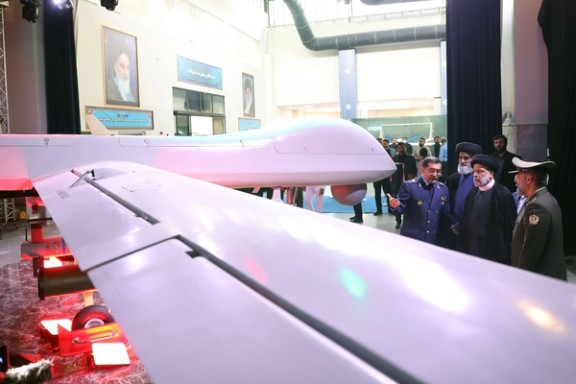
Iran has unveiled a new drone, the Mohajer-10, with enhanced capabilities and increased flight duration, according to state news media agency.
Iran has unveiled a new drone, the Mohajer-10, with enhanced capabilities and increased flight duration, according to state news media agency.
Official statements from Iranian media on Tuesday reveal that the homemade UAV (unmanned aerial vehicle), has an operational range of 2,000 km and can fly for up to 24 hours.
Reports indicate that the drone is equipped to carry missiles, bombs, and hand grenades. It is also outfitted with electronic warfare and reconnaissance systems.
Iran claims that drone's payload capacity can now accommodate up to 300 kilograms, double that of its predecessor; the Mohajer-6 drone.
The Mohajer-10 was unveiled in the presence of President Ebrahim Raisi, and is part of a new generation of Iranian military drones.
During the same ceremony, the air-launched Arman-1 bomb was also revealed. Concurrently, the release of a large quantity of advanced missiles – the Khorramshahr and Haj Qasem missiles – to the Armed Forces and the Aerospace Force of the Islamic Revolutionary Guard Corps (IRGC) has already commenced.
While US officials have alleged that Iran supplied Mohajer-6 drones, along with other unmanned aerial vehicles, to Russia to aid with their invasion of Ukraine, Iranian authorities have denied such allegations.
Rising tensions in the region have continued to draw global attention. Iran's attempt to seize two commercial vessels in early July was met with a resolute response from the United States, prompting Iran to withdraw, as confirmed by the Pentagon. Over the past two years, Tehran has reportedly harassed or seized more than 15 commercial ships in the broader Persian Gulf region.
In light of these challenges, the White House announced its intention to take decisive actions to safeguard stability in the region. While specific details were not provided at the time, subsequent actions have included a bolstered US military presence. In July, the Pentagon deployed F-16 and F-35 warplanes, and dispatched three naval vessels carrying over 3,000 sailors and marines, underscoring their commitment to maintaining a robust presence in the region.
Addressing the evolving situation, the Pentagon has affirmed its readiness to provide onboard armed protection to commercial vessels in the region, a development that Iranian media described as unprecedented. This move has also ignited discussions about the heightened prospects of potential military clashes in the region.
In recent months, numerous media reports have discussed covert diplomatic initiatives aimed at mitigating tensions with Iran. These efforts include the potential release of Tehran's frozen funds from nations like Iraq and South Korea, contingent upon Iran's commitment not to escalate its uranium enrichment to weapons-grade levels.
However, as of now, apart from a US sanctions waiver granted to Iraq to facilitate a partial fund release, there have been no notable developments. Simultaneously, in addition to the discourse surrounding Iran's nuclear program, the United States is actively pursuing the liberation of several American dual-nationals held captive in Iran. The unlocking of $7 billion in South Korean funds has been proposed as a concession in exchange for the release of these detainees.