• العربية
  • فارسی
BrandBrand
  • Iran Insight
  • Politics
  • Economy
  • Analysis
  • Special Report
  • Opinion
  • Podcast
  • Live TV
  • Iran Insight
  • Politics
  • Economy
  • Analysis
  • Special Report
  • Opinion
  • Podcast
  • Live TV
  • Theme
  • Language
    • العربية
    • فارسی
  • Iran Insight
  • Politics
  • Economy
  • Analysis
  • Special Report
  • Opinion
  • Podcast
  • Live TV
All rights reserved for Volant Media UK Limited
volant media logo

Former Iran PM Turned Opposition Has Believers And Critics

Maryam Sinaiee
Maryam Sinaiee

Iran International

Feb 8, 2023, 07:27 GMT+0Updated: 18:13 GMT+1
Mousavi, during his presidential run in 2009

The 2009 Green Movement leader Mir-Hossein Mousavi’s rejection of the reform option in the Islamic Republic has been met with admiration and antipathy alike.

In a rather short statement entitled “To Save Iran” Saturday, Mousavi who has been under house arrest along with his wife Zahra Rahnavard since 2011 underlined his recognition of the ‘Woman, Life, Freedom’ movement and called for a fair and free referendum to decide whether the present constitution should be amended or completely replaced.

He also called for elections to appoint a constitutional assembly to decide the future form of government as well as a further vote to decide whether the new constitution is acceptable to the people or not.

Such a referendum would very likely put an end to Velayat-e Faghih (rule of the Islamic jurist) which gives a cleric such as Ali Khamenei extraordinary powers including the power to overrule all elected bodies and officials and hence, people’s choice.

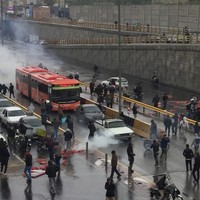
This comes in contrast to his position in 2009 when in a highly disputed election result he was denied the presidency running against the incumber Mahmoud Ahmadinejad. At that time although millions of people poured into the streets to support him, he refrained from seriously challenging the regime and its leader Ali Khamenei.

Mousavi admitted that he did not know who should decide to hold a referendum, since the current rulers would not, but called for cooperation among all political forces and figures who believe in preserving the country’s territorial integrity and non-violence to clarify these points.

100%
Mousavi and his wife Rahnavard casting their votes in June 2009

“There were two types of reformists in Iran. Some neither desired nor thought it possible to overthrow the misery [caused by the clerical rule] and sought a share of power. A minority including Mir-Hossein Mousavi believed that the misery of the clerical rule was reformable and could evolve into democracy. Mir-Hossein Mousavi’s courageous new statement showed that he has given up the dream of reform,” US-based academic Abbas Milani tweeted.

Some reformists, including seven prominent political prisoners and over a dozen figures of the ‘religious intellectual movement’, and its mentor Abdolkarim Soroush, have welcomed his proposal, others have strongly rejected it.

Speaking to Iran International, Soroush said Mousavi’s supporters and opponent agree that he “bears a weight” that cannot be ignored.

The political prisoners who have supported Mousavi’s new move have said that they will do their best to advance his proposal to bring a “peaceful and non-violent transition to a completely democratic and developed Iranian structure."

100%
A scene from protests in 2009 following a highly disputed presidential election

Many of Mousavi’s opponents say as a former prime minister (1981-1989) he is responsible for much of the regime’s wrongdoings and atrocities including mass execution of thousands of political prisoners in 1988 and the Cultural Revolution to expurgate universities from Marxists and militant political groups such as the Mujahedeen-e Khalq Organization.

Arguing that Mousavi has never denounced the Islamic Republic’s founder, Ruhollah Khomeini and his ideology, and still admires him and his “golden era”, pro-monarchy journalist and activist Morteza Esmailpour said in a tweet that Mousavi himself should be put on trial because “the regime was always criminal”.

The prison executions were carried out based on a fatwa by Iran's then-supreme leader, Ruhollah Khomeini, against the MEK which carried out a wave of bombings in Iran and struck an alliance with Saddam Hussein during the 1980-88 war. “Showing mercy to those who take up arms against the Islamic government is being naïve,” Khomeini said in his fatwa.

In June 2010 Mousavi claimed, in a meeting with a group of journalists and political activists, that not only he, but also other top officials -- including the president, chief justice and the speaker as well as Khomeini’s designated successor Hossein-Ali Montazeri – were unaware of what was happening in prisons and blamed the prison purge on others including a former warden of the infamous Evin Prison Assadollah Lajevardi.

He also admitted that many of the prisoners who were executed had not committed any crimes or if they had, they were already serving their sentences. “We even knew some of them, from before the revolution and after that… They were poets, they were writers … They had not taken up arms,” he said.

Most Viewed

Iran’s dams may have been built to support missile bases - NYT
1

Iran’s dams may have been built to support missile bases - NYT

2

US Army seeks 17 bunkers in Israel, Saudi, Lebanon amid Iran threats - report

3

UK PM warns Iran against attacks on journalists and military bases

4

Senior Guards commander admits deep Israeli intelligence infiltration

5

Iran’s daily hardships find a voice in IRGC-linked media

Banner
Banner
Banner
Banner
Banner
Banner
Banner

Spotlight

  • How Thai clerics in Iran were recruited to attack Israeli embassy in Bangkok
    EXCLUSIVE

    How Thai clerics in Iran were recruited to attack Israeli embassy in Bangkok

  • Mapping aircraft losses from US-Israeli strikes on Tehran airport
    SPECIAL REPORT

    Mapping aircraft losses from US-Israeli strikes on Tehran airport

  • Iraq’s move on militia stronghold may do little to curb Iran’s influence
    ANALYSIS

    Iraq’s move on militia stronghold may do little to curb Iran’s influence

  • 'Our turn to play': Iran hardliners call for breaking US blockade

    'Our turn to play': Iran hardliners call for breaking US blockade

  • Head full of pellets: protester recalls ordeal on Iran holiday island
    EXCLUSIVE

    Head full of pellets: protester recalls ordeal on Iran holiday island

  • Israeli opposition to Islamic Republic transcends party lines
    ONE-ON-ONE

    Israeli opposition to Islamic Republic transcends party lines

  • 2019 crackdown failed to break cycle of Iran street protests
    ANALYSIS

    2019 crackdown failed to break cycle of Iran street protests