US Sanctions Hezbollah's Accountants, Weapons Facilitator
Hezbollah forces parading in Beirut, Lebanon
The United States Thursday sanctioned individuals and companies for providing financial services to and facilitating weapons procurement for Hezbollah, the Treasury Department said.
The Treasury Department's Office of Foreign Assets Control (OFAC) took action against two individuals and two companies based in Lebanon for providing financial services to Hezbollah, along with an additional individual involved in facilitating weapons procurement for the group, it said in a statement.
Founded in 1982 by Iran's Revolutionary Guards and classified by the United States and other Western countries as a "terrorist organization," Hezbollah is a powerful group in Lebanon and acts as a proxy for the Islamic Republic. It has been fighting in Syria with other Iran-backed forces.
OFAC regulations generally prohibit all dealings by US persons or within the United States that involve any property or interests in property of designated entities.
Among the individuals sanctioned on Thursday were Adel Mohamad Mansour, who led a Hezbollah-run quasi-financial institution; Hassan Khalil, who worked to procure weapons on behalf of Hezbollah; and Naser Hassan Neser, who worked with an entity that provided financial services to the group, the Treasury Department said.
The two companies sanctioned on Thursday over providing financial services to Hezbollah were named Al-Khobara and Auditors.
Last month, the United States issued sanctions against an international oil smuggling network it said supports Hezbollah and Iran's Quds Force, targeting dozens of people, companies and tankers.
Ruhollah Zam, an Iranian expat journalist who was kidnapped and taken back to be executed
The Washington Post says the Islamic Republic of Iran is beefing up its plans to kidnap and kill opponents abroad with the help of gangsters and criminal groups.
The Washington Post said in an article on Thursday, that the expansion of the Islamic Republic's “terror and kidnapping plots” has worried officials in Western countries.
The article is based on government documents and interviews with 15 officials in Washington, Europe and the Middle East, who spoke on the condition of anonymity to discuss sensitive information.
It adds that the tempo of the plots has significantly increased in the past two years, and they are among the most ambitious and far-reaching in recent memory, according to the officials and documents.
The paper goes on to quote officials that the Islamic Republic’s intelligence and security services depend largely on proxies to carry out their plans, “offering hundreds of thousands of dollars to jewel thieves, drug dealers and other criminals in murder-for-hire schemes.”
The Revolutionary Guard Intelligence Organization and the IRGC Quds Force have been mentioned as two main actors in designing these plots.
The Iranians’ recruitment of agents appears as varied as the geographic distribution of their targets.
That hands-off approach probably caused some operations to fail, the officials said, as plots have been disrupted — and, in some cases, the hired hit men appear to have gotten cold feet and never carried out their orders.
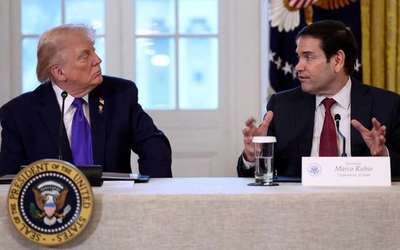
US Special Envoy for Iran Robert Malley says President Joe Biden is prepared for a military option to prevent Iran from acquiring a nuclear weapon in case sanctions and diplomacy fail.
During an interview with Foreign Policy’s podcast Playlist released on Wednesday, Malley said that the US and Iran came very close to reaching an agreement to revive the 2015 nuclear deal – or the Joint Comprehensive Plan of Action (JCPOA) -- many times in the past two years, the latest of which was in August, but each time Iran stepped back and came up with new demands that often had nothing to do with the nuclear talks.
“We'll have the sanctions, pressure and diplomacy. If none of that works, the President has said, and, as a last resort, he will agree to a military option because if that’s what it takes to stop Iran from acquiring a nuclear weapon, that’s what will happen. But we’re not there," he said.
Defending the Biden administration’s efforts to keep diplomacy as an option and criticizing the Trump administration for its maximum-pressure campaign, he said, “We owe it to ourselves to have an honest examination of how sanctions work and how they don’t work.”
The Iranian system as a whole is divided, and not yet concluded whether they really want to come back to the deal, and so each time Tehran was presented with a deal, even about the deals that were considered fair by other parties such as Russia and China, Iran was the one that walked back.
The Palais Coburg, the venue of Iran nuclear talks in Vienna
“Iran has rejected countless opportunities to come back to the deal... We are prepared for a world with the JCPOA and without the JCPOA. We’ve continued to put pressure on Iran... We made sure there are sanctions for their support for terrorism, their human rights violations, for their ballistic missile program and for their nuclear program,” he added. “The JCPOA is not on the agenda because of Iran’s position, and we’re continuing with our policy to respond to all of Iran’s destabilizing activities.”
Malley also said reviving the deal would be dead when the non-proliferation benefits of the deal do not justify or warrant the sanctions relief that the US is ready to offer, emphasizing that the US focus and energy are not on the deal. Currently, the focus is on what is happening in Iran and its support for the Russian invasion of Ukraine.
He also talked about many troubling issues emanating from Iran, saying the US supports aspirations of the Iranian people to achieve the fundamental rights and freedoms that all peoples across the globe should enjoy. “We are mobilizing international attention, putting the spotlight on what’s happening in Iran. It’s very important that the world know at a time when the Iranian regime is trying to hide what’s happening and to distort what’s happening,” he said.
The administration has also put the spotlight on developments in Iran by sanctioning those up and down the chain who are violating the basic rights of the Iranian people, “whether it’s a top leadership or whether it’s an anonymous person in a prison,” Malley noted. “The world should know who is behind that repression.”
He also said Washington is pushing for measures against the Islamic Republic in international bodies, mentioning the resolution at the UN Human Rights Council and the move to kick out Iran from the UN Commission on the Status of Women. “It’s an aberration, a complete anomaly, that Iran would be on the commission that is supposed to defend the rights of women when they are repressing them,” he added.
The US will continue to voice its support for the Iranians who are protesting for their rights, he reiterated, saying that “it's an extraordinary page in Iran’s history that’s being written right now.”
Praising “the courage, the determination, the persistence and the creativity of Iranians, particularly women and girls,” Malley said “we’re not going to be the authors; we can be there to express support for the fundamental rights of Iranians. This page will be written by Iranians themselves. It won’t be written in Washington, in London or anywhere around the globe other than Iran.”
Also on Wednesday, The US secretary of state says that the Islamic Republic has a deeply incorrect understanding of its people and is trying to blame others for the current protests.
A large group of Lebanese politicians have slammed claims by Iran’s Supreme Leader who said recently that Tehran’s influence in Lebanon must be expanded.
The National Council for Ending Iranian Occupation says such remarks are a clear sign of Islamic Republic's intervention in Lebanon.
On Saturday, Khamenei once again called Lebanon a territory in Iran’s orbit, saying the active policy of the Islamic Republic in Lebanon, Syria and Iraq has led to the failure of “US plots” in these countries.
The Lebanese government has not yet reacted to these statements. However, The National Council for the Ending Iranian Occupation in a press conference said that the Lebanese presidential election is being controlled by Iran.
“After seven unsuccessful attempts to elect the president, the signs of fatigue are visible on your faces. The reason for this failure is that Lebanon is occupied by Iran,” added the statement.
According to the Lebanese media, the “Axis of Resistance” is one of how Iran is expanding its strategic influence in the region.
The term Axis of Resistance refers to an anti-Western, anti-Israeli and anti-Saudi political and informal military alliance between Iran, Palestinian militant groups, the Syrian government and the Lebanese Hezbollah.
The National Council for the Ending Iranian Occupation was officially launched in January to break free from Hezbollah's armed hegemony over the country that has always been a threat to Lebanese sovereignty.
The Islamic Republic has sentenced four people to death for what the judiciary calls “cooperating with the Israeli intelligence service and committing kidnappings.”
Iran’s Mizan News Agency, which is affiliated with the Judiciary, said Wednesday that the four, who had been arrested back in June, have been “destroying private and public property and obtaining fake confessions.”
The Islamic Republic has long accused arch-enemy Israel of carrying out covert operations on its soil. However, it has not provided evidence to prove its claims against those who received the death penalty. Iran’s judiciary never holds such trials transparently and it is not clear if such trials have indeed been held.
Throughout the years, due process has not been implemented during political and security trials while the Islamic Republic often accuses Israel and the West of having spies in the country.
This time the identities of the accused have been announced, alleging that “with guidance from the Israeli intelligence service, this network of thugs” were committing crimes.
Israeli is believed to have been behind assassinations and acts of sabotage against Iran’s nuclear facilities, but no one was ever put on trial for these incidents.
On Wednesday, three other people were handed prison sentences of between five and 10 years for alleged crimes such as acting against national security and possessing illegal weapons.
International community and human rights organizations have repeatedly expressed concerns about Islamic Republic’s detentions, sham trials, and the death sentence for people.
The US State Department has approved the potential sale of an anti-drone system to Qatar in a deal valued at $1 billion, the Pentagon said on Tuesday.
The potential sale approval comes after U.S. President Joe Biden, earlier this year, designated Qatar as a major non-NATO ally of the United States, granting special status to a key friend in a turbulent region.
"Qatar is a good friend and reliable and capable partner. And I'm notifying Congress that I will designate Qatar as a major non-NATO ally to reflect the importance of our relationship. I think it's long overdue," Biden said in January when he met Qatar's emir, Sheikh Tamim bin Hamad al-Thani.
Separately, Qatar has also played a role in the Iran nuclear talks and in relations with Afghanistan, where Washington's interests were represented by the small Gulf country.
The proposed sale will improve Qatar's capability to meet threats by providing electronic and kinetic defeat capabilities against drones, the Pentagon said.
The principal contractors will be Raytheon Technologies Corp RTX.N, SRC and Northrop Grumman Corp NOC.N, the Pentagon said in a statement. It added that the Pentagon's Defense Security Cooperation Agency notified Congress of the possible sale on Tuesday.
It will require the assignment of five additional US government and 15 US contractor representatives to Qatar for five years to support fielding, training and sustainment activities, the statement added.
Despite approval by the State Department, the notification does not indicate that a contract has been signed or that negotiations have concluded.