Two Iranian Clerics Beaten Up In Religious City Of Qom
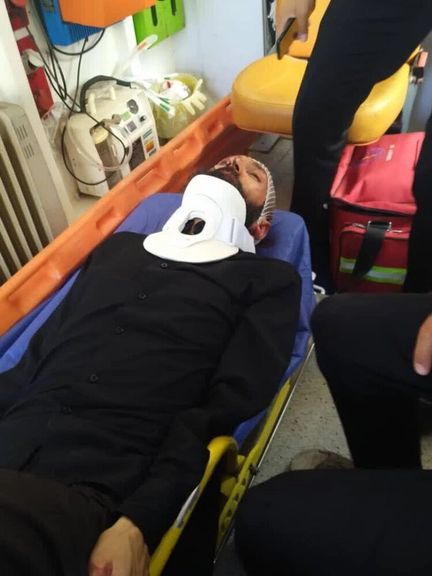
One of the beaten clerics in the city of Qom on August 31, 2022
Two unidentified men beat up two clerics in the religious city of Qom on Wednesday, leaving one of them with severe bruises and the other in the hospital waiting for a surgery.
One of them said that he saw two people beating up a cleric he knew with metal pipes and when the attackers saw him looking from his car they started beating him too and broke his cars windows. The clerics are prayer imams at two mosques
The second cleric who has lighter injuries criticized the city’s police for showing up very late -- after about 40 minutes – and for not arresting the perpetrators despite the fact that they knew where they were hiding.
It is not clear if the attackers knew the first victim and if they attacked him for a personal reason.
Late in July, a cleric named Mojtaba Hosseini was stabbed several times in his back during his sermon in the city of Karaj in Western Tehran. And earlier in July, a congregational prayer imam was injured in an assassination attempt by an assailant on a motorcycle in the city of Esfahan.
Supreme Leader Ali Khamenei casting his vote in the 2021 election
A prominent conservative figure has told the IRGC-linked Tasnim news that "Not all reformists are seditionists," while criticizing the current government.
The calibre of the political figure and the media outlet that has interviewed him may be taken as a green light for Iran's embattled reformists to actively take part in the 2024 parliamentary elections.
Conservatives loyal to Supreme Leaser Ali Khamenei coined the ‘seditionist’ label for those who protested Mahmoud Ahmadinejad’s controversial re-election in 2009.
The comment by Expediency Council member Mohammad Javad Bahonarcame one day after friends and foes lashed out at President Ebrahim Raisi for giving a misleading report at a news conference about his success in tackling inflation. He had said that his economic policy reduced last year's 60 percent inflation rate to 35 percent.
Many critics, including government supporters reminded that same time last year the official annual inflation rate was around 42 percent, which remains almost the same despite claims of economic improvement.
Khamenei's advice to Raisithis week to follow a better and more convincing propaganda method was obliquely referring to the President's whitewashing of the failure of his economic team, after conservatives consolidated their power by taking over all three government branches and pushing aside ‘reformist’ politicians by barring them from elections.
Prominent conservative politician Mohammad Javad Bahonar
Soufi complained that watchdogs including the conservative dominated Guardian Council that vets election candidates, tend to disqualify reformist figures and in such a situation competition is meaningless.
Pointing out the discriminatory situation Soufi said that while former president Hassan Rouhani had to submit the 2015 nuclear agreement for parliament’s approval, hardliners now say that their comrade, President Raisi does not need to do the same with the new nuclear deal. He pointed out that "the core of the Iranian pollical system simply does not trust anyone who is not a hardliner."
Ali Soufi, 'reformist' politician in Iran who says he will not run in any election
"The system even did not tolerate Iranian and US foreign ministers walking together during the negotiations," in 2015 he said. He also pointed out that many hardliners believe reformists are traitors only because they believe in dialogue and diplomatic relations. "Meanwhile, the Supreme Leader has said over and over that the West is not trustworthy," Soufi noted, adding that some hardliners characterize reformists as pro-Western elements.
He also noted that Iran's problem at the time being is that most Iranians, whether conservative, moderate or reformist, no longer trust the government and many evade the polls.
Nonetheless, the conservative figure Bahonar also criticized the current ultraconservative government "because many of their officials are not familiar with the way big jobs should be done." He added that the government makes ad-hoc problematic decisions such as announcing pay raise for workers that they cannot afford.
Assessing Iran's current political situation, Bahonar said that only less than 10 percent of Iranians are religious, revolutionary and follow the regime’s guidelines in every respect. He added that a lot of Iranians understand national interests and national security, but they are not interested in politics. They simply want to live. "I know many reformists who respect the Islamic revolution, the Islamic Republic and the Supreme Leader. Not all reformists are seditionists," he reiterated.
Iranian Education Minister Yousef Nouri said Wednesday that 200 schoolbooks of the country’s education system will be revised as ordered by the Supreme Leader.
Nouri said that the revision of textbooks and educational content will be carried out for the next academic year in 2023 because the books were being printed when the order was issued.
About 200 titles of books from all grades of elementary to high school have been sent for revision, he said, adding that some of them will be revised by the professors at the Farhangian teacher training university and some by the country's educational research and planning organization.
Earlier in the year, Ali Khamenei said that the content of some schoolbooks that is not practical and does not benefit the students should be removed.
In the last few years, some changes and edits in students’ textbooks, including removal of an illustration of some girls from the cover of the third-grade math book and adding anti-American and pro-Russia materials, led to controversy among Iranians.
A conscious ‘Islamization’ of primary, middle and high school books started soon after the 1979 Islamic Revolution. The process has applied to literature, art and all illustrations in the teaching of history. Last year textbooks were revised to play down historical rivalry between Iran and Russia, particularly in the 18th and early 19th century, reflecting Tehran’s current desire for closer relations with Moscow.
President Ebrahim Raisi has also permanently cancelled the implementation of UNESCO 2030, a United Nations document calling for gender equality in education that Khamenei had suspended in 2017. Former President Hassan Rouhani’s administration had adopted the document as a UN member state and was planning its implementation when hardliners lobbied Khamenei to suspend it.
Human rights group Amnesty International said Wednesday that Iranian and Turkish security forces have repeatedly opened fire at Afghans who attempted to cross their borders to reach safety.
In a new report, titled 'They don’t treat us like humans,' Amnesty released documents of numerous instances -- mostly at Iran border -- where security forces have shot directly at the refugees as they climbed over walls or crawled under fences to prevent their entry or forcibly return them to face life-threatening risks under the Taliban regime, in violation of international law.
Highlighting their plight, the report said the migrants are poor and lack passports or other valid travel documents, therefore they are especially vulnerable to border police who use threats or outright violence to keep them out.
It added that Afghans who do manage to enter Iran or Turkey are routinely arbitrarily detained and subjected to torture, with a total of 11 killings by Iranian security forces. Although the true death toll is likely to be significantly higher, the Amnesty said.
“One year after the end of airlift evacuations from Afghanistan, many of those left behind are risking their lives to leave the country – Afghans who have travelled to the Iranian and Turkish borders over the past year, in search of safety, have instead been forcibly returned under fire. We documented how Iranian security forces have unlawfully killed and injured dozens of Afghans since last August, including by firing repeatedly into packed cars,” said Marie Forestier, researcher on refugee and migrants rights.
Hundreds of thousands fled Afghanistan in August 2021 after the US left the country in a chaotic military pullout, allowing the hardline Taliban Islamists to retake control.
A member of the Ukrainian parliament says Russia is going to buy 100 more drones from Iran in addition to the drones it recently bought from the Islamic Republic.
Yuliya Leonidivna Klymenko, a member of the liberal party, told Iran International that she was “deeply shocked and saddened" by the fact that Iran sent drones to Russia to be used in its invasion of Ukraine.
US Defense Department spokesperson Todd Breasseale said on Tuesday that Russia has faced "numerous failures" with Iranian-made drones acquired from Tehran this month, adding that the United States assesses Russia has received the delivery of Mohajer-6 and Shahed-series unmanned aerial vehicles (UAVs) over several days this month. "We assess that Russia intends to use these Iranian UAVs, which can conduct air-to-surface attacks, electronic warfare, and targeting, on the battlefield in Ukraine," the official said.
In July, US National Security Adviser Jake Sullivan told reporters the US has information that shows Iran is preparing to provide Russia with up to several hundred drones.
The Biden administration last month released satellite imagery indicating that Russian officials visited Kashan Airfield on June 8 and July 5 to view the Iranian drones.
Iran's foreign minister, Hossein-Amir Abdollahian, never denying these reports, said last month that Tehran had "various types of collaboration with Russia, including in the defense sector."
Iran’s prosecutor-general Mohammad-Jafar Montazeri says since Tehran and Washington have no treaty on the expatriation of prisoners, such exchanges should be done through diplomatic channels.
In response to a question about earlier remarks by the country’s foreign ministry spokesman, who had expressed Iran’s readiness for prisoner swaps as part of the agreement to revive the 2015 nuclear deal, he did not rule out such a possibility.
“We have a duty to follow up on the problems of our citizens anywhere in the world and support them, but relations between countries can be very effective in this field. The level of relationships and the quality of relationships are effective in this field,” he said.
He noted that such exchanges work much more easily with Islamic countries and neighboring countries, especially with countries with whom Tehran has agreements in this regard, but “these relations and contracts do not exist with a country like the United States, and things must be done diplomatically.”
Earlier in the month, foreign ministry spokesman Nasser Kanaani said Iran is ready for swift agreements for prisoner swaps with the US, regardless of the result of talks to restore the JCPOA.
A few days earlier, the spokesman for the Iranian parliament's National Security and Foreign Relations Committee Mahmoud Abbaszadeh Meshkini said, "I don't know specifically whether there is going to be an exchange of prisoners between Iran and the United States, but in international relations this is customary and it is not unusual for some prisoners to be exchanged between the two countries.”