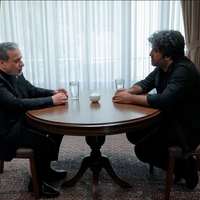
Ex-British Minister Jack Straw giving an interview to Iran International. November 17, 2021
Jack Straw, ex-British foreign secretary, told Iran International Wednesday that Britain should pay £400 million owed Iran since 1971 and linked to Iran's detention of a dual national.
Straw said the only possible obstacle to paying the debt was potential United States sanctions, which threaten punitive action against any third party dealing with Iran’s financial sector. But Straw suggested this was unlikely given past US behavior in similar circumstances.
“When there was previously a Democrat [Party] government in power in Washington, and John Kerry was the secretary of state, he arranged for about $2 billion to be paid to the Iranian government – [money] the US owed - the money was put on a plane,” Straw said. “The United States are not going to make a fuss about us paying a debt, if necessary in a similar way.”
On the same day, in January 2016, that the US flew to Tehran $1.7 billion it owed Iran, the Iranian authorities released four Americans, including Jason Rezaian, an Iranian-American journalist arrested in July 2014. Washington also freed seven Iranians held over alleged sanctions violations.
Straw said he was convinced that “from time to time the Islamic Republic of Iran has engaged in what amounts to hostage taking” and that while he could not be certain, he assumed this was the case with Nazanin Zaghari-Ratcliffe detained in Iran since 2016.
Straw has been a proponent of improving ties with Iran, arguing that the regime in Tehran is not the revolutionary government of 40 years ago and diplomacy can work to change its policies.
But the former foreign secretary insisted that, nonetheless, the money was owed: “If we pay, it will not create any further difficulties for Nazanin Zaghari-Ratcliffe and may very well ease her circumstances of release.”
International arbitration ruled in 2001 that London should repay money given by Iran for military hardware that was never delivered.
‘Complicated’ relations
Straw noted that Britain’s relationship with Iran was “complicated,” and had been so before the 1979 Revolution. While he said Britain had on occasions handled Zeghari-Ratcliffe’s case poorly – he cited Boris Johnson’s 2017 statement to a parliamentary committee that she was in Iran training journalists – the situation needed “very careful diplomacy” and that “shouting at them, or as some people have said, breaking off diplomatic relations, is going to get us absolutely nowhere.”
Straw said he shared the frustration of Richard Ratcliffe, who is in hospital for tests after a 21-day hunger strikeoutside the British foreign office in London to draw attention to the plight of his wife.
The issue of paying the £400 million ($540 million) debt is controversial in British politics, with Ratcliffe alleging his wife is forbidden from leaving Iran, effectively held ‘hostage,’ to pressure London to pay.
Taking ‘hostages’
While Straw has earlier argued that Britain should pay, others, including many within the ruling Conservative Party, oppose the move, arguing it would encourage Iran to take other hostages. An ex-detainee in Iran, theAustralian-British academic Kylie Moore-Gilbert, said Wednesday that the British government should repay the £400 million only in the form of “humanitarian aid.”
In a debate Tuesday in the British parliament Jeremy Hunt, a former Conservative foreign minister, said the UK should immediately pay “if necessary, by getting an RAF [British air force] plane to fly gold to Tehran.”
Zaghari-Ratcliffe, a project manager for Thomson Reuters Foundation, was arrested in 2016, convicted without a fair trial of working to overthrow the government and sentenced to five years jail. After being paroled early in 2020, she was charged with new offences and has been refused permission to leave the country. Other British citizens held in Iran are dual-nationals Anoosheh Ashoori, a businessman, and labor activist Mehran Raoof.
Prominent Iranian human rights defender, Narges Mohammadi. FILE PHOTO
Iranian rights activist Narges Mohammadi said Wednesday she faces an outstanding sentence of 80 lashes and 30 months’ jail after she was arrested on Tuesday.
Mohammadi called her husband, who lives in France, from Evin prison telling him that she was in solitary confinement. Rahman wrote later in a Twitter post that the line had been cut when Mohammadi insisted that she would not allow the lashing.
According to the Human Rights Activists News Agency (HRANA), Mohammadi was arrested Tuesday at a death anniversary ceremony at a cemetery in Karaj, west of Tehran, for Ebrahim Ketabdar, shot dead by security forces during 2019 protests, reportedly while shopping.
In a video posted to Twitter, Ketabdar's mother claimed security beat Mohammadi, dragged her into their vehicle and took her away. Another video posted on Twitter showed her protesting to the security forces over Mohammadi’s arrest amid chants of "Down with the Dictator."
Solitary cell
Former political prisoner Arash Sadeghi in a tweet Wednesday said Mohammadi was being held in “a solitary cell in a ward run by the Revolutionary Guards.”
"Narges Mohammadi and Atena Daemi's [an anti-capital punishment campaigner] sentencing to lashes is for their protest against people's massacre in November 2019,” Sadeghi tweeted. “Let's not remain silent against this inhumane sentence.”
The outstanding convictions date to July, when Mohammadi was convicted on charges of "propaganda against the Islamic Republic" for issuing a statement against the death penalty and "disobeying the prison governor and authorities." Mohammadi claimed this resulted from what she claimed was a prison governor's inappropriate behavior that amounted to sexual harassment.
Mohammadi refused to attend her trial in March having said in an open letter the previous month that she would refuse to accept any sentence passed by the court. She then refused a summons to serve the sentence in September.
Cofounder and chair of the Defenders of Human Rights Center, Mohammadi has been to jail several times over the past two decades. She was freed from Evin September 2020 after serving five and half years when she had no contact with her husband and children for long stretches.
She was detained twice before this year, once for participating in a rally in front of the interior ministry during week-long water protests in Khuzestan and again at an anti-Taliban rally outside the Pakistan embassy in Tehran in September. She was freed both times after a few hours.
Kylie Moore-Gilbert, a British-Australian academic previously jailed in Iran. FILE PHOTO
Kylie Moore-Gilbert, an academic previously jailed in Iran, has told the British government it should repay its £400 million debt to Iran only as humanitarian aid.
Paying the debt – due over Britain’s failure to supply military hardware sold to Iran in the 1970s – has become controversial in British politics. Richard Ratcliffe alleges his wife Nazanin Zaghari-Ratcliffe is forbidden from leaving Iran to pressure London to pay, and while some politicians and clerics argue Britain should do so, others, notably on the right wing of the ruling Conservative Party, argue it should not.
In a series of tweets Wednesday, Moore-Gilbert, a lecturer in Islamic Studies at Melbourne University exchanged by Iran last year in a prisoner swapwith three Iranian prisoners in Thailand two of whom had been convicted in connection with a bombing plot in Bangkok in 2012, said the UK should not pay the debt but rather decide itself in what form to transfer “humanitarian aid” to Iran.
Tehran won its case over the debt in international arbitration in 2001, but the UK has sat on the money ever since.
"An international court of arbitration has ruled that this debt must be paid," Moore-Gilbert wrote. “But to the Iranian government, not the IRGC [Revolutionary Guards]. “It is the Iranian people's money, and should go to the Iranian people, who are suffering greatly from economic catastrophe and the disastrous impact of Covid.”
RAF plane to Iran
The academic seized on a statement by Jeremy Hunt, former British foreign minister, in Tuesday’s parliamentary debate on the Zaghari-Ratcliffe case, that the UK should immediately pay “if necessary, by getting an RAF [British air force] plane to fly gold to Tehran.”
"Is anyone in any doubt where this gold will end up? Who it will benefit?" Moore-Gilbert tweeted. "What is certain is that £400m will only incentivise the IRGC to take more hostages."
Moore-Gilbert wrote that Zaghari-Ratcliffe, a project manager for Thomson Reuters Foundation, was a hostage, as were other dual citizens including British-Iranian businessman Anoosheh Ashoori and labor activist Mehran Raoof, American-Iranian environmentalist Morad Tahbaz, journalist Jason Rezaian, and Australian backpackers Jolie King and Mark Firkin. Rezaian, King and Firkin have all been released: the backpackers were held for a few months after reportedly flying an unlicensed drone.
Sadiq Khan, London mayor, and Tulip Siddiq, Zaghari-Ratcliffe's member of parliament, in a joint statement before the parliamentary debate said that Prime Minister Boris Johnsonshould take “stronger action” over Zaghari-Ratcliffe: “We believe that this innocent woman has suffered enough. Though responsibility for Nazanin’s predicament lies with Iran, there is more that the UK Government could be doing to help her, and we are making a personal plea to the Prime Minister to take stronger action to try to bring her home.”
Zaghari-Ratcliffe, now 42, was arrested in 2016, convicted in a trial without due process of law of working to overthrow the government and sentenced to five years imprisonment. After being paroled early in 2020, she was charged with new offences and has been refused permission to leave the country.
UN experts and human rights organizations have said Iran imprisons foreigners and dual nationals to use them as bargaining chips against other countries.
Ratcliffe, her husband, has just ended a three-week hunger strike outside the UK Foreign Office. Ratcliffe listened to parliamentary debate Tuesday afternoon from hospital where he is undergoing checks and treatment after his fast.
Some of the victims who were killed in protests in Iran in November 2019.
Iran’s Writers Association (IWA) on the anniversary of November 2019 killings of protesters has said that no one believes the Islamic Republic can be reformed.
The banned writers’ group said in a statement, “The foundations [of the Islamic Republic] rest on imprisonments, killings and elimination of dissidents, intellectuals and protesters.”
On the second day of widespread protests in mid-November 2019, Iranian security forces opened fire on demonstrators in many cities killing and injuring thousands. Estimates range from 300 to more than 1,500 fatalities. No one has been held responsible and many detained protesters have been tortured and sentenced to prison.
The IWA said that the government has continued persecution of the families of those killed in protests since December 2017, to prevent them from seeking justice. The statement went to say that today even the most optimistic and gullible people have realized that there is no chance for change and reforms.
Members of IWA who meet in secret, having been stripped of their headquarters, also condemned the government for increasing poverty in the country, saying current policies are destroying Iran’s social fabric.
Some of the victims of a 1988 prison massacre in Iran.
A witness in the Swedish trial of an Iranian over his alleged role in 1988 prison executions has named President Ebrahim Raisi as one of the officials directly involved in the massacre.
The trial of Hamid Noury (Nouri), ex-judicial official, over alleged involvement in Iran’s 1988 prison executions has begun hearings in Albania with testimony on the part played by President Ebrahim Raisi.
The sessions, which started August 10 in Stockholm, moved to Albania to question members of the opposition Mujahedin-e Khalq (MEK), who were relocated by the United States after the post-2003 government in Baghdad objected to the presence in Iraq of the armed group, which had been allied to Saddam Hussein.
Six judges, two prosecutors, and the lawyer of 60-year-old Noury all travelled to Duress, Albania. Noury, who was arrested in Sweden in November 2019, is being tried there under a principle of universal jurisdiction and attended Wednesday’s sessions through videoconferencing.
Akbar Samadi, an MEK member, told the court he had been arrested in 1981, aged 14, when a sympathizer of the group. By summer 1988, Samadi had been in prison for seven years serving a ten-year sentence, and Raisi was Tehran deputy prosecutor.
Iranian protesting in Stockholm with pictures of 1988 victims
"Raisi … took me to an empty room,” Samadi told the court. “He ordered me to denounce armed uprising. I told him I was shorter than a G-3 battle rifle [a German-made automatic weapon] when I was arrested…Then Raisi told me to denounce a Kurdish party, the Komala, and I protested that I was neither a Kurd nor belonged to the Komala. He got angry and threw me out of the room and sent me to the death corridor.”
Calling out names
Samadi said after being pressed by a commission of interrogators on four occasions he agreed to a televised interview to denounce the MEK. He also alleged that Noury, known as Hamid Abbasi to prisoners, was responsible for calling out victims' names and taking them to be executed.
In his first press conference as president-elect, on June 21, Raisi replied to questions about the 1988 executions that those accusing him were “guilty themselves” and that foreign powers were harboring "17,000 murderers" who had killed Iranian officials, a reference to MEK bombings and other attacks killing Iranian officials and others.
Noury, the only former Iranian official to face trial for the 1988 executions, has denied all allegations and claims he was on paternity leave at the time.
MEK members were the main victims of the 1988 prison executions, with a lower number of executions of leftists. The MEK has claimed 30,000 members died, and in 2019 launched a booklet Crimes Against Humanity naming 5,000.
In 2016, nearly 30 years after the massacres and seven years after his death, the family of Hossein-Ali Montazeri published an audiotape from a meeting with senior judges in which Montazeri condemned the executions. Montazeri, who had been removed as designated successor of then Supreme Leader Ruhollah Khomeini after protesting the executions, said between 2,800 and 3,800 MEK were killed.
United Nations experts on Tuesday called on Iran to repeal a law that restricts abortion and contraception “in direct violation of women’s human rights under international law.”
Iran recently passed a law to boost population growth dubbed as ‘Youthful Population and Protection of the Family’ law, which aims to boost the fertility rate and increase the low population growth rate, well under 2 percent.
UN experts reviewing the law said it is in “clear contravention of international law,” threatening the death penalty for those conducting abortions.
“The consequences of this law will be crippling for women and girls’ right to health and represents an alarming and regressive U-turn by a government that had been praised for progress on the right to health,” the experts said.
Iran’s clerical government has been urging a to achieve a higher population growth rate in recent years as economic hardship and a more educated population have reduced births.
The experts said that instead of repealing laws that discriminate against women or adopting the outstanding yet much needed bill on protection of women against violence, “the Iranian Government is taking further steps to use criminal law to restrict the rights of women.”