Investigation Into Leaked Zarif Tape Still Ongoing, Iran Says
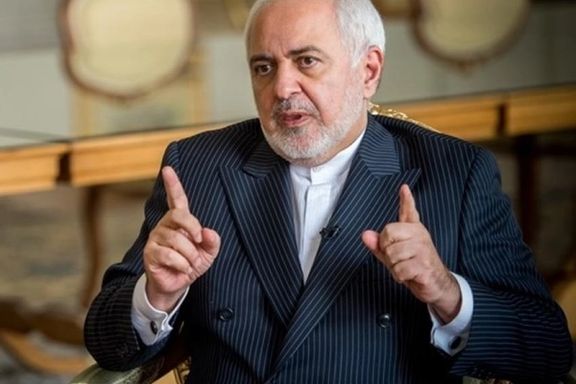
Former Iranian foreign minister Mohammad Javad Zarif. FILE PHOTO
Iran’s Judiciary announced Tuesday that an investigation into how a confidential recording from former foreign minister Javad Zarif was leaked is still ongoing.
Iran International published on April 25 a three-hour confidential interview with Zarif meant to remain in government archives, that led to a political storm in Iran.
In the interview Zarif spoke about the interference of the military in Iran’s foreign policy, specifically referring to the role of former IRGC Quds force commander Qasem Soleimani, who was killed by a US drone strike in Baghdad in January 2020.
At the time, President Hassan Rouhani ordered an investigation into who had leaked the tape to Iran International, which is not allowed to have a bureau or any presence in Iran.
The Judiciary’s spokesman told local media on Tuesday that many people have been interviewed about the leak, but the case is still pending.
In the interview Zarif had also mentioned that former US secretary of state John Kerry had divulged to him, possibly in 2017, that Israel was attacking Iranian targets in Syria. The information led to Congressional questions from Kerry, who denied ever having disclosed confidential information to Zarif.
The largest Indian port has put in effect a ban on container ships carrying cargoes from Iran, Pakistan and Afghanistan since Monday due to smuggling concerns.
Iran Labour News Agency (ILNA) reported on Tuesday that despite Iranian government denials, Adani Ports and Logistics, the operator of Mundra port in Gujarat has put in effect a ban it had announced in October.
Indian officials announced on September 21 that they had seized nearly three tons of heroin originating from Afghanistan and shipped from Iran’s Bandar Abbas Port worth an estimated 200 billion rupees ($2.72 billion). This followed the Taliban takeover of Afghanistan in mid-August.
Adani Ports and Logistics announced in October that starting November 15 it will not accept ships coming from Iranian and Pakistani ports.
ILNA expresses concern that Iran’s exports to western India will suffer because of the ban by the Mundra port operator, which has apparently not accepted a request from the Indian Customs Commissioner to reconsider its ban.
Ships from Iran can still use a government-operated port in Gujarat, but ILNA quoted Iranian merchants as saying that logistics at this port is more limited.
Anwar Gargash, diplomatic adviser to the UAE president. FILE PHOTO
The United Arab Emirates is taking steps to de-escalate tensions with Iran as part of a policy choice towards diplomacy and away from confrontation, a UAE senior official said on Monday.
Anwar Gargash, diplomatic adviser to the UAE president, said the Gulf state remains deeply concerned about Iran's behavior in Iraq, Syria, Yemen and Lebanon.
"Despite this we have taken steps to de-escalate tensions as we have no interest in a confrontation. The whole region would pay the price of such a confrontation for decades to come," Gargash told the Abu Dhabi Strategic Debate.
"I am realistic about the chances of success. It will be a slow process, but we hope that over time we can build together greater confidence between us and start to make progress towards a more sustainable and mutually beneficial status quo," he said.
Gulf states are closely watching talks between global powers and Iran to revive a 2015 nuclear pact. The UAE, along with neighbour Saudi Arabia, believe the deal was flawed for not addressing Iran's missile program and network of regional proxies.
Gargash said the UAE was working to build bridges with all countries, including those with which it has serious disagreements.
"We know that (the US) role is changing, but it is still a vital one," he said, adding that the United States remains the UAE's dominant security partner.
The Pentagon has said that an Iranian military helicopter came as close as 25 yards to USS Essex Navy ship in the Gulf of Oman, in a “reckless” move last week.
Iran’s Islamic revolution Guard Corp has released a video on November 13 showing the flight of the helicopter very close to the US Navy vessel. They said the incident took place on November 11.
Pentagon spokesman John Kirby was pressed by reporters during his briefing on Monday about why the Essex did not take any defensive measure. Kirby refused to elaborate saying that he would not comment on engagement rules enforced by Navy commanders in charge.
"The ship's commander did what he believed was in the best interest of the ship and its crew. They have necessary means to protect themselves," Kirby maintained.
Iranian forces have harassed US forces on many occasions before in the Persian Gulf region but the Essex incident in one of the closest approaches they have made to a US vessel.
Earlier last week the US military announced that USS Essex amphibious assault warship and a Marine expeditionary force had joined the Fifth Fleet in the Sea of Oman and had conducted exercises with the British Navy.
Turkish and Iranian foreign ministers in Tehran. November 15, 202`1
Tehran and Ankara are set to agree a plan for long-term cooperation, Mevlut Cavusoglu, Turkey’s Foreign Minister told a joint press conference in Tehran Monday.
"Our delegations will work to determine a roadmap for a long-term comprehensive cooperation upon Iran's proposal,” said Cavusoglu, who arrived in Tehran Monday. The minister expressed hope this could be signed during Turkish President Recep Tayyip Erdogan's visit to Tehran later this year for the seventh meeting of the two countries’ High-Level Cooperation Council.
"With the President of the Republic, we discussed our bilateral relations, including trade, investments, and the fight against terrorism, and the latest developments in our region,” the Turkish foreign minister tweeted after meeting with Iran's President Ebrahim Raisi (Raeesi) in his first visit since Raisi took office in August.
Cavusoglu described United States sanctions against Iran as "wrong,” and urged all parties to revive Iran’s 2015 nuclear deal with world powers, the Joint Comprehensive Plan of Action (JCPOA), from which former US president Donald Trump withdrew in 2018, slapping ‘maximum pressure’ sanctions on Iran.
"Those who withdrew from this agreement in particular need to take the necessary steps," Cavusoglu said, adding that a positive outcome to the Vienna nuclear talks aimed at reviving the JCPOA was important for regional stability. Unlike Israel and Saudi Arabia, Turkey has supported the agreement.
Cavusoglu welcomed as promising increasing trade between Tehran and Ankara − up 71 percent in volume this year − but said it was "very far from our goals.” Bilateral trade stands at around $4 billion. Amir-Abdollahian told the press that obstacles in the way of trade between the two neighboring countries, presumably a reference to US ‘maximum pressure,’ required countermeasures to clear the way for more trade.
Cavusoglu said he had discussed security issues such as terrorism, migration, and human smuggling with his Iranian counterpart. Turkey has been a conduit for refugees from Afghanistan, Syria and Iraq, while Ankara and Tehran have intermittently cooperated against Kurdish groups, especially those linked to the PKK (Kurdistan Workers Party).
Among regional issues where Ankara and Tehran saw eye to eye, Cavusoglu told the press conference, was Syria, where a political solution was needed, and over the humanitarian crisis in Afghanistan. "Our leaders and ministers of foreign affairs will get together in the near future," the minister said. Some analysts have argued Turkey’s priorities in Syria have long shifted from supporting the Sunni opposition to President Bashar al-Assad, an Iranian ally, towards containing the Syrian Kurds.
A view of a building damaged by clashes is seen on the outskirts of the Red Sea port city of Hodeidah, Yemen November 13, 2021
The Saudi-led coalition in Yemen said on Monday a redeployment of its forces from the western coast was meant to back Yemeni government forces on other fronts.
Yemeni forces under a Saudi-led coalition said on Friday they had withdrawn from around the main Red Sea port of Hodeidah held by their foes the Houthis to help deter the Iran-aligned group's advances in other parts of Yemen.
A UN monitoring mission on Monday called on Yemen's warring parties to hold new talks over Hodeidah as the Saudi-led coalition strafed areas south of the port city, where Houthi fighters advanced in the wake of withdrawing coalition forces.
The air strikes, which began on Sunday, were the first since late 2018 when the Saudi-backed government and the Iran-aligned Houthis agreed a U.N.-sponsored pact for a truce in Hodeidah and a troop redeployment by both sides that never materialized.
The coalition said on Monday it carried out 11 operations "outside the areas covered under the Stockholm pact" to support west coast forces, Saudi state media reported.