Syria Says Israel Carried Out Air Attacks Near Border

Syrian said Israel attacked targets southern Syria on Monday in a frontier zone where Israel has long been concerned about the presence of Iran-backed groups.

Syrian said Israel attacked targets southern Syria on Monday in a frontier zone where Israel has long been concerned about the presence of Iran-backed groups.
The Israeli military declined to comment.
A Syrian foreign ministry source said Israel had committed "a new aggression in the southern region" at dawn, the Syrian state news agency SANA reported.
Israel has mounted regular strikes against what it has described as Iranian-linked targets in Syria, where Tehran-backed forces including Lebanon's Hezbollah have deployed in support of President Bashar al-Assad during Syria's war.
A pro-Assad source familiar with the incident said an Israeli drone had struck several sites including a base operated by Hezbollah in al Baath city in Quneitra province and a second target. A third missile hit a reconnaissance tower near a Syrian army base, the source said.
The Syrian Observatory for Human Rights, a UK-based organisation which reports on the war, said an Israeli aircraft had fired rockets at two positions held by Syrian government forces and their allies in Quneitra province.
The attack had caused material damage and there was no information yet about casualties, it said.
Syria was discussed last week at a meeting in Sochi between Israeli Prime Minister Naftali Bennett and Russian President Vladimir Putin, Assad's most powerful ally.
Bennett told his cabinet on Sunday the two secured "stable and good" understandings over Syria - an allusion to deconfliction efforts with Russian forces amid continued Israeli air strikes on suspected Iranian assets.
Syria affirmed its right to respond to the attacks, the foreign ministry source quoted by SANA said.
A Lebanese judge on Monday charged 68 people including 18 detainees with murder and incitement to sectarian strife over fatal clashes this month in Beirut.
Seven followers of Lebanon's Shiite Iran-backed Hezbollah group and its ally, the Amal Movement, were killed on Oct. 14 in the worst street violence in Beirut in over a decade.
The gunfire began as protesters assembled for a demonstration called for by Hezbollah and Amal against Judge Tarek Bitar, who is leading an investigation into an explosion at Beirut port that killed over 200 people on Aug. 4 last year.
Monday's charges were filed by Judge Fadi Akiki, a government representative at the military court. They also include charges of attempted murder, possession of unlicensed weapons and destruction of public and private property.
The case was referred to an investigative judge.
Hezbollah has accused the Christian Lebanese Forces party of targeting demonstrators with sniper fire.
The party's leader, Samir Geagea, has denied the allegations and said residents of the Christian-majority Ain al-Remmaneh area, where the violence took place, had acted in self-defense.
In a local television interview last week, Geagea said the trouble began when supporters of the Shi'ite Muslim parties entered the neighborhood and vandalized cars, and that four residents were wounded before a shot was fired.
Footage released later appeared to show at least one person being shot by a soldier.
Report b y Reuters

The leader of Lebanon's Hezbollah on Friday warned Israel against drilling for oil and gas in the disputed maritime border area until the issue is resolved.
Hezbollah would take action if Israel did so, Hassan Nasrallah, the leader of the Iran-backed group warned.
"If the enemy thinks they can act as they please before reaching a solution to this issue they are wrong," Nasrallah said in a televised speech.
Lebanon's cabinet had raised the question to the United Nations permanent representative after Israel granted US oilfield services group Halliburton an offshore drilling contract in the Mediterranean, asking to clarify whether the drilling would take place in disputed areas.
Lebanon and Israel are in dispute over the delineation of their territorial waters and negotiations could lead to Lebanon being able to unlock valuable gas reserves amid its worst-ever financial crisis. Israel already pumps gas from huge offshore fields.
The two countries have been holding on-off US mediated talks since October 2020 to try to resolve the issue.
"I will not state any positions on this as I don't want to complicate the negotiations but for sure the resistance in Lebanon…when it finds that Lebanese oil and gas is in danger…it will act accordingly," Nasrallah said.
The US mediator for the indirect talks, Amos Hochstein, visited Beirut this week and said a period of shuttle diplomacy would proceed any return to indirect talks between the two countries.
Reporting by Reuters

Russian President Vladimir Putin said Friday that his meeting with Israeli Prime Minister Naftali Bennett had been very productive as both hailed friendly ties.
Putin made the remarks as Bennett was leaving his residence in Russia's Black Sea resort of Sochi, after his first meeting with the Russian leader after becoming prime minister in June.
Russia and Israel have developed close political, economic and cultural ties that have helped them tackle delicate and divisive issues, such as the situation in Syria where Moscow has teamed up with Tehran to shore up Syrian President Bashar Assad's rule.
Russia has waged a military campaign in Syria since 2015, helping Assad's government reclaim control over most of the country.
Moscow also has helped modernize Syria's military, including providing Assad with air defense systems, and trained its personnel.
Israel, however, has been targeting Iranian military bases and weapons transfers in Syria since early 2017 stating that it cannot tolerate a dangerous Iranian presence on its borders. Russia has looked the other way as Israel has bombed hundreds of targets.
Russia and Israel established a military hotline to coordinate air force operations over Syria to avoid clashes.
In 2018, Russia-Israeli ties were severely tested by the downing of a Russian warplane by Syrian forces that responded to an Israeli air raid and mistook a Russian reconnaissance plane for Israeli jets.
All 15 members of the Russian crew died.
Moscow also has played a delicate diplomatic game of maintaining friendly ties with both Israel and Iran.
In 2018, Moscow struck a deal with Tehran to keep its fighters away from the Golan Heights to accommodate Israeli concerns about the Iranian presence in Syria.
Russia is one of the international parties that negotiated a 2015 nuclear deal with Iran.
The deal fell apart after then-President Donald Trump withdrew in 2018.
But the new US administration is now trying to revive the deal with other international powers — a step that Israel opposes.
Bennett said earlier that he would also discuss Iran’s nuclear talks, stalled since June, with Putin. but there are no details so far about the discussion.
"We will also talk about the situation in Syria, and the efforts to halt the Iranian military nuclear program," Bennett said at the start of the talks.
Bennett and other Israeli officials have been warning in the past months that they have to take the matters into their own hands to stop Iran from becoming a nuclear power. Latest reports indicate Israeli preparations for a potential confrontation with Iran.
With reporting by AP

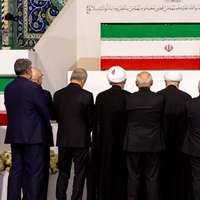
Mass Friday Prayers resumed in Tehran after a 20-month Covid-19 interruption, as the main sermon emphasized unity among Muslims and warned of foreign plots.
The youngest Friday Prayers’ Imam in Tehran, Mohammad-Javad Haj Ali Akbari reiterated this week’s calls by Iranian officials at the International Islamic Unity Conference held in Tehran for Muslims to strive for friendship and close ranks against “foreign plots”.
The Islamic conference is a public relations event organized by the Islamic Republic to show that there is unity among Shiites and Sunnis and to carve a place for the clerical regime among other Muslims.
Iran has started talks with Saudi Arabia since April for reducing tensions and possibly reestablishing relations that were severed in 2016. Iran is keen to show the West that it is trying to improve ties with regional countries on its own and there is no need for them to demand negotiations over the issue.
The Friday Prayers Leader praised Iranian armed forces for their “brilliant” accomplishments and claimed that “Americans with their scandal in elections and defeat in West Asia, which was a strategic defeat, have no option but exit from Iraq.” He added that the US after spending 8 trillion dollars in West Asia was defeated and “even if it spends 800 trillion, it has no option but to leave” the region.
The prayers at Tehran University, a gathering of religious and political significance, came as authorities warned of a sixth wave of the coronavirus, which according to official figures has claimed 124,928 lives in Iran and afflicted more than 5.8 million. Critics of the government’s handling of the pandemic say the real death toll was at least twice the official figure.
The government says more than 28.2 million people have so far received a second dose of the Covid-19 vaccine.
“Today is a very sweet day for us. We thank the Almighty for giving us back the Friday prayers after a period of restrictions and deprivation,” said Haj Ali Akbari said.
Worshippers had to heed social distancing and use face masks during the gathering, a forum where officials present a unified front in the weekly sermon, a duty that rotates around senior members of Iran’s conservative clerical establishment.
Most worshippers brought their own prayer rugs and clay tablets used during prostration, said the broadcast.
It said Friday prayers also were performed in several other Iranian cities.
Health Minister Bahram Einollah said earlier this week that it was a "certainty" that Iran would face a sixth wave next week. The warning came even as the country has accelerated its vaccination drive.
Einollahi added that his country was well-prepared for the new surge.
Schools with more than 300 students will re-open on Nov. 6, Alireza Kamarei, spokesman for Iran’s Education Ministry, said earlier this week, adding that it was not essential for students and teachers to be vaccinated. He said 85% of the country's teachers and 68% of students had so far been inoculated and that classrooms were well ventilated.
With reporting by Reuters

Israeli Prime Minister Naftali Bennett flew to Russia on Friday for his first meeting as premier with Russian President Vladimir Putin, amid tensions with Iran.
Bennett stressed the importance of the relationship between Israel and Russia, highlighting the "million" Russian speakers who live in the country.
Bennett’s predecessor, Benjamin Netanyahu regularly had meetings with Putin to regulate their interactions regarding Syria.
Bennett also confirmed Israel's international status was "significantly strengthening" and was progressing well.
Bennett will meet Putin to discuss political, security and economic issues, including the Iran nuclear program.
The two countries operate a military hotline to coordinate air force operations over Syria to avoid clashes.
Israel often attacks Iranian-linked targets in Syria, while Russia has provided protection for the Bashar al-Assad’s government in Syria.
Russia is one of the international parties that negotiated a 2015 nuclear deal with Iran.
The deal fell apart after then-President Donald Trump withdrew in 2018.
But the new US administration is now trying to revive the deal that would lift sanctions and offer a lifeline to the Islamic Republic — a step that Israel, Saudi Arabia and others in the region oppose.