• العربية
  • فارسی
Brand
  • Iran Insight
  • Politics
  • Economy
  • Analysis
  • Special Report
  • Opinion
  • Podcast
  • Iran Insight
  • Politics
  • Economy
  • Analysis
  • Special Report
  • Opinion
  • Podcast
  • Theme
  • Language
    • العربية
    • فارسی
  • Iran Insight
  • Politics
  • Economy
  • Analysis
  • Special Report
  • Opinion
  • Podcast
All rights reserved for Volant Media UK Limited
volant media logo

Bridges and military sites hit as US-Iran fighting intensifies in southern Iran

Jul 17, 2026, 08:26 GMT+1
US personnel stand aboard the M/T Wen Yao during a verification boarding in the Gulf of Oman on July 16, in an image released by US Central Command.

The sixth day of fighting since the collapse of the Iran-US ceasefire ended with five bridges hit in southern Iran, US forces turning back three commercial vessels near the Strait of Hormuz, and President Donald Trump declaring that Washington was “winning big in Iran.”

The developments unfolded along three parallel fronts: Iranian attacks on US facilities across the Persian Gulf, continued US strikes inside Iran and an intensifying contest over control of the Strait of Hormuz.

Iran said it launched drone attacks on US facilities in Kuwait and Bahrain early Friday, after a sixth consecutive night of American strikes on Iranian military targets.

Iran’s army said it targeted US force deployment and logistics centers in Kuwait, Iran’s IRGC-affiliated Fars news agency reported.

In Bahrain, the army said it struck US helicopters and reconnaissance aircraft at Sakhir Air Base. Sirens sounded in the country for the second time on Friday, according to the Interior Ministry.

In Qatar, several booms were heard after the government sent a second security alert to mobile phones, Reuters reported. The Defense Ministry said Qatar was intercepting several air attacks, while the Interior Ministry said a child was injured by shrapnel from an intercepted missile.

US Central Command has not confirmed the reported attacks in Kuwait or Bahrain.

At the same time, US forces continued striking targets in southern Iran.

CENTCOM said US fighter jets, drones and warships used precision munitions to hit dozens of military targets, including coastal surveillance and air defense sites, logistics infrastructure and maritime capabilities near Bandar Abbas and on Qeshm Island.

Hamshahri, a newspaper owned by Tehran Municipality, reported that five bridges in Hormozgan province were hit in the latest wave of attacks.

The death toll from strikes on bridges in Bandar Khamir rose to seven, Iran’s IRGC-affiliated Tasnim news agency reported. Iranian media also reported damage to a power substation on Kish Island and attacks on transport infrastructure in Bandar Abbas and Bandar Khamir.

The reports could not be independently verified.

Control over Strait of Hormuz

As the two sides exchanged attacks on land, their confrontation also deepened at sea.

CENTCOM said US forces redirected three commercial vessels attempting to breach the naval blockade against Iran, disabled another that failed to comply with orders and boarded the M/T Wen Yao in the Gulf of Oman to verify compliance.

US Defense Secretary Pete Hegseth shared an image from the boarding and wrote that Iran “does not control” the Strait of Hormuz.

CENTCOM said the strait and surrounding waters remained free and open, except for vessels attempting to violate what it called the US “steel wall” blockade.

Iran’s Revolutionary Guards, however, said Tehran remained in full control of the waterway and would prevent oil and gas exports through it for as long as US attacks continued.

Trump cast the military and maritime operations as signs of US momentum.

“You will see the fruits of that labor very, very shortly,” he said after declaring that Washington was “winning big in Iran.”

The possibility of a wider regional conflict emerged more clearly on Friday, when the Revolutionary Guards said they had struck a US special operations command center in Syria’s al-Tanf region, destroying a radar system and several helicopters and killing US personnel.

US Central Command has not confirmed the report.

Most Viewed

Iran hardliners cry foul as Ghalibaf camp gains ground
1
INSIGHT

Iran hardliners cry foul as Ghalibaf camp gains ground

2

Petition tells Iran hardliners: Fight the US war yourselves

3
INSIGHT

Leaked presidency report shows how Iran plans to manage record public anger

4
VOICES FROM IRAN

Inflation leaves Iranian pensioners unable to cover basic costs

5

Tehran billboard hints Trump is the 'next one' after Graham's death

Banner
Banner
Banner

Spotlight

  • Iran hardliners blamed as cost of US strikes mounts
    INSIGHT

    Iran hardliners blamed as cost of US strikes mounts

  • Vance, Ghalibaf back diplomacy as US, Iran strikes continue
    INSIGHT

    Vance, Ghalibaf back diplomacy as US, Iran strikes continue

  • Leaked presidency report shows how Iran plans to manage record public anger
    INSIGHT

    Leaked presidency report shows how Iran plans to manage record public anger

  • Wave of Iran plots drove UK action against IRGC, terror law tsar says
    EXCLUSIVE

    Wave of Iran plots drove UK action against IRGC, terror law tsar says

  • Two Iranians at the World Cup final – and neither represents the Islamic Republic

    Two Iranians at the World Cup final – and neither represents the Islamic Republic

•
•
•

More Stories

As Tehran debates, Iran's south lives the war

Jul 15, 2026, 17:30 GMT+1
•
Behrouz Turani
100%
A screen-grab from a video published by citizen journalist Vahid Online, purporting to show the aftermath of a US strike on Iran's southeastern port city of Chabahar, July 15, 2026

A week of heavy fighting has left parts of Iran’s southern coast looking unmistakably like a war zone. Yet in Tehran, many still struggle to believe the country is at war.

Watching explosions on television and social media from hundreds of kilometers away, many see the confrontation with the United States as another familiar cycle of pressure that may yet give way to negotiations.

Fatemeh Rajabi, the news anchor who first reported the U.S. strikes on ports and military sites in southern Iran on the YouTube program Hasht-e Shab, says many in the capital find it difficult to grasp that a war is unfolding along the northern shores of the Persian Gulf — the region they casually refer to as “down under.”

Reporter Ali Pakzad, who visited the area during the strikes, says missiles hit targets from Abadan near the Iraqi border to Chabahar and Saravan near Pakistan.

He described damaged fishing vessels, battered ports and communities whose livelihoods have been shattered by attacks documented in the program’s footage.

That contrast lies at the heart of an investigative report by journalist Mira Ghorbanifar in Toseh Irani, titled The South in the Fire of War and Ashes of Ceasefire.

Ghorbanifar writes that explosions now puncture the dawn along Iran’s southern coast. Smoke rises from damaged docks, charred dhows lie abandoned, and fish markets once full of noise now speak only of “a war for which no one has yet chosen a definite name.”

While officials speak of “understandings,” “ceasefires” and “crisis management,” she argues, people in Iran’s south are grappling with damaged infrastructure and disrupted shipping, trying to adapt to what increasingly resembles a war of attrition.

She also asks whether the so-called Islamabad Understanding still exists. Is the fighting along Iran’s southern coast part of the same hundred-day conflict, or the start of a new phase of controlled escalation? And can both sides return to negotiations before crossing a point of no return?

The concerns extend well beyond independent journalists.

Government-aligned newspapers have increasingly questioned whether Iran can sustain a prolonged confrontation while struggling to protect civilians and critical infrastructure.

Moderate daily Sharq describes the country’s predicament as “structural and accumulated,” arguing that damaged infrastructure, naval disruption and collapsing logistics have left even minor shocks capable of triggering major crises.

Centrist Etemad warns that public trust has eroded while the state remains unprepared for cascading emergencies.

Economic newspapers have echoed those warnings.

Jahan Sanat argues that Iran’s deterrence is steadily weakening under sustained pressure, while Donya-ye Eghtesad says military decisions are increasingly driven by political necessity rather than strategic advantage, leaving the country more vulnerable in a prolonged conflict.

Washington-based analysts Mohammad Ghaedi and Farzin Nadimi have voiced similar concerns in interviews with Persian-language media abroad.

Ghaedi argues that Iran’s governing system “has repeatedly refused to learn from past mistakes,” pointing to what he sees as a widening disconnect between insulated decision-makers and citizens bearing the costs of conflict.

Nadimi says Iran is confronting the United States at “a moment of maximum structural fragility,” with deterrence eroding and escalation driven more by political necessity than strategic advantage.

“Iran is not in a position to manage a prolonged conflict,” he warns, adding that every new attack “burns away another part of Iran’s deterrent capability.”

Even hardline media have shown hints of concern. Resalat recently urged Iran to “rebuild its defensive capacity” after recent military losses — a rare acknowledgement from a conservative newspaper that the country’s deterrence has been weakened.

For now, the divide remains striking. In Tehran, politicians and commentators continue to debate negotiations, ceasefires and diplomatic understandings.

Along the southern coast, many residents have already stopped asking what to call the conflict. They are simply living through it.

Two Iranians at the World Cup final – and neither represents the Islamic Republic

Jul 15, 2026, 13:27 GMT+1
•
Arash Sohrabi
100%
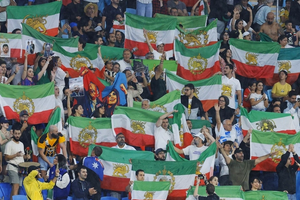
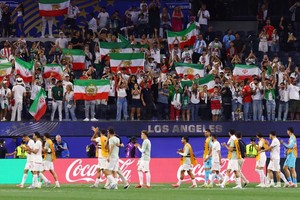
Iranian fans during the Team Melli match against New Zealand at Los Angeles Stadium, Inglewood, California, on June 15, 2026

Iran's national team exited the World Cup in the group stage, yet two Iranians may still command Sunday's final: an exiled violinist on the halftime stage and the referee tipped for the whistle. Neither arrives representing the Islamic Republic.

When the whistle blows for halftime at MetLife Stadium on Sunday, July 19, football's first-ever World Cup halftime show will begin – an 11-minute spectacle curated by Coldplay's Chris Martin, headlined by Madonna, Shakira, Justin Bieber, BTS and Burna Boy, with conductor Gustavo Dudamel and the PS22 Chorus.

And if the past week's frenzy in the Persian-speaking world is to be believed, somewhere in that lineup will stand Bijan Mortazavi, the Iranian violin virtuoso, with his famous white violin.

The story first surfaced through Persian-language music outlets, which reported that FIFA had selected Mortazavi for a live performance during the final's interval.

Skepticism followed almost immediately. FIFA's official announcements listed the marquee names but made no mention of the 68-year-old Iranian, and veteran music journalists would only call it the closest rumor to reality.

Then Mortazavi himself all but ended the debate. He posted a photograph alongside Chris Martin and Gustavo Dudamel, describing an "excellent and fruitful" first rehearsal with the New York Philharmonic, an image Coldplay fan accounts quickly carried around the world.

FIFA has yet to publish his name. But artists do not rehearse with the show's musical director and its conductor by accident, and reports say he will perform one of his instrumental works, with a solo passage on the white violin that has been his visual signature for three decades.

The news set Persian social media alight. Posts declaring "It's confirmed" drew hundreds of thousands of views within hours, and the pride quickly turned pointed.

Users contrasted an artist whose albums are still denied release permits inside Iran standing on the world's biggest stage, while the officials who ban his music watch from a country at war and in crisis. Others noted the bitter symmetry: Iran's team went home; Iran's music reached the final.

That symmetry stings because the national team's bond with its own public has frayed. After the side's elimination – three draws in three games – many Iranians described the failure less as a sporting loss than as a verdict on players seen as siding with the government during the nationwide protests, with defender Ramin Rezaeian's name recurring most often.

  • Iran’s lion-and-sun flag at center of FIFA row before 2026 World Cup

    Iran’s lion-and-sun flag at center of FIFA row before 2026 World Cup

  • Iran bows out of World Cup amid flags, Pride and protest

    Iran bows out of World Cup amid flags, Pride and protest

Unlike past tournaments, the matches drew few public gatherings inside Iran, and some openly welcomed the exit. When Shoja Khalilzadeh's late goal against Egypt was ruled offside by five centimeters, users linked it mockingly to his past pledge to dedicate goals to the Supreme Leader.

For millions of Iranians, representation has quietly migrated from the federation's badge to individuals in the diaspora, and Mortazavi embodies that shift.

Born in Sari in 1957, he began violin at three, trained in Tehran under masters including Parviz Yahaghi, and – in a fitting twist – played as a youth goalkeeper, part of Iran's junior national football setup, before music won out.

He left Iran after high school, studied in England, moved to the United States in 1979 and settled in California, where his blend of Persian melody and Western pop made him the best-known Iranian violinist in the world. In 1994 he became the first Iranian artist to headline Los Angeles' Greek Theatre.

  • Can Iranians cheer Team Melli without cheering the state?

    Can Iranians cheer Team Melli without cheering the state?

  • Citizens tell Iran football team it lost the public long ago

    Citizens tell Iran football team it lost the public long ago

He may not be the only Iranian at MetLife on Sunday. Alireza Faghani – born in Kashmar and the first man to referee at four men's World Cups – is widely reported as FIFA's leading candidate to take charge of the final itself.

Faghani left Iran for Australia in 2019, a move linked to his support for the protest movement, and now officiates under the Australian flag. State media in Tehran has attacked him – even censoring footage of him receiving his 2025 Club World Cup final medal – while many Iranians claim him proudly as their own.

No World Cup has ever had a halftime show. Shakira's "Waka Waka" in 2010, Ricky Martin's "La Copa de la Vida" in 1998 and Jung Kook's Qatar 2022 performance all belonged to the ceremonies, never to the final's interval. 

Which means that if Mortazavi walks out on Sunday, he will not just be the first Iranian on a World Cup final stage. He will be part of the first such stage ever built.

  • Thumbs up: Iranian football referee's pose alongside Trump stokes ire

    Thumbs up: Iranian football referee's pose alongside Trump stokes ire

If FIFA's final appointments hold, Sunday could end with an Iranian raising a violin at halftime and another raising the whistle for kickoff – two men who left, on the one stage the country's team could not reach.

Millions inside Iran will likely watch them the way they watch most things now: on any screen but state television's.

US infrastructure threats no reason to continue talks, senior Iranian cleric says

Jul 15, 2026, 13:21 GMT+1
100%
Alireza Arafi

A senior Iranian cleric said on Wednesday that Iranian officials should not continue negotiations with the United States by citing concerns over damage to the country's infrastructure, after President Donald Trump threatened to strike Iran's power plants and bridges.

Alireza Arafi, head of Iran's seminaries, said officials should not continue "negotiations and the memorandum with the infidels" because of economic difficulties, fear of the costs of war or the prospect of infrastructure being targeted.

"Officials must not retreat from the legitimate rights of the Islamic nation under the pretext of economic problems, fear of the costs of war or strikes on infrastructure, and they must not continue the path of negotiations and the memorandum with the infidels any further," Arafi said in a statement.

  • Who is the cleric suddenly at the center of Iran’s power struggle?

    Who is the cleric suddenly at the center of Iran’s power struggle?

Trump said on Tuesday that the United States would strike Iran's power plants and bridges next week unless Tehran returned to negotiations.

Arafi also said retaliation for the killing of former Supreme Leader Ali Khamenei was "certain" and would be pursued regardless of changes in government or officials.

He called on President Masoud Pezeshkian, members of the Supreme National Security Council, military commanders and diplomatic officials to treat the memorandum with the United States as finished and pursue what he called "the path of jihad and resistance."

Arafi, a hardline cleric and longtime Khamenei protégé, served on the interim leadership council formed after Khamenei's death. He is also a member of the Assembly of Experts and has been viewed within clerical circles as a possible contender for Iran's highest office.

Trump says Iran power plants, bridges could be hit next week

Jul 15, 2026, 08:55 GMT+1
100%
A man looking at the B1 Bridge linking Karaj to Tehran that was bombed by the US in April

US President Donald Trump said he would expand military strikes on Iran to power plants and bridges unless Tehran returned to negotiations, warning in a Fox News interview broadcast on Tuesday that attacks would intensify next week.

"We're going to hit them very hard tonight," Trump said. "We're going to hit them hard tomorrow night. We're gonna hit them really hard the night after."

"Next week it gets really bad for them because next week comes the power plants," he said. "Next week comes the bridges. We're gonna knock out all their power plants. We're going to knock out all their bridges unless they get to the table and negotiate."

Trump said US representatives had recently spoken with Iranian negotiators but said Tehran had repeatedly broken agreements.

"They want to make a deal. But every time they make a deal, they break it," he said.

"You better make a deal. You're not going to have anybody left," Trump added, saying the United States was taking care to limit harm to civilians.

  • How Tehran made the most of Trump's Hormuz proposal

    How Tehran made the most of Trump's Hormuz proposal

He also said Iran's military capabilities had been significantly weakened but retained some ability to fight back.

"They have some fight left, but they don't have much," he said.

Trump added that the United States could quickly strike a nuclear site outside Tehran where new activity had been reported.

"We can hit that one very easily," he said. "It only takes a matter of minutes for us to do it and do major damage."

Ground campaign and Kharg Island

Trump declined to say whether the United States could launch a ground campaign in Iran but suggested he would not rule out the option entirely.

"I don't want to say that either, but I would say no," he said when asked by Fox News whether he was ruling out a limited ground campaign. "Sometimes you need a ground campaign, but we have other people that will do the ground campaign for us."

Trump said US forces had already struck Iran's Kharg Island three times but had deliberately avoided its oil facilities.

  • A remote bridge shows how US-Iran war is expanding

    A remote bridge shows how US-Iran war is expanding

"I said, 'Hit everything but the oil,'" he said. "Leave that little area. Don't touch the oil because I don't want that in terms of the world economy."

Asked whether the United States could seize the island, Trump said: "If we degrade them far enough and deep enough back, I would do that."

Hormuz policy

Trump said he had abandoned plans to impose a 20% fee on cargo transiting the Strait of Hormuz, saying countries in the region had instead agreed to make major investments in the United States.

"I was going to charge a fee, but instead they'd rather spend a lot of money in the United States," he said.

He said the United States had reinstated a naval blockade on Iranian shipping and that its objectives, including keeping the Strait of Hormuz open, had largely been achieved, although commercial traffic through the waterway has fallen sharply.

"I think they're completed now, honestly," Trump said of the military campaign. "If we left right now, it would take them 20 years to rebuild what they have."

Iranian retaliation vows

Trump's remarks came as Iranian officials and lawmakers stepped up calls for retaliation following US strikes and the killing of former Supreme Leader Ali Khamenei.

About 180 lawmakers said on Tuesday that Iran should treat its memorandum of understanding with the United States as terminated after Trump declared the agreement over.

They pledged to pursue retaliation for Khamenei's killing and called for a special parliamentary committee to review negotiations with Washington.

The lawmakers also backed legislation on the management of the Strait of Hormuz and voiced support for Iran's armed forces.

Iran's army said on Wednesday it would deliver a "decisive response" after a US strike on a barracks in Bampur near Iranshahr killed seven military personnel.

"The retaliation for the blood of the martyrs of this crime is certain and imminent," the army said.

Calls for military action

Manouchehr Mottaki, a former Iranian foreign minister who is now a member of parliament, called for a ground assault on a US military base in the region.

"My proposal is that we launch a ground attack on one of the US bases in the region, capture 100 Americans and bring them to Iran," Mottaki said.

Another lawmaker, Shahrokh Ramin, criticized a parliamentary proposal titled "Revenge against Trump," saying genuine retaliation would not come through legislation.

"Someone who wants to take revenge does not turn it into a law," Ramin said. "If we are truly seeking revenge, we take revenge, and the way to do it is not through legislation."

One flight, two chokepoints: why Iran wants an air bridge to Yemen

Jul 15, 2026, 02:58 GMT+1
•
Negar Mojtahedi
100%
An Iranian Mahan Air flight lands in Sanaa airport in this screen-grab from a video by Houthi television Al-Masirah, July 13, 2026

An Iranian plane landing in Houthi-controlled Yemen looked like an oddly minor victory for Tehran. But it may have been the opening move in an effort to rebuild the allied force capable of threatening a second global maritime chokepoint alongside the Strait of Hormuz.

As the US-Iran memorandum of understanding unravels and the confrontation shifts toward the Strait of Hormuz, renewed fighting in Yemen is raising a broader question: is Tehran preparing another source of maritime pressure at Bab al-Mandab?

Hezbollah and Hamas have been severely weakened by Israeli military operations. The Houthis, by contrast, remain armed, entrenched and positioned astride one of the world's busiest shipping lanes.

Even a credible threat to Bab al-Mandab could unsettle shipping, energy markets and global supply chains. For Iran, that threat alone may be valuable.

The fight over one airplane

The latest escalation followed Yemen's decision to block an Iranian aircraft carrying a Houthi delegation returning from the funeral of Supreme Leader Ali Khamenei in Tehran. Yemen's internationally recognized government accused Iran of attempting to enter its airspace without authorization.

The dispute quickly escalated. An attack damaged Sanaa International Airport's runway. The Houthis blamed Riyadh before targeting Saudi Arabia's Abha International Airport with missiles and drones.

Senior Houthi official Mohammed al-Bukhaiti later warned of what he described as a "siege" of the Kingdom and openly identified Bab al-Mandab as a strategic pressure point.

"The key thing here was the precedent," Chatham House fellow Thomas Juneau told Iran International. "Iran and the Houthis are trying to force open the air bridge between Tehran and Sanaa."

Iran has long supplied the Houthis through maritime smuggling routes stretching around Oman and the Horn of Africa. Those routes are slow, costly and vulnerable to interdiction.

A direct air bridge would dramatically improve Tehran's ability to move sensitive military components into Houthi-controlled territory. That is why one apparently ordinary passenger flight mattered.

Rebuilding the Houthis

Farzin Nadimi, a defense and security analyst at the Washington Institute, believes Iran's urgency reflects another problem: after years of Red Sea operations and repeated US and Israeli strikes, the Houthis are running low on some of their more advanced military capabilities.

"They are very much eager to help the Houthis rebuild their strategic inventory in order to be a viable player again," he said.

Nadimi suspects the aircraft may have been carrying critical weapons components, although there is no independent confirmation of its cargo.

Modern missile and drone forces depend less on complete weapons than on a steady flow of electronics, guidance systems, engines and other specialized components.

If the Houthis are running low, a direct air link would offer Tehran a faster and more reliable route to replenish those capabilities.

A second chokepoint

The strategic importance extends well beyond Yemen.

The dispute between Tehran and Washington is already centered on the Strait of Hormuz, where Iran has demonstrated the leverage that can be created by threatening one of the world's most important energy corridors.

A revitalized Houthi force capable of disrupting Bab al-Mandab would force Washington, Saudi Arabia and their regional partners to consider the security of two strategic waterways simultaneously.

"Iran, having demonstrated the extraordinary value for itself of closing the Strait of Hormuz, absolutely understands that if it closes both Hormuz and Bab al-Mandab at the same time, the effect would be magnified," Juneau said.

"The effect on the global economy, the ability to pressure the US, to pressure Saudi Arabia and to pressure all of their allies."

Juneau cautioned that neither Tehran nor the Houthis appear poised to close Bab al-Mandab in the near term. But the ability to credibly threaten it would give Iran another source of strategic leverage.

Yemeni-American researcher and author Fatima Abo Alasrar believes the latest confrontation was deliberately engineered by Tehran.

"I think, honestly, Iran has engineered this escalation," she said.

In her view, widening the potential cost of confrontation creates another avenue through which Tehran can shape future negotiations with Washington.

Saudi Arabia's red line

The confrontation also threatens to upset the fragile balance that has prevailed in Yemen since the 2022 truce.

Saudi Arabia has spent years trying to extricate itself from a costly war that increasingly looked unwinnable.

"It's really Saudi Arabia that's been absorbing a lot of the pain here," Juneau said.

The Houthis understood Riyadh's reluctance to return to full-scale conflict and repeatedly tested how far they could push.

The attempt to establish a direct air bridge between Tehran and Sanaa appears to have crossed a different threshold.

Saudi Arabia may still prefer de-escalation. But allowing Iran an easier route to replenish Houthi military capabilities would strengthen an armed group positioned directly on its southern border and potentially restore its ability to threaten Saudi cities, airports and energy infrastructure.

Alasrar described Saudi Arabia and the Houthis as pieces on a much larger geopolitical chessboard.

"Houthis and Saudis are almost like pieces on a chessboard that are fighting with each other right now," she said. "But it's Iran and the US that get to impose everything."

Whether the Houthis intend to launch a renewed campaign around Bab al-Mandab remains uncertain. Juneau cautions they are not simply Iranian proxies waiting for orders, while Nadimi expects de-escalation unless the wider US-Iran confrontation expands significantly.

Hormuz has already demonstrated the leverage created by maritime chokepoints. Iran may not even need the Houthis to close Bab al-Mandab. If it succeeds in rebuilding their capabilities, simply making the threat credible could become a source of strategic pressure in its own right.